


The Legislative Yuan today passed the third reading of a special defense budget of NT$780 billion (US$24.82 billion), with a budget ceiling of NT$300 billion for the first round of US arms procurement and a cap of NT$480 billion for the second round.
The bill, which fell short of the NT$1.25 trillion requested by the Democratic Progressive Party (DPP) government, passed by a 59-0 margin with 48 abstentions in the 113-seat legislature.
The act states that it was formulated in response to enemy threats and urgent national defense needs, with the goal of acquiring weapons and equipment capable of safeguarding national security and enhancing asymmetric warfare capabilities.
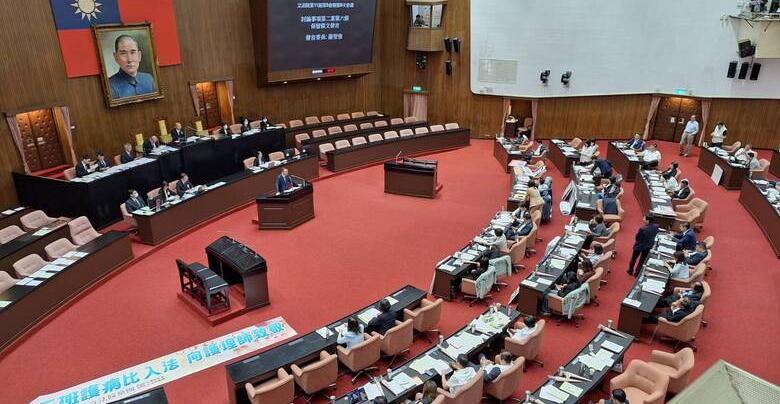
Photo: Fang Pin-chao, Taipei Times
The act specifies that procurement items in the first round include M109A7 self-propelled howitzers, High Mobility Artillery Rocket Systems, anti-armor drone missile systems, Javelin anti-tank missiles and tube-launched, optically tracked, wire command link guided 2B anti-tank missiles.
The legislation also authorizes the purchase of additional weapons systems approved by the US government within a year of the act taking effect, including integrated soft-kill and hard-kill counter-drone systems, several anti-ballistic and air defense missiles, medium and low-altitude air defense systems, and the replenishment of anti-tank missile stockpiles.
Funding for the items is to be formally budgeted based on the actual costs listed in Letters of Offer and Acceptance once formal approval is granted by Washington.
Under the act, budget preparation would not be subject to restrictions stipulated in Article 23 of the Budget Act (預算法) and funds cannot be reallocated without approval by the Legislative Yuan.
The act stipulates that the combined borrowing of the central government under the general budget and special budgets during the implementation period cannot exceed 15 percent of the combined total annual expenditures under those budgets.
The special act and its associated special budgets would take effect upon promulgation and remain in force through the end of 2033, and the period could be extended with legislative approval if necessary.
The Ministry of National Defense, serving as the competent authority, would be required to conduct military procurement and related force-building projects in accordance with the Government Procurement Act (政府採購法) and other defense-related laws and regulations.

A signaling system malfunction disrupted high-speed rail (HSR) services beginning at 8am today, with trains temporarily reduced to three northbound and three southbound trains per hour as authorities conduct inspections. The malfunction occurred on a section of track in Miaoli County during pre-operation checks early this morning, forcing northbound and southbound trains to use a single track, the HSR operator said. The regular schedule has been replaced with three hourly trains offering only nonreserved seating in each direction, stopping at every station, it said, adding that business class cars would still have reserved seating. Departures from terminal stations are scheduled at the top

Taiwan is still in the process of assessing the possibility of recruiting workers from Eswatini, the Ministry of Foreign Affairs said yesterday, adding that its goal is to help Eswatini upgrade its vocational training centers. If there are plans to recruit workers from Eswatini, safeguarding national security, protecting public health and ensuring the employment rights of Taiwanese would be prerequisites, Department of West Asian and African Affairs Director-General Yen Chia-liang (顏嘉良) told a news conference. Key considerations would also include filling labor shortages in specific industries, and fostering bilateral professional and technical exchanges, he said. Yen was asked about the progress of labor

A US uncrewed surface vessel (USV) encountered multiple Chinese warships during an autonomous transit of the Taiwan Strait, US defense company Seasats said in a statement on Wednesday. Seasats announced that a Lightfish USV had completed the first autonomous transit of the Taiwan Strait. Over five days, the USV traversed the entire length of the Strait while constantly monitoring surface vessel traffic, the company said. The Lightfish encountered multiple Chinese warships, one of which was a Chinese People’s Liberation Army Navy (PLAN) Type 056 corvette, it said. The Chinese vessels were operating “well within Taiwan’s exclusive economic zone without transmitting their identity via the

VERBOSE VESSELS: A CGA cutter and a China Coast Guard exchanged verbal barbs for more than a day in Taiwanese-controlled waters before the Chinese vessel left The Taiwanese and Chinese coast guards had a standoff near the strategically located Pratas Islands (Dongsha Islands, 東沙群島) in the north of the South China Sea, the Coast Guard Administration (CGA) said yesterday. The two sides engaged in intense radio exchanges over sovereignty claims during the 33-hour standoff. China Coast Guard vessel 3501 eventually left the restricted waters, 26.6 nautical miles (49.2km) west of the Pratas Islands, at 5pm yesterday, the CGA said. Lying approximately between southern Taiwan and Hong Kong, the Taiwan-controlled Pratas are seen by some security experts as vulnerable to Chinese attack due to their distance — more than


 RSS
RSS