


President William Lai (賴清德) yesterday visited several projects in Eswatini that are funded by Taiwan, and he called for increased private Taiwanese investment in the nation's sole African ally.
Accompanied by senior Eswatini officials, Lai and his delegation began the second day of their visit to the African country with a trip to the site of a planned Taiwan Industrial Innovation Park (TIIP) project.
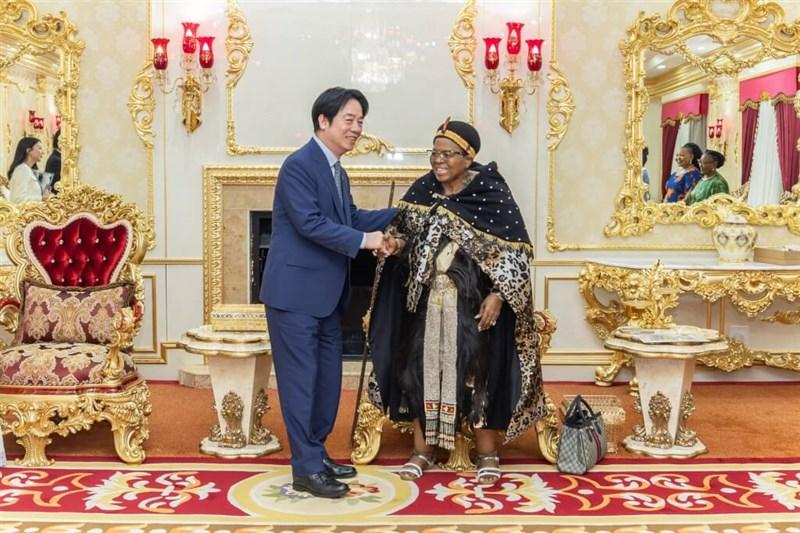
Photo courtesy of the Presidential Office
According to the Ministry of Foreign Affairs, the purpose of the TIIP is to help Taiwanese businesses expand globally, connect with African markets and create local jobs.
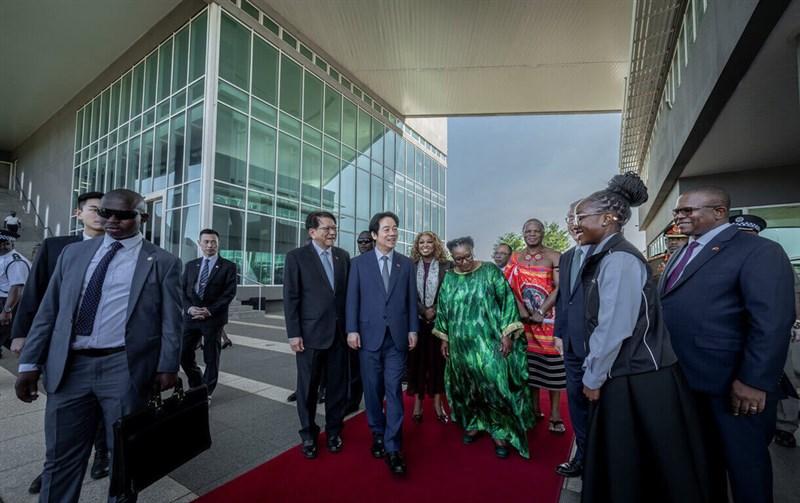
Photo courtesy of the Presidential Office
Lai was also briefed on a Strategic Oil Reserve project, which the ministry said is intended to ensure a 60-day fuel reserve for Eswatini.
During Lai's visit to the two Taiwan-funded projects, he said Taiwan remains a reliable and resilient partner for Eswatini in a rapidly changing global landscape, according to a Presidential Office news release today.
Eswatini is a steadfast diplomatic ally of Taiwan and a major gateway for Taiwanese businesses seeking to expand into the African continent, the release quoted Lai as saying.
He expressed the hope that more private Taiwanese companies would invest in Eswatini and cultivate talent there, as Taiwan seeks to deepen bilateral economic and trade cooperation, the office said.
Taiwan also hopes to work with Eswatini to explore the broader African market and create greater economic value together, he was quoted as saying.
Later yesterday, Lai visited the newly opened International Convention Center (ICC), also funded by Taiwan, which is designed to host global conferences, trade shows, exhibitions and meetings.
The president also called on Queen Mother Ntombi Tfwala, thanking her and King Mswati III for inviting him to Eswatini, which he described as his "second home," the office said.
Lai arrived in Eswatini on Saturday, after an earlier planned trip to Taiwan's sole African ally was canceled due to revoked overflight permits.
The office on April 21 announced that Lai's planned visit to Eswatini, to mark the 40th anniversary of King Mswati III's accession and his 58th birthday, had been suspended after the Seychelles, Mauritius and Madagascar revoked overflight permits for the president's chartered plane.
Lai's office attributed the decision to China's "economic coercion" of the three African states.
Neither Taiwan nor Eswatini have disclosed how Lai ultimately made the trip to the kingdom on the weekend, but according to local media reports, he flew directly from Taipei to Eswatini aboard King Mswati III's private jet, an Airbus A340-313.
The aircraft had landed in Taiwan earlier in the week, carrying the king's special envoy and Deputy Prime Minister Thulisile Dladla, who met with Lai at the Presidential Office in Taipei on Thursday.
Asked yesterday whether the US had helped make Lai's trip possible, the US Department of State did not give a direct answer.
Instead, a department spokesperson said that Lai's ongoing trip is "routine and should not be politicized."
"Every democratically elected Taiwan president has made overseas trips to visit Taiwan's diplomatic partners," the unnamed spokesperson said, adding that Lai's predecessor, former president Tsai Ing-wen (蔡英文), visited Eswatini in 2023 and 2018.
"Taiwan is a trusted and capable partner of the United States and many others, and its relationships around the world provide significant benefits to the citizens of those countries, including Eswatini," the spokesperson said.

‘NO SECURITY RISK’: The Railway Bureau reassured the public that the technicians’ activities were limited to technical guidance and did not involve sensitive systems The Railway Bureau yesterday said it had invited eight Chinese technicians to assist with an airport MRT construction project. The bureau issued the confirmation after an Internet user said Chinese nationals had entered the construction zone of Taiwan Taoyuan International Airport’s Terminal 3 project. They asked why “individuals from an enemy state” were allowed access to such a major national infrastructure project, which raised serious concerns over Taiwan’s industrial safety, sensitive systems and information security. The bureau’s Northern Region Engineering Branch Office said subcontractor Taiwan Handle Industrial Co (台灣手把工業) of the Taoyuan airport MRT’s “Contract No. CU05 Project A14 Station Civil, MEP &

A US uncrewed surface vessel (USV) encountered multiple Chinese warships during an autonomous transit of the Taiwan Strait, US defense company Seasats said in a statement on Wednesday. Seasats announced that a Lightfish USV had completed the first autonomous transit of the Taiwan Strait. Over five days, the USV traversed the entire length of the Strait while constantly monitoring surface vessel traffic, the company said. The Lightfish encountered multiple Chinese warships, one of which was a Chinese People’s Liberation Army Navy (PLAN) Type 056 corvette, it said. The Chinese vessels were operating “well within Taiwan’s exclusive economic zone without transmitting their identity via the
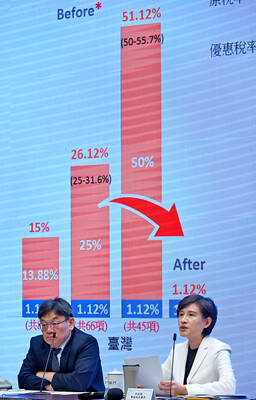
GREATER REACH? Auto parts and wood products would face tariffs of up to 15%, matching those targeting the EU, Japan and South Korea, Vice Premier said The US has announced that preferential tariff treatment for Taiwan’s non-semiconductor Section 232 goods would take effect retroactively from May 1, the Executive Yuan said yesterday. The US government yesterday posted a notice on the Federal Register’s public inspection Web site previewing tariff concessions for Taiwan under a memorandum of understanding (MOU) on Taiwan-US investment after two months of negotiations. The MOU signed on Jan. 15 stipulated three major preferential tariff arrangements: a 15 percent “reciprocal” tariff rate for Taiwan without stacking most-favored nation (MFN) rates; preferential Section 232 treatment for semiconductors and related products; and preferential Section 232 treatment for non-semiconductor

The National Chungshan Institute of Science and Technology yesterday showcased its locally developed variants of the Vision 60 robotic patrol dog, which it plans to deploy on the nation’s outlying territories in the South China Sea. The variants were produced under the Joint Lab project — created by the institute and domestic companies — and assembled with domestically produced motors, lenses and artificial intelligence (AI) systems alongside licensed tech from the US, Missile and Rocket Systems Research Division deputy director Jen Kuo-kang (任國光) told the media event at a military base in Taipei’s Dazhi (大直) area. Taiwan has built up its strengths


 RSS
RSS