


President William Lai (賴清德) yesterday detailed cuts to income tax and excises aimed at improving workers’ livelihoods ahead of the tax filing period, which starts tomorrow.
Lai, who is chairman of the Democratic Progressive Party, made the remarks at the party’s Central Standing Committee meeting.
The policies were crafted so that the public would feel the benefits of economic growth, he said.
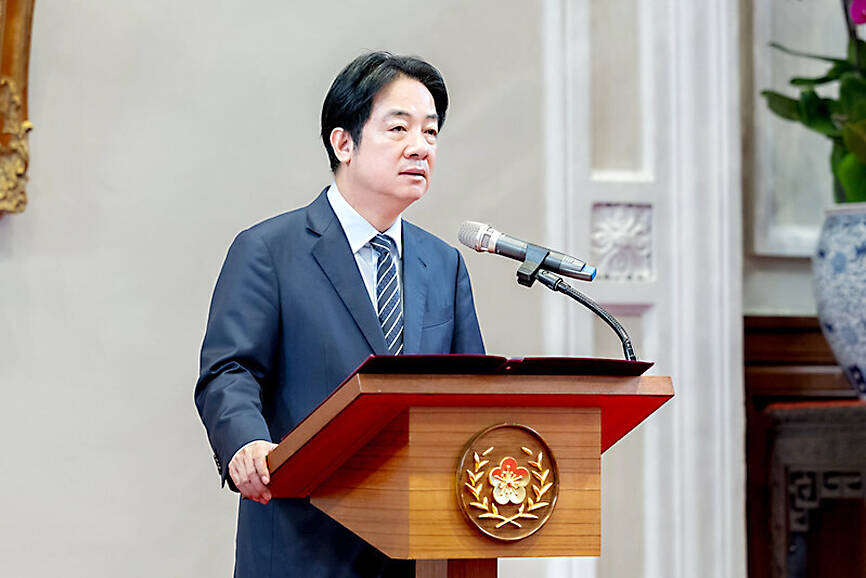
Photo courtesy of the Presidential Office
The period for filing last year’s taxes runs through June 1.
“Taiwan’s economy has grown steadily in the past few years, achieving 8.68 percent growth last year, a 15-year high,” Lai said. “The hard work of the public and the resilience of the economy made that possible amid global trade challenges.”
“The government is well aware that the fiscal benefits of growth must be transformed into value that the public can feel in their everyday lives,” he said.
Following the principle that the public must share in the fruits of economic growth, the Cabinet approved income and excise tax cuts designed to spread wealth across society, he said.
The government has increased the annual cost of living used for income tax calculations to NT$213,000 (US$6,750) for Taiwanese needing relief for their economic burden, Lai said.
The tax deduction for supporting people in long-term care has been increased by 50 percent to NT$180,000, he said.
Tax deductions for raising children of pre-school age are to be applied more broadly, covering those aged six or younger, compared with aged five or younger previously, he said.
The tax cut for a family raising a first child has been increased to NT$150,000 from NT$120,000, while each child after the first grants an additional NT$225,000 cut, a 50 percent increase, Lai said.
Tax deductions would be available for families that undergo assisted reproduction, he said.
People who last year donated to disaster relief, including Tropical Storm Danas, the Mataian (馬太鞍) floods in Haulien County and other registered charitable causes, would receive tax breaks, he said.
The administration’s priorities remain to facilitate the creation of an equitable and prosperous Taiwan that looks after older people, and protects the future of young men and women, he said.
Separately, the Ministry of Finance on Monday said in a statement that the cost-of-living adjustments, which increased by NT$3,000 from last year, would provide tax relief to 2.02 million households totaling NT$12.9 billion.
The Taxpayer Rights Protection Act (納稅者權利保護法), which was promulgated in 2017, guaranteed the public an untaxable part of their income necessary to sustain life, the ministry said.
The amount is defined as 60 percent of median disposable income, it said.
In response to the rising consumer price index, the ministry increased the tax-exempt part of personal income and standard deductions to NT$101,000 and NT$136,000, respectively, it said.
For people with a spouse, the standard deduction was increased to NT$272,000, while the special deduction from wages and salaries was upped to NT$227,000, the ministry said.
The deductions would benefit 6.96 million households and increase total disposable income by NT$14.4 billion, it said.
The changes mean that the tax exemption for a single-salary worker living in a rented unit would be NT$664,000 in yearly wages, NT$1,108,000 for dual-wage families, and NT$1,685,000 couples with two children aged six or younger living in a rented unit, it said.
In addition, tax exemptions would apply to NT$2,183,500 of wages for three-generation families consisting of at least one member aged 70 or older with long-term care needs, or mental or physical handicaps, and two children aged six or younger, it added.

PROVOCATIVE: Chinese Deputy Ambassador to the UN Sun Lei accused Japan of sending military vessels to deliberately provoke tensions in the Taiwan Strait China denounced remarks by Japan and the EU about the South China Sea at a UN Security Council meeting on Monday, and accused Tokyo of provocative behavior in the Taiwan Strait and planning military expansion. Ayano Kunimitsu, a Japanese vice foreign minister, told the Council meeting on maritime security that Tokyo was seriously concerned about the situation in the East China and South China seas, and reiterated Japan’s opposition to any attempt to change the “status quo” by force, and obstruction of freedom of navigation and overflight. Stavros Lambrinidis, head of the EU delegation to the UN, also highlighted South China Sea
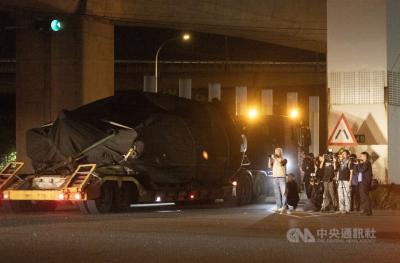
The final batch of 28 M1A2T Abrams tanks purchased from the US arrived at Taipei Port last night and were transported to the Armor Training Command in Hsinchu County’s Hukou Township (湖口), completing the military’s multi-year procurement of 108 of the tanks. Starting at 12:10am today, reporters observed more than a dozen civilian flatbed trailers departing from Taipei Port, each carrying an M1A2T tank covered with black waterproof tarps. Escorted by military vehicles, the convoy traveled via the West Coast Expressway to the Armor Training Command, with police implementing traffic control. The army operates about 1,000 tanks, including CM-11 Brave Tiger
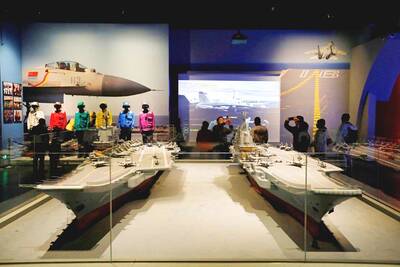
China on Wednesday teased in a video an aircraft carrier that could be its fourth, and the first using nuclear power, while making an allusion to Taiwan and vowing to further build up its islands, as it looks to boost maritime power, secure resources and bolster territorial claims. The video, issued on the eve of the 77th founding anniversary of the Chinese People’s Liberation Army Navy, featured fictional officers with names that are homophones of three commissioned aircraft carriers, the Liaoning (遼寧), Shandong (山東) and Fujian (福建). Titled Into the Deep, it showed a 19-year-old named “Hejian” (何劍) joining the group, sparking
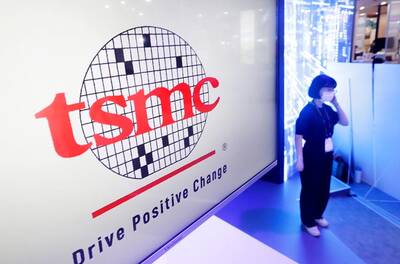
BIG YEAR: The company said it would also release its A12 chip the same year to keep a ‘reliable stream of new silicon technologies’ flowing to its customers Taiwan Semiconductor Manufacturing Co (TSMC, 台積電) yesterday said its newest A13 chip is to enter volume production in 2029 as the chipmaker seeks to hold onto its tech leadership and demand for next-generation chips used in artificial intelligence (AI), high-performance-computing (HPC) and mobile applications. TSMC, the world’s biggest contract chipmaker, also unveiled its A12 chip at its annual technology symposium in Santa Clara, California. The A12 chip, which features TSMC’s super-power-rail technology to provide backside power delivery for AI and HPC applications, is also to enter volume production in 2029, a year after the scheduled release of the A14 chip. The technology moves


 RSS
RSS