


The Centers for Disease Control (CDC) yesterday said an imported case of measles has been confirmed in a man who returned from Japan, marking the first case of measles from the country in seven years, so it has raised the travel notice for Japan to Level 1 — “watch.”
CDC epidemiologist Lin Yung-ching (林詠青) said the new case is a Taiwanese man in his 30s, who does not have a medical record of underlying health conditions and has not been vaccinated. He visited Nagoya earlier this month.
After returning to Taiwan on April 16, he began experiencing symptoms including a fever and coughing, so he sought treatment three times. He went to a hospital on Monday last week after developing a rash, Lin said, adding that he was reported as a suspected case of measles by the hospital and later tested positive.
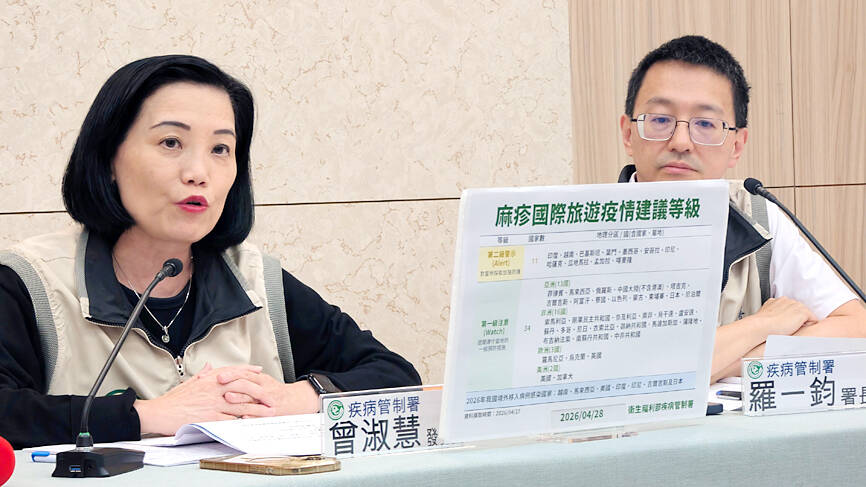
Photo: CNA
The first signs of measles — including fever, coughing and conjunctivitis — are often mistaken as respiratory infections such as influenza or the common cold, and a rash typically appears a few days after the initial symptoms, he said.
Young children and immunocompromised individuals are at the highest risk of severe measles complications, including pneumonia, encephalitis, middle ear infection and even death, Lin said.
The CDC encourages people who were born in 1966 or after, who are traveling to places where measles is spreading, to consult with a travel clinic doctor about getting a paid-out-of-pocket measles-mumps-rubella vaccine at least two to four weeks before departure, he added.
CDC Epidemic Intelligence Center Deputy Director Lee Chia-lin (李佳琳) said Japan has reported a rapid increase in measles cases this year, up to 299 cases as of April 15, mostly in Tokyo and the prefectures of Kanagawa, Kagoshima, Aichi, Chiba and Saitama.
Japan also reported 56 confirmed cases last week alone, most in Tokyo and Kanagawa Prefecture, she said.
The CDC has issued a Level 1 “watch” travel notice — practice usual precautions — for Japan due to measles, Lee said.
CDC Director-General Philip Lo (羅一鈞) said the case is the first imported case of measles from Japan in seven years, and because Japan is a popular travel destination among Taiwanese, the travel notice has been issued to remind people to take precautions.
Meanwhile, COVID-19 activity remains low in Taiwan, but as the annual hajj pilgrimage to Mecca is set to begin on May 25, the CDC urges travelers who are planning to attend to get meningococcal and COVID-19 vaccinations, which is mandated by the Saudi Arabian government, while the CDC also advises being vaccinated against influenza and measles, mumps and rubella.
They should also avoid contact with camels and avoid consuming raw camel milk or other raw camel products, to prevent infection with Middle East Respiratory Syndrome, Lee said.
Lo said that the BA.3.2 subvariant of SARS-CoV-2, nicknamed “Cicada,” is being closely monitored globally as it has the potential to evade existing vaccines, so there could be a wave of infections in the summer, just as Taiwan has experience increased cases in the summers of the past two years.
Publicly funded COVID-19 vaccination for people aged six months or older are to be extended to July 31, he said, adding there are still about 165,000 doses of the Novavax vaccine and about 738,000 doses of the Moderna vaccine.
He added that the CDC plans to introduce a new type of Moderna COVID-19 vaccine for the autumn and winter seasons, which utilizes a significantly lower dose — only one-fifth of its original vaccine — and causes fewer side effects.
The new vaccine has been approved by the US Food and Drug Administration (FDA) and obtained a permit from Taiwan’s FDA, so when vaccine strain selection takes place in the summer, the CDC can begin procurement and prepare for vaccinations starting on Oct. 1, he said.
LEVERAGE: China did not ‘need to fire a shot’ to deny Taiwan airspace over Africa when it owns ‘half the continent’s debt,’ a US official said, calling it economic warfare The EU has raised concerns about overflight rights following the delay of President William Lai’s (賴清德) planned state visit to the Kingdom of Eswatini after three African nations denied overflight clearance for his charter at the last minute. Taiwanese allies Paraguay and Saint Kitts and Nevis, as well as several US lawmakers and the Inter-Parliamentary Alliance on China (IPAC) condemned China for allegedly pressuring the countries. Lai was scheduled to fly directly to Taiwan’s only African ally from yesterday to Sunday to celebrate the 40th anniversary of King Mswati III’s accession and his 58th birthday, but Seychelles, Mauritius and Madagascar suddenly revoked
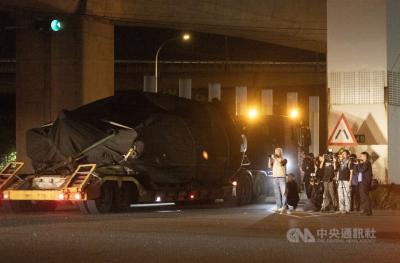
The final batch of 28 M1A2T Abrams tanks purchased from the US arrived at Taipei Port last night and were transported to the Armor Training Command in Hsinchu County’s Hukou Township (湖口), completing the military’s multi-year procurement of 108 of the tanks. Starting at 12:10am today, reporters observed more than a dozen civilian flatbed trailers departing from Taipei Port, each carrying an M1A2T tank covered with black waterproof tarps. Escorted by military vehicles, the convoy traveled via the West Coast Expressway to the Armor Training Command, with police implementing traffic control. The army operates about 1,000 tanks, including CM-11 Brave Tiger
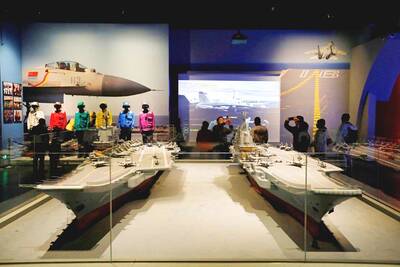
China on Wednesday teased in a video an aircraft carrier that could be its fourth, and the first using nuclear power, while making an allusion to Taiwan and vowing to further build up its islands, as it looks to boost maritime power, secure resources and bolster territorial claims. The video, issued on the eve of the 77th founding anniversary of the Chinese People’s Liberation Army Navy, featured fictional officers with names that are homophones of three commissioned aircraft carriers, the Liaoning (遼寧), Shandong (山東) and Fujian (福建). Titled Into the Deep, it showed a 19-year-old named “Hejian” (何劍) joining the group, sparking
BIG YEAR: The company said it would also release its A12 chip the same year to keep a ‘reliable stream of new silicon technologies’ flowing to its customers Taiwan Semiconductor Manufacturing Co (TSMC, 台積電) yesterday said its newest A13 chip is to enter volume production in 2029 as the chipmaker seeks to hold onto its tech leadership and demand for next-generation chips used in artificial intelligence (AI), high-performance-computing (HPC) and mobile applications. TSMC, the world’s biggest contract chipmaker, also unveiled its A12 chip at its annual technology symposium in Santa Clara, California. The A12 chip, which features TSMC’s super-power-rail technology to provide backside power delivery for AI and HPC applications, is also to enter volume production in 2029, a year after the scheduled release of the A14 chip. The technology moves


 RSS
RSS