


A former Taiwan Semiconductor Manufacturing Co (TSMC, 台積電) engineer has been sentenced to 10 years in prison for his role in leaking trade secrets involving the company’s advanced 2-nanometer process, a court ruled yesterday.
The Intellectual Property and Commercial Court found Chen Li-ming (陳力銘) guilty of contraventing the National Security Act (國家安全法), and of other offenses related to the unauthorized acquisition and the use of Taiwan’s “national core key technologies.”
The ruling can be appealed.
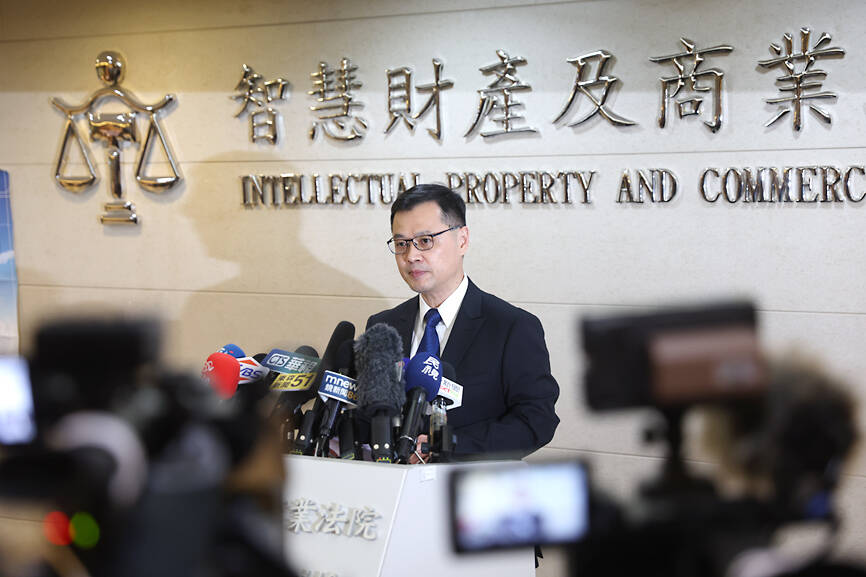
Photo: CNA
The case is the first involving a corporate entity under the National Security Act.
Two other TSMC engineers — Wu Ping-chun (吳秉駿) and Ko Yi-ping (戈一平) — were sentenced to three and two years in prison respectively, while another employee, Chen Wei-chieh (陳韋傑), received a six-year sentence.
A fourth defendant, Lu Yi-yin (盧怡尹), was given a 10-month suspended sentence and fined NT$1 million (US$31,779). She is an employee of Tokyo Electron Taiwan (東京威力), the company to which the TSMC trade secrets were leaked.
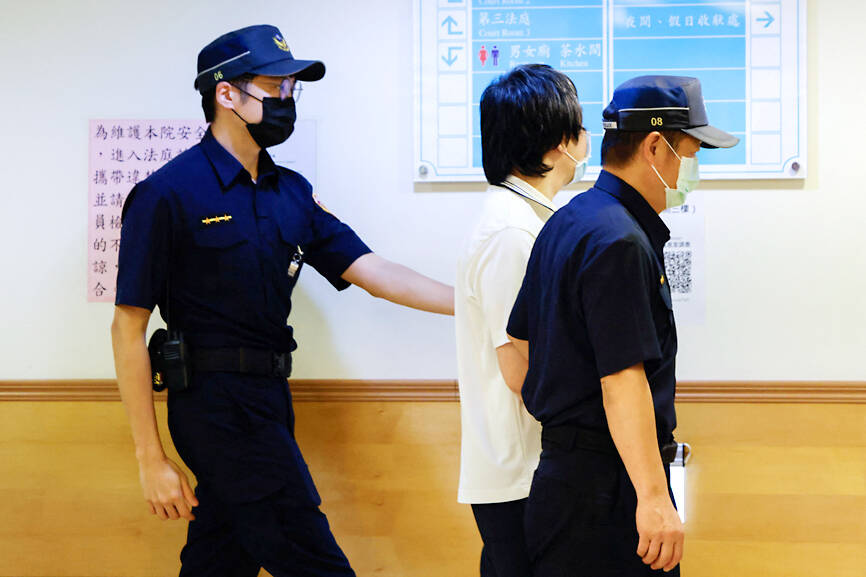
Photo: Ann Wang, Reuters
Tokyo Electron Taiwan, a TSMC equipment supplier, was fined NT$150 million, which could be suspended if it pays NT$100 million in compensation to TSMC and NT$50 million to the treasury, the ruling said.
Chen Li-ming, who previously worked in a yield engineering unit at TSMC’s Fab 12, joined Tokyo Electron Taiwan’s marketing division after leaving the chipmaker, prosecutors from the Intellectual Property Branch of the Taiwan High Prosecutors’ Office said.
Between the second half of 2023 and the first half of last year, Chen Li-ming repeatedly solicited confidential technical information from Wu and Ko, who were still employed at TSMC, in a bid to help Tokyo Electron secure more equipment supply positions for TSMC’s advanced process nodes.
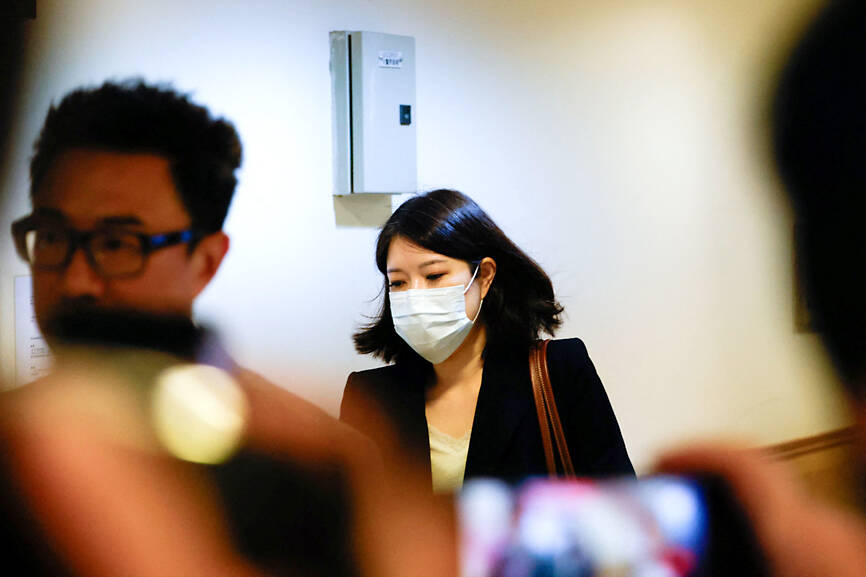
Photo: Ann Wang, Reuters
The information, including trade secrets related to etching equipment used in 2-nanometer production, was photographed and reproduced to allow Tokyo Electron to evaluate and improve its equipment performance, prosecutors said.
TSMC reported the case to authorities on July 8 last year after detecting irregularities through an internal investigation, an earlier statement said.
Prosecutors conducted an investigation between July 25 and 28 last year, and obtained court approval to detain and hold Chen Li-ming, Wu and Ko incommunicado.
The three suspects were indicted in August last year on charges including theft of trade secrets and extraterritorial use of national core technologies. Prosecutors sought prison terms of 14 years, nine years and seven years for Chen Li-ming, Wu and Ko respectively.
Prosecutors later determined that Tokyo Electron Taiwan failed to exercise adequate supervision over Chen Li-ming and did not take sufficient measures to prevent breaches of the law, and pursued corporate criminal liability under the National Security Act, seeking a fine of NT$120 million against the company.
Investigators also found that the company’s cloud storage still contained TSMC’s trade secrets, including chip manufacturing technologies below the 14-nanometer node, and related equipment and chemical processes.
Tokyo Electron, Japan’s largest semiconductor equipment maker and TSMC’s major Japanese supplier, in a statement issued after the indictments last year said that it had found no evidence that TSMC’s 2-nanometer technology had been leaked to third parties, adding that it does not tolerate contraventions of the law or ethical standards.
TSMC has said it maintains a zero-tolerance policy toward trade secret violations and pledged to strengthen internal controls to safeguard its technological advantage.
Additional charges were filed in January against Chen Li-ming, Chen Wei-chieh, Tokyo Electron Taiwan and Lu, who was accused of destroying evidence.

The National Chungshan Institute of Science and Technology yesterday showcased its locally developed variants of the Vision 60 robotic patrol dog, which it plans to deploy on the nation’s outlying territories in the South China Sea. The variants were produced under the Joint Lab project — created by the institute and domestic companies — and assembled with domestically produced motors, lenses and artificial intelligence (AI) systems alongside licensed tech from the US, Missile and Rocket Systems Research Division deputy director Jen Kuo-kang (任國光) told the media event at a military base in Taipei’s Dazhi (大直) area. Taiwan has built up its strengths

RIGHT DIRECTION: Taiwan’s efforts to prevent forced labor include a proposal to ‘fully prohibit’ employers from withholding workers’ documents, an official said Taiwan is to establish a mechanism to restrict imports of goods linked to forced labor, the Executive Yuan said yesterday, after the US proposed imposing additional tariffs on Taiwanese goods over labor concerns. “The Ministry of Labor and the Ministry of Economic Affairs are to establish an interministerial review procedure,” Executive Yuan spokesperson Michelle Lee (李慧芝) said at a news briefing in Taipei. “The government is to use the Foreign Trade Act [貿易法] as the legal basis to restrict imports of goods produced with forced labor” and bring its supply chain governance more in line with international standards on human rights, resilience
NOT IMMEDIATE: Taiwan has a chance to appeal the proposed 10 percent tariff before it starts, while other countries face a 12.5 percent tariff from the trade office Taiwan is among 60 economies determined by the US to have failed to impose or enforce a ban on the importation of goods produced with forced labor, according to a notice released on Tuesday by the Office of the US Trade Representative (USTR), which proposed imposing an additional 10 percent or more tariff on them. The USTR in a statement said that following an investigation, it had determined under Section 301 of the Trade Act of 1974 that the failure of the 60 economies to impose and effectively enforce a prohibition on the importation of goods produced with forced labor is
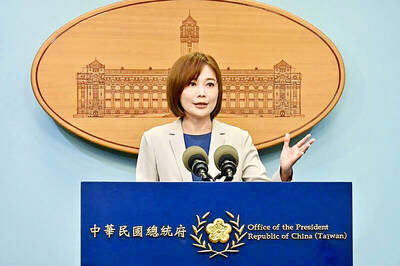
TIT-FOR-TAT: The US allegedly revoked the visa of a Chinese national working at Xinhua News Agency in the US in response to Beijing’s expulsion of Vivian Wang The Presidential Office yesterday condemned China for expelling a New York Times correspondent from Beijing following the newspaper’s interview with President William Lai (賴清德), saying the move highlighted Beijing’s suppression of press freedom and its threat to international news media. Taiwan has noted a series of recent incidents in which Beijing used similar tactics to “threaten and pressure international media outlets and journalists,” Presidential Office spokeswoman Karen Kuo (郭雅慧) said in a statement. “This concerns not only press freedom and freedom of expression, but also the safety of journalists, and Taiwan and relevant partners are paying close attention to the situation,” she


 RSS
RSS