


The government would keep increasing subsidies for complex medical procedures and reforming the compensation system after the National Health Insurance (NHI) budget surpassed NT$1 trillion (US$31.73 billion) for the first time this year, President William Lai (賴清德) told the opening ceremony of the Taiwan Surgical Association Annual Meeting and International Joint Surgical Conference at the Taipei International Convention Center yesterday.
Lai said that his experience as a doctor allows him to understand that surgeons must possess precise judgement, quick reflexes, mature professional skills and a strong team spirit, while also prioritizing patient safety, efficiency and quality of care.
Taiwan’s healthcare quality has an excellent reputation globally, and it is his responsibility as president to support healthcare professionals, and provide them with more resources and better working conditions so that they can keep contributing to people’s health, he said.
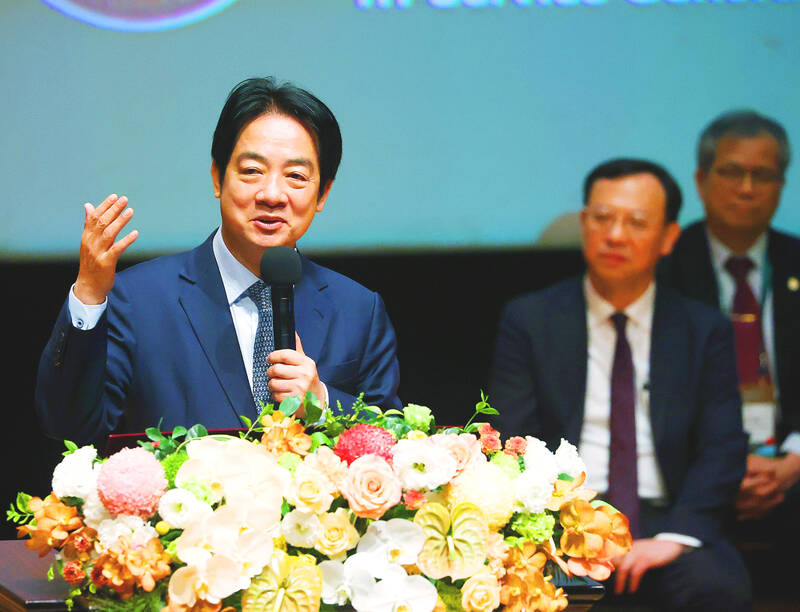
Photo: CNA
In the two years since he took office, the government has increased the NHI budget by 5.5 percent annually, with this year’s budget topping NT$1 trillion for the first time, Lai said.
At the same time, the government has reviewed items covered by the NHI and removed from it those that are the purview of other agencies, with about NT$10 billion saved in each of the two years of his presidency, he said.
“The goal is to improve medical services and the working conditions of healthcare providers,” Lai said. “Simply put — we need to raise their pay.”
Medical institutions need sufficient funding to purchase equipment, invest in advanced systems and train personnel, he told the conference, which had the theme “surgical excellence for a healthy world.”
The government has sought to adjust payments for healthcare providers, introducing value-based payment models to address a shortage of personnel in some specialized departments, he said.
“We want to end the practice of equal pay for unequal work. That is very important for the surgical field. Specifically, the NHI payment for complex surgeries should be increased and guaranteed,” he said.
Regarding the NHI point-based reimbursement system, Lai that it is above 0.95, with some areas nearing 0.99, “close to 1.00,” Lai said.
The system works on points that are typically equivalent to NT$1.
The first step is to stabilize the system before increasing payments for high-intensity, high-risk medical procedures, Lai said.
Improving working environments and talent retention of healthcare providers are the primary objectives at this time, he added.
The government last year launched the five-year Healthy Taiwan Cultivation Plan with a budget of NT$48.9 billion to support medical institutions at all levels and medical associations developing holistic care services to address health needs at all stages of life, Lai said.
He also outlined four key areas for medical development in Taiwan: talent cultivation, improving working conditions, advancing smart healthcare and promoting the sustainable development of the medical system.
The Ministry of Health and Welfare is integrating electronic medical record formats across medical institutions, while artificial intelligence is being integrated in medical procedures to help enhance the efficiency and effectiveness of care services, he said.
The Medical Accident Prevention and Dispute Resolution Act (醫療事故預防及爭議處理法) was implemented in 2024, helping medical personnel and patients clarify issues, and reduce litigation risks, he said.
The act helps ensure that medical personnel no longer have to face medical disputes alone, and that both groups can face problems and seek solutions together, he added.
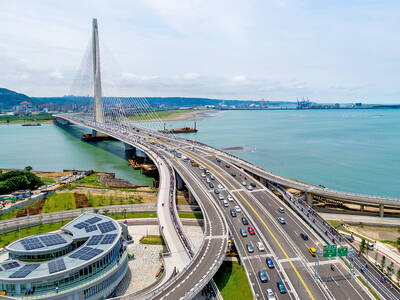
The Ministry of Transportation and Communications yesterday inaugurated the Danjiang Bridge across the Tamsui River in New Taipei City, saying that the structure would be an architectural icon and traffic artery for Taiwan. Feted as a major engineering achievement, the Danjiang Bridge is 920m long, 211m tall at the top of its pylon, and is the longest single-pylon asymmetric cable-stayed bridge in the world, the government’s Web site for the structure said. It was designed by late Iraqi-British architect Zaha Hadid. The structure, with a maximum deck of 70m, accommodates road and light rail traffic, and affords a 200m navigation channel for boats,
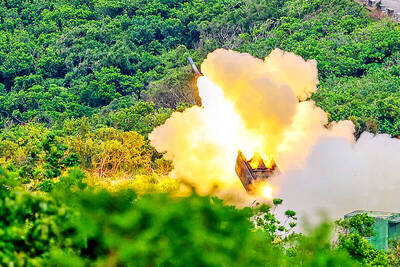
PRECISION STRIKES: The most significant reason to deploy HIMARS to outlying islands is to establish a ‘dead zone’ that the PLA would not dare enter, a source said A High Mobility Artillery Rocket System (HIMARS) would be deployed to Penghu County and Dongyin Island (東引) in Lienchiang County (Matsu) to force the Chinese military to retreat at least 100km from the coastline, a military source said yesterday. Taiwan has been procuring HIMARS and Army Tactical Missile Systems (ATACMS) from the US in batches. Once all batches have been delivered, Taiwan would possess 111 HIMARS units and 504 ATACMS, which have a range of 300km. Considering that “offense is the best defense,” the military plans to forward-deploy the systems to outlying islands such as Penghu and Dongyin so that
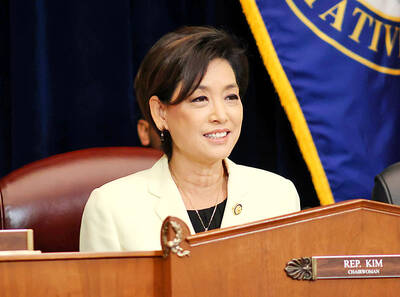
‘CLEAR MESSAGE’: The bill would set up an interagency ‘tiger team’ to review sanctions tools and other economic options to help deter any Chinese aggression toward Taiwan US Representative Young Kim has introduced a bill to deter Chinese aggression against Taiwan, calling for an interagency “tiger team” to preplan coordinated sanctions and economic measures in response to possible Chinese military or political action against Taiwan. “[Chinese President] Xi Jinping [習近平] has directed the People’s Liberation Army to be ready to invade Taiwan by 2027. China has a plan. America should have one too,” Kim said in a news release on Thursday last week. She introduced the “Deter PRC [People’s Republic of China] aggression against Taiwan act” to “ensure the US has a coordinated sanctions strategy ready should

TAIWAN ISSUE: US treasury secretary Scott Bessent said on the first day of meetings that ‘it wouldn’t be a US-China summit without the Taiwan issue coming up’ There were no surprises on the first day of the summit between US President Donald Trump and Chinese President Xi Jinping (習近平), the Mainland Affairs Council (MAC) said yesterday, as the government reiterated that cross-strait stability is crucial to the Asia-Pacific region, as well as the world. As the two presidents met for a highly anticipated summit yesterday, Chinese state media reported that Xi warned Trump that missteps regarding Taiwan could push their two countries into “conflict.” Trump arrived in China with accolades for his host, calling Xi a “great leader” and “friend,” and extending an invitation to visit the White House


 RSS
RSS