


Government agencies have been banned from using the Chinese navigation app AMap (高德地圖) due to national information security concerns, the Ministry of Digital Affairs said yesterday.
Concerns were raised after it was found that the app displayed countdown timers for some traffic lights, prompting fears of cybersecurity risks.
Some user data from AMap could be transmitted back to servers in China, Minister of Digital Affairs Lin Yi-jin (林宜敬) told the Legislative Yuan on Wednesday.
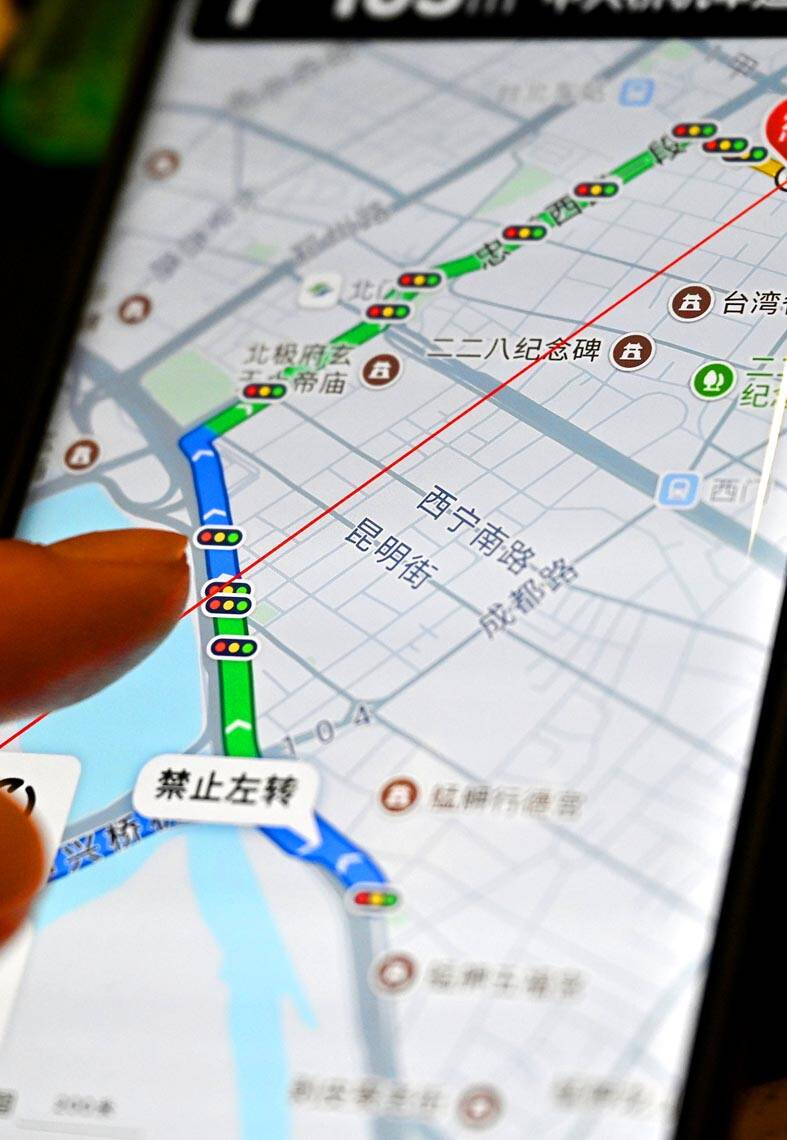
Photo: Wang Yi-sung, Taipei Times
The ministry is reviewing the situation with the Mainland Affairs Council and national security agencies, he added.
Guidelines restricting the use of products deemed harmful to national information security have been in place since 2019, Executive Yuan spokeswoman Michelle Lee (李慧芝) told a news conference following a Cabinet meeting yesterday.
Software widely considered to pose cybersecurity risks is prohibited in government agencies, while the public is advised to remain vigilant and avoid downloading such apps, she added.
The National Institute of Cyber Security is conducting cybersecurity testing on AMap, Administration for Cybersecurity Director-General Tsai Fu-lung (蔡福隆) said.
The app’s map data are obtained through cooperation with a Dutch firm, rather than being collected independently in Taiwan, he said.
The traffic light countdown feature is not linked to Taiwan’s traffic signal systems, but is instead calculated using aggregated user behavior, such as when users stop and start at intersections, he added.
Under Chinese regulations, the government has the authority to access corporate data, and citizens are obligated to cooperate, Tsai said, adding that data collected by AMap, including locations and movement trajectories, could be transmitted back to servers in China and accessed by Chinese authorities.
Minister of National Defense Wellington Koo (顧立雄) told reporters that the military would follow the ministry’s lead in banning the use of AMap.
Asked whether privately owned mobile phones would also be subject to regulation, he said that the ministry would adhere to the ban and ensure that all service members comply.
Regarding the app’s ability to identify military installations — even those that have been stripped of identifying information or blurred — by using nearby landmarks, Koo said that Chinese satellites pass over Taiwan on a daily basis.
In the event of a conflict, fixed positions would never be entirely secure, he said, adding that the military would identify suitable concealed operational positions in terms of tactical planning.
The Ministry of Transportation and Communications yesterday denied that it had given data recorded on the Transport Data Exchange Service Platform (運輸資料流通服務平臺) to AMap, saying the platform does not provide real-time traffic signal countdown data, nor does it offer an interface to access traffic light information.
Traffic signal control is highly specialized and operates within a closed system, it said, adding that the data are used exclusively by local governments for traffic management and transmitted via the government’s secure network.
AMap’s developer, AutoNavi (高德軟件), is headquartered in Beijing and has been wholly owned by Alibaba Group Holding Ltd (阿里巴巴) since 2014.
In China, digital mapping is considered a highly sensitive sector requiring a government-issued surveying and mapping license, as such data involve national security, people familiar with the matter said, adding that AMap operates under strict government oversight.
Such apps could collect long-term data on users’ movements, which could be used to analyze traffic nodes, population flows and activity patterns, Tunghai University Center for Mainland China and Regional Development Research deputy director Hung Pu-chao (洪浦釗) said.
If such data are transmitted to China, Taiwan would have no control over who accesses them or how they are used, and they could potentially be leveraged for further analysis, he added.
Additional reporting by Shelley Shan, Huang Tzu-yang and Fang Wei-li


RESILIENCE: Taiwan plays a key role in semiconductors, energy, information infrastructure and advanced manufacturing, AIT Director Raymond Greene said Taiwan’s continued investment in deterrence and resilience remains vital, especially in uncrewed systems and other emerging technologies, American Institute in Taiwan (AIT) Director Raymond Greene said yesterday. Greene made the remarks at the annual National Strategic Summit on Supply Chain Resilience held by the Research Institute for Democracy, Society and Emerging Technology (DSET), a government-backed think tank. As Taiwan last year became the US’ fourth-largest trading partner and supply chain security is becoming more important, cooperation in emerging technologies continues to deepen between the two countries, he said. The US is committed to accelerating innovation, building key infrastructure, strengthening cooperation

The National Chungshan Institute of Science and Technology yesterday showcased its locally developed variants of the Vision 60 robotic patrol dog, which it plans to deploy on the nation’s outlying territories in the South China Sea. The variants were produced under the Joint Lab project — created by the institute and domestic companies — and assembled with domestically produced motors, lenses and artificial intelligence (AI) systems alongside licensed tech from the US, Missile and Rocket Systems Research Division deputy director Jen Kuo-kang (任國光) told the media event at a military base in Taipei’s Dazhi (大直) area. Taiwan has built up its strengths

RIGHT DIRECTION: Taiwan’s efforts to prevent forced labor include a proposal to ‘fully prohibit’ employers from withholding workers’ documents, an official said Taiwan is to establish a mechanism to restrict imports of goods linked to forced labor, the Executive Yuan said yesterday, after the US proposed imposing additional tariffs on Taiwanese goods over labor concerns. “The Ministry of Labor and the Ministry of Economic Affairs are to establish an interministerial review procedure,” Executive Yuan spokesperson Michelle Lee (李慧芝) said at a news briefing in Taipei. “The government is to use the Foreign Trade Act [貿易法] as the legal basis to restrict imports of goods produced with forced labor” and bring its supply chain governance more in line with international standards on human rights, resilience

NOT IMMEDIATE: Taiwan has a chance to appeal the proposed 10 percent tariff before it starts, while other countries face a 12.5 percent tariff from the trade office Taiwan is among 60 economies determined by the US to have failed to impose or enforce a ban on the importation of goods produced with forced labor, according to a notice released on Tuesday by the Office of the US Trade Representative (USTR), which proposed imposing an additional 10 percent or more tariff on them. The USTR in a statement said that following an investigation, it had determined under Section 301 of the Trade Act of 1974 that the failure of the 60 economies to impose and effectively enforce a prohibition on the importation of goods produced with forced labor is


 RSS
RSS