


Taiwan must show the resolve to defend itself, including by passing a NT$1.25 trillion (US$39.63 billion) special defense budget, to secure US support, US Indo-Pacific Commander Admiral Samuel Paparo told a US Senate hearing on Tuesday.
“We can’t want Taiwan’s defense more than they want it itself,” he told a full hearing of the US Senate Committee on Armed Services.
The opposition-controlled legislature has repeatedly blocked the passage of President William Lai’s (賴清德) proposed NT$1.25 trillion special defense budget, prompting concern from Washington.
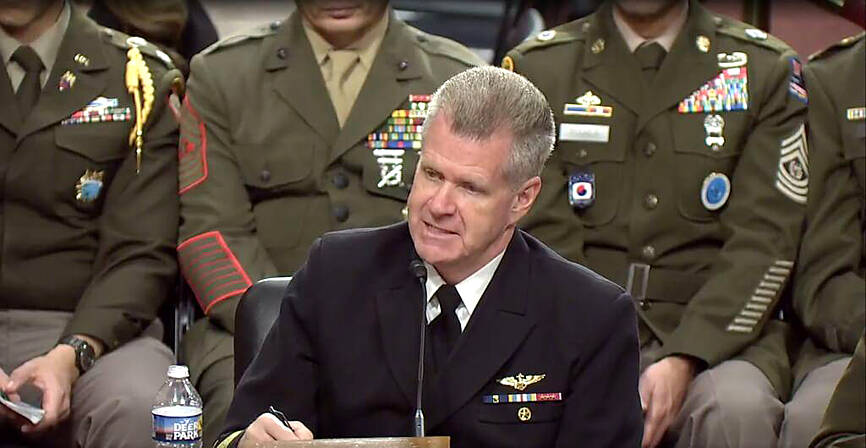
Photo: Screen grab from video of the hearing on the Senate Committee on Armed Services Web site
Opposition parties have proposed versions providing NT$380 billion to NT$400 billion in funding, which would only be enough to pay for an US$11.1 billion arms package announced by the US in January last year, but not enough to cover future arms purchases from the US or domestic drone programs.
US Senator Jeanne Shaheen, a Democrat, said she supported the passage of Taiwan’s special budget to send a signal to China and to the US Congress, and that Congress is supportive of Taiwan and wants to see the budget passed.
US Senator Tom Cotton, a Republican, asked whether a visit to China by Chinese Nationalist Party (KMT) Chairwoman Cheng Li-wun (鄭麗文) would affect Taiwan’s defense spending.
“The proof will be in the pudding,” Paparo said, adding that progress on the special budget would reflect “how committed they are” to self-defense.
“The Indo-Pacific is the defining strategic theater of the 21st century,” he said.
The US stance on Taiwan has not changed, from foreign military sales under the Taiwan Relations Act to the Three Joint Communiques and the “six assurances,” Paparo said.
However, it is “very important” that Taiwan funds its own defense, he said.
“It’s not a chicken and the egg, because you’re not going to get chicken or eggs if you starve the chicken,” he said.
“I have a great deal of faith in Taiwan’s military-age population’s willingness, capability and will to defend themselves,” he added.
He compared polling numbers from Taiwan and Ukraine on the willingness of civilians to fight to defend their nation.
Taiwan’s polling is “orders of magnitude” higher than that of pre-conflict Ukraine, Paparo said.
“They’re building the kind of operational concepts that would lead them to be successful in thwarting an invasion,” he added.
Paparo outlined three “meta trends” driving the shift in modern conflict.
First, information, influence, cyber and cognitive and operations are achieving increasingly strategic effects by shaping perceptions and disrupting decisionmaking, he said.
Second, the commoditization of cheap, massed, uncrewed and often autonomous systems has lowered barriers to advanced capabilities, increasing the cost of assault operations and compressing decision timelines, he said.
Third, the commoditization of long-range, precision, penetrating and, frequently, inexpensive strike munitions has enabled greater leverage for coercion and cost imposition, he said.
The trends “converge into a mega-trend”: achieving information and decision superiority via space proliferation, data and computing applications including artificial intelligence (AI) and human adoption, Paparo said.
Democratic US Senator Richard Blumenthal asked Paparo how Taiwan, a smaller country with fewer troops, yet highly capable in cyber and uncrewed asymmetric forces, is viewed by China.
The Chinese are “deeply worried,” and are trying to reckon with the three meta-trends, the mega-trend and the changing character of warfare, Paparo said.
China wants to build a drone force that would be “a vanguard of an assaulting force,” but mass deployment and employment of cheap expendable munitions would favor the defensive, he said.
Taiwan and the US must pursue asymmetric, uncrewed warfare capabilities with mass, numbers, sustainability and AI tools that would enable them to outfight potential adversaries, he said.
US Senate Armed Services Committee Chairman Jack Reed said that comparisons could be drawn between Ukraine and Taiwan in that Taiwan would largely use asymmetric strategies to counter China, asking what lessons the US has drawn from Ukraine in that regard.
The US would continue to prioritize the “hellscape strategy,” and has learned that low-cost munitions and drone warfare make assault much more costly, Paparo said.
The “hellscape” strategy involves saturating the air and waters around Taiwan with thousands of drones and other platforms capable of striking invading forces from multiple domains at once.
Additional reporting by CNA
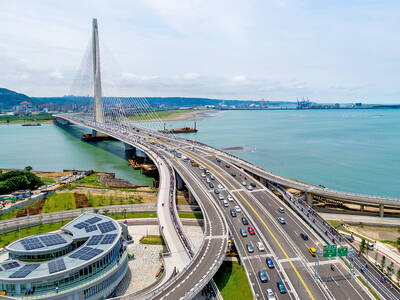
The Ministry of Transportation and Communications yesterday inaugurated the Danjiang Bridge across the Tamsui River in New Taipei City, saying that the structure would be an architectural icon and traffic artery for Taiwan. Feted as a major engineering achievement, the Danjiang Bridge is 920m long, 211m tall at the top of its pylon, and is the longest single-pylon asymmetric cable-stayed bridge in the world, the government’s Web site for the structure said. It was designed by late Iraqi-British architect Zaha Hadid. The structure, with a maximum deck of 70m, accommodates road and light rail traffic, and affords a 200m navigation channel for boats,
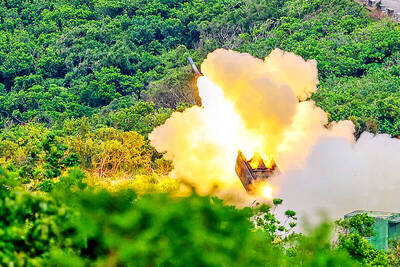
PRECISION STRIKES: The most significant reason to deploy HIMARS to outlying islands is to establish a ‘dead zone’ that the PLA would not dare enter, a source said A High Mobility Artillery Rocket System (HIMARS) would be deployed to Penghu County and Dongyin Island (東引) in Lienchiang County (Matsu) to force the Chinese military to retreat at least 100km from the coastline, a military source said yesterday. Taiwan has been procuring HIMARS and Army Tactical Missile Systems (ATACMS) from the US in batches. Once all batches have been delivered, Taiwan would possess 111 HIMARS units and 504 ATACMS, which have a range of 300km. Considering that “offense is the best defense,” the military plans to forward-deploy the systems to outlying islands such as Penghu and Dongyin so that
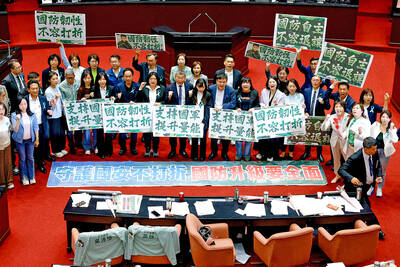
WHAT WAS ALL THAT FOR? Jaw Shaw-kong said that Cheng Li-wen had pushed for more drastic cuts and attacked him, just for the outcome to be nearly identical to his bill The legislature yesterday passed a supplementary budget bill to fund the purchase of separate packages of US military equipment, with the combined amount of spending capped at NT$780 billion (US$24.8 billion). The Chinese Nationalist Party (KMT) and Taiwan People’s Party (TPP) used their legislative majority to pass the bill, which runs until 2033 and has two main funding provisions. One was for NT$300 billion of arms sales already approved by the US for Taiwan on Dec. 17 last year, the other was for NT$480 billion for another arms package expected to be announced by Washington. The bill, which fell short of the NT$1.25

‘CLEAR MESSAGE’: The bill would set up an interagency ‘tiger team’ to review sanctions tools and other economic options to help deter any Chinese aggression toward Taiwan US Representative Young Kim has introduced a bill to deter Chinese aggression against Taiwan, calling for an interagency “tiger team” to preplan coordinated sanctions and economic measures in response to possible Chinese military or political action against Taiwan. “[Chinese President] Xi Jinping [習近平] has directed the People’s Liberation Army to be ready to invade Taiwan by 2027. China has a plan. America should have one too,” Kim said in a news release on Thursday last week. She introduced the “Deter PRC [People’s Republic of China] aggression against Taiwan act” to “ensure the US has a coordinated sanctions strategy ready should


 RSS
RSS