


The Ministry of National Defense yesterday released a report detailing unclassified portions of the government’s proposed NT$1.25 trillion (US$39.7 billion) special defense budget as it continued to seek legislative approval for the bill.
A redacted version of the report released to the public detailed seven major acquisition programs: tube and rocket artillery systems, air defense systems, long-range strike missiles, uncrewed aerial vehicles, drone countermeasures and ammunition stocks.
The budget is to cover the programs’ costs for eight years, it said.
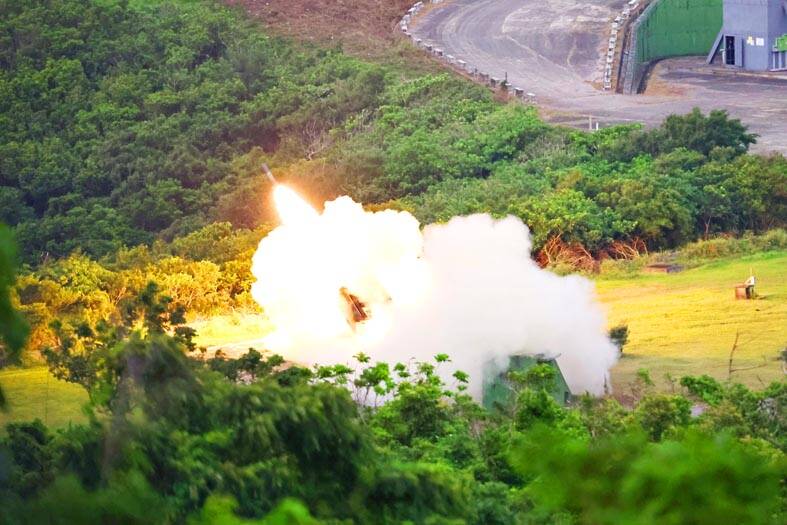
Photo: CNA
Taiwan is to buy two types of artillery systems from the US: 60 M109A7 Paladin self-propelled howitzers worth NT$81 billion, and NT$160 billion for 82 High Mobility Artillery Rocket Systems plus 420 Army Tactical Missile Systems, the report said.
These platforms would replace the obsolete guns that the military currently uses, it said.
The ministry would dedicate NT$335 billion to obtain a large fleet of uncrewed aerial vehicles, and countermeasures against drones, the report said.
The platforms include 32 Chungshan Institute of Science and Technology Albatross II drones, 1,146 coastal surveillance and reconnaissance drones to be acquired by the Armaments Bureau, and 280 vertical takeoff and landing-capable aerial drones.
They also include 208,200 uncrewed coastal strike drones to be acquired by the bureau, and US-made anti-armor loitering munitions, including 478 Altius-600ISRs and 1,554 Altius-700Ms.
Taiwan is to obtain soft-kill and hard-kill counterdrone capabilities, but the make and model of the systems have been redacted in the report.
The ministry is to buy 635 man-portable counterdrone systems off the shelf, and the Armaments Bureau would be tasked with acquiring 1,320 kamikaze boats, the document said.
It plans to allocate NT$550 billion for air defense systems, anti-ballistic missile interceptors and anti-tank guided missile systems.
It is to obtain two types of systems developed by the institute, including 128 effectors, it said.
The nation would also buy 70 Javelins with 1,050 missiles and 24 TWO-2B with 1,545 missiles, all from the US, the report said.
The ministry plans to acquire or develop another missile whose name, purpose and quantity have all been redacted.
Taiwan would use the special defense budget to fund applied artificial intelligence (AI) and C4ISR (Command, Control, Communications, Computers, Intelligence, Surveillance and Reconnaissance) systems, the report said.
A domestically developed system described only as an AI-assisted decisionmaking tool is included in the budget, with all other details redacted.
The ministry is additionally creating a Taiwan Tactical Network and team awareness kits consisting of 120,191 tablets and smartphones designed for military use, with 10 types of devices planned, the report said.
The government is to invest NT$50 billion in the defense industrial base to strengthen the military’s staying power, it said.
This means funding the establishment of new assembly lines for multiple types of ammunition, military-spec batteries and armored fighting vehicles, and foreign suppliers for 120mm and 105mm main gun ammunition, and 30mm chaingun ammunition, and 350 deployable barrier systems, it said.
The final program, which concerns Taiwan-US collaborations in arms development, is to be allocated NT$64 billion.
All other details about this program is classified.
The legislature must approve the special budget for foreign suppliers to secure export authorizations and establish production plans in time for Taiwan to obtain key military capabilities necessary for the nation’s defense, the ministry said in the report.
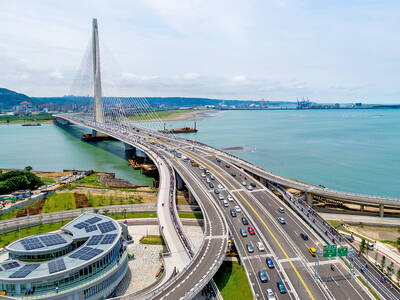
The Ministry of Transportation and Communications yesterday inaugurated the Danjiang Bridge across the Tamsui River in New Taipei City, saying that the structure would be an architectural icon and traffic artery for Taiwan. Feted as a major engineering achievement, the Danjiang Bridge is 920m long, 211m tall at the top of its pylon, and is the longest single-pylon asymmetric cable-stayed bridge in the world, the government’s Web site for the structure said. It was designed by late Iraqi-British architect Zaha Hadid. The structure, with a maximum deck of 70m, accommodates road and light rail traffic, and affords a 200m navigation channel for boats,
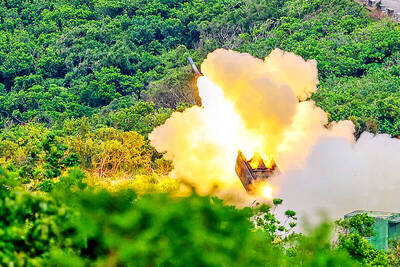
PRECISION STRIKES: The most significant reason to deploy HIMARS to outlying islands is to establish a ‘dead zone’ that the PLA would not dare enter, a source said A High Mobility Artillery Rocket System (HIMARS) would be deployed to Penghu County and Dongyin Island (東引) in Lienchiang County (Matsu) to force the Chinese military to retreat at least 100km from the coastline, a military source said yesterday. Taiwan has been procuring HIMARS and Army Tactical Missile Systems (ATACMS) from the US in batches. Once all batches have been delivered, Taiwan would possess 111 HIMARS units and 504 ATACMS, which have a range of 300km. Considering that “offense is the best defense,” the military plans to forward-deploy the systems to outlying islands such as Penghu and Dongyin so that
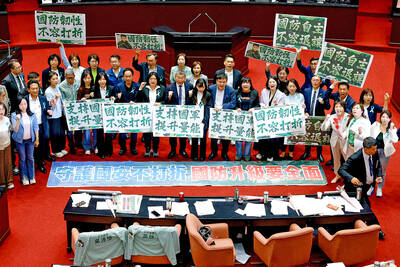
WHAT WAS ALL THAT FOR? Jaw Shaw-kong said that Cheng Li-wen had pushed for more drastic cuts and attacked him, just for the outcome to be nearly identical to his bill The legislature yesterday passed a supplementary budget bill to fund the purchase of separate packages of US military equipment, with the combined amount of spending capped at NT$780 billion (US$24.8 billion). The Chinese Nationalist Party (KMT) and Taiwan People’s Party (TPP) used their legislative majority to pass the bill, which runs until 2033 and has two main funding provisions. One was for NT$300 billion of arms sales already approved by the US for Taiwan on Dec. 17 last year, the other was for NT$480 billion for another arms package expected to be announced by Washington. The bill, which fell short of the NT$1.25
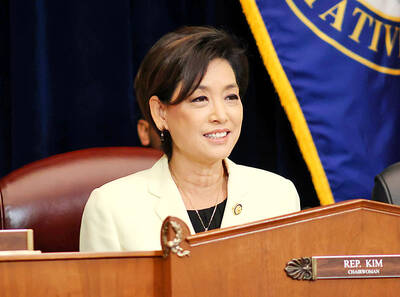
‘CLEAR MESSAGE’: The bill would set up an interagency ‘tiger team’ to review sanctions tools and other economic options to help deter any Chinese aggression toward Taiwan US Representative Young Kim has introduced a bill to deter Chinese aggression against Taiwan, calling for an interagency “tiger team” to preplan coordinated sanctions and economic measures in response to possible Chinese military or political action against Taiwan. “[Chinese President] Xi Jinping [習近平] has directed the People’s Liberation Army to be ready to invade Taiwan by 2027. China has a plan. America should have one too,” Kim said in a news release on Thursday last week. She introduced the “Deter PRC [People’s Republic of China] aggression against Taiwan act” to “ensure the US has a coordinated sanctions strategy ready should


 RSS
RSS