


The Philippines discovered cyanide on Chinese boats operating around a disputed atoll in the South China Sea, Philippine security officials said on Monday.
Authorities said laboratory tests confirmed the presence of the highly toxic substance in bottles seized by the Philippine Navy in operations at Second Thomas Shoal (Renai Shoal, 仁愛暗沙) last year.
Officials warned that the cyanide could have had serious consequences for marine life and weaken the reef supporting a warship that Manila grounded on the atoll to reinforce its maritime claim.
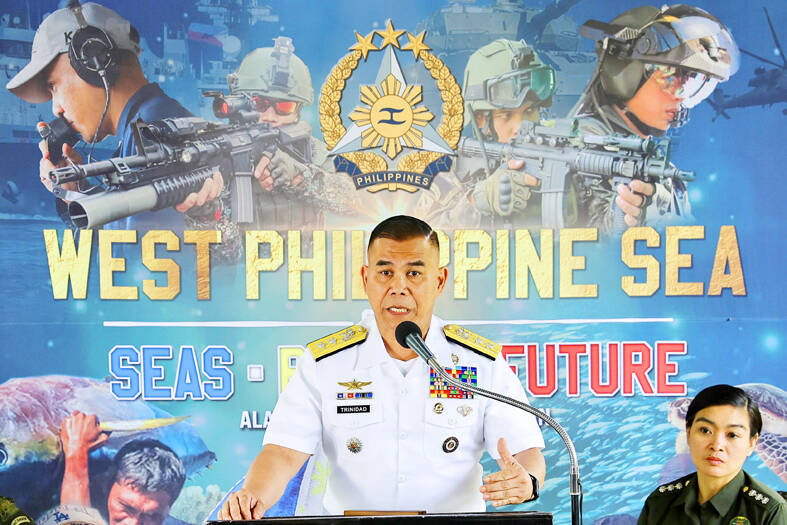
Photo: EPA
“We wish to underscore that the use of cyanide in Ayungin Shoal is a form of sabotage that seeks to kill local fish populations, depriving navy personnel of a vital food source,” Philippine National Security Council spokesman Cornelio Valencia told a news conference using the Philippines’ name for the atoll.
Valencia added that cyanide could damage the reef and “ultimately compromise” the warship’s stability.
The Chinese Ministry of Foreign Affairs dismissed the assertions, calling them a “stunt.”
“The Philippine side illegally harassed the Chinese fishing boats conducting normal fishing, grabbed the fishermen’s living supplies and staged this so-called cyanide stunt. There is no credibility whatsoever to their story,” ministry spokesman Guo Jiakun (郭嘉昆) said on Monday.
The shoal is within the Philippines’ 200 nautical mile (370km) exclusive economic zone and 1,300km off China.
The Philippines has accused China of disrupting resupply missions to troops on the vessel, including a June 17, 2024, incident that turned violent and resulted in a Filipino sailor losing a finger.
China has denied allegations of aggressive conduct during such encounters and accused the Philippines of trespassing in its waters.
The June confrontation later led to a provisional understanding for resupply missions to the grounded ship.
China and the Philippines held high-level talks last month over the South China Sea, exploring preliminary steps toward oil and gas cooperation, and confidence-building measures, including communication between their coast guards.
The Philippine Department of Foreign Affairs in a statement on Monday said that the scope of the coast guard cooperation would be limited, and “does not contemplate cooperation in sensitive operational areas,” adding that there had been no discussions on joint patrols.

A signaling system malfunction disrupted high-speed rail (HSR) services beginning at 8am today, with trains temporarily reduced to three northbound and three southbound trains per hour as authorities conduct inspections. The malfunction occurred on a section of track in Miaoli County during pre-operation checks early this morning, forcing northbound and southbound trains to use a single track, the HSR operator said. The regular schedule has been replaced with three hourly trains offering only nonreserved seating in each direction, stopping at every station, it said, adding that business class cars would still have reserved seating. Departures from terminal stations are scheduled at the top

Taiwan is still in the process of assessing the possibility of recruiting workers from Eswatini, the Ministry of Foreign Affairs said yesterday, adding that its goal is to help Eswatini upgrade its vocational training centers. If there are plans to recruit workers from Eswatini, safeguarding national security, protecting public health and ensuring the employment rights of Taiwanese would be prerequisites, Department of West Asian and African Affairs Director-General Yen Chia-liang (顏嘉良) told a news conference. Key considerations would also include filling labor shortages in specific industries, and fostering bilateral professional and technical exchanges, he said. Yen was asked about the progress of labor

A US uncrewed surface vessel (USV) encountered multiple Chinese warships during an autonomous transit of the Taiwan Strait, US defense company Seasats said in a statement on Wednesday. Seasats announced that a Lightfish USV had completed the first autonomous transit of the Taiwan Strait. Over five days, the USV traversed the entire length of the Strait while constantly monitoring surface vessel traffic, the company said. The Lightfish encountered multiple Chinese warships, one of which was a Chinese People’s Liberation Army Navy (PLAN) Type 056 corvette, it said. The Chinese vessels were operating “well within Taiwan’s exclusive economic zone without transmitting their identity via the

VERBOSE VESSELS: A CGA cutter and a China Coast Guard exchanged verbal barbs for more than a day in Taiwanese-controlled waters before the Chinese vessel left The Taiwanese and Chinese coast guards had a standoff near the strategically located Pratas Islands (Dongsha Islands, 東沙群島) in the north of the South China Sea, the Coast Guard Administration (CGA) said yesterday. The two sides engaged in intense radio exchanges over sovereignty claims during the 33-hour standoff. China Coast Guard vessel 3501 eventually left the restricted waters, 26.6 nautical miles (49.2km) west of the Pratas Islands, at 5pm yesterday, the CGA said. Lying approximately between southern Taiwan and Hong Kong, the Taiwan-controlled Pratas are seen by some security experts as vulnerable to Chinese attack due to their distance — more than


 RSS
RSS