


In light of China’s authoritarian expansion and military threat, democratic countries should reconceptualize the First Island Chain as a single theater, and build a collective and coordinated democratic shield to deter aggression, Minister of Foreign Affairs Lin Chia-lung (林佳龍) told a forum in Taipei yesterday.
Lin made the remark at the “Shield of Democracy: The First Island Chain Social Resilience Cooperation Forum” held by the Formosa Republican Association and the Ministry of Foreign Affairs’ Drone Diplomacy Task Force.
“We are confronting a reality that is becoming clearer day by day. The First Island Chain is no longer a line on a map, it has become a major front line for global freedom, democracy and order,” Lin said.
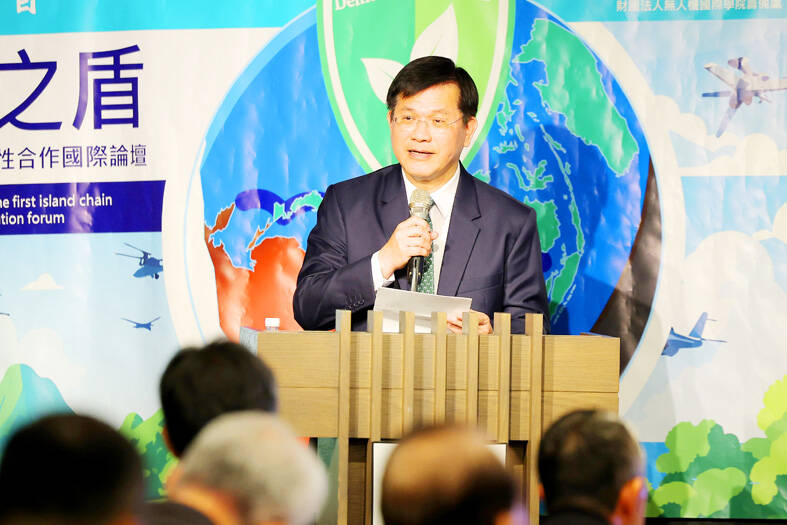
Photo: CNA
Countries in the First Island Chain prioritize preventing war and preserving peace, but “peace is never sustained by hope alone,” as true peace relies on “credible deterrence” that shows those that seek to destroy it that they cannot succeed, he said.
China’s mounting military pressure, gradual intimidation, cognitive warfare and economic coercion against Taiwan, Japan, South Korea, the Philippines and the US are not isolated incidents, but part of a coordinated security threat, he added.
“We can no longer rely on independent defense and response systems. We must move toward building a collective and coordinated democratic shield for the first island chain,” Lin said.
“We must begin to understand the First Island Chain through the lens of a single theater,” he said, adding that it includes the Taiwan Strait, the East and South China seas, the Miyako Strait, the Bashi Channel, and their surrounding sea and air spaces.
These seemingly separate domains are increasingly being integrated into one strategic framework: authoritarian expansionism, “gray zone” tactics, electromagnetic disruption, supply chain coercion and cognitive warfare, Lin said.
Therefore, the First Island Chain should be viewed as a single theater where countries jointly monitor the situation, issue joint warnings, conduct joint deployments and jointly maintain resilience, he said.
Low-cost and high-endurance uncrewed systems are key components of the democratic shield, as they are essential to protecting sea lanes and other sea infrastructure, as well as central to establishing an “asymmetrical” framework that raises the cost of invasion and extends resilience, Lin said.
Low-altitude airspace is more than a battle space; it is also a space of governance, carrying out peacetime tasks such as daily coastal patrols, bridge inspections, mountain search and rescue, port security, disaster response, and logistics for outlying islands — becoming a part of national resilience, he added.
“Building a democratic shield should not stop in wartime. It should be built up step by step in peacetime governance,” Lin said. “If uncrewed devices are the nervous system of the democratic shield, then democratic supply chains are its backbone.”
If an uncrewed system could be paralyzed in wartime, data cannot be integrated in a crisis, maintenance resources cannot be replenished quickly, or training has not reached optimal levels in peacetime, then even the most advanced equipment would struggle to provide credible deterrence, he said.
The key to a democratic shield for the First Island Chain comes down to “whether we can build a comprehensive framework that links research, development, manufacturing, validation, training, maintenance and deployment into one coherent system,” he added.
“When we speak today about the first island chain, a single theater, uncrewed systems and a democratic shield, we are not calling for war. On the contrary, we want to prevent conflict,” Lin said. “We emphasize deterrence not because we want confrontation, but because we know that peace is more likely to endure when aggressive authoritarianism leaders understand that they cannot prevail.”

A signaling system malfunction disrupted high-speed rail (HSR) services beginning at 8am today, with trains temporarily reduced to three northbound and three southbound trains per hour as authorities conduct inspections. The malfunction occurred on a section of track in Miaoli County during pre-operation checks early this morning, forcing northbound and southbound trains to use a single track, the HSR operator said. The regular schedule has been replaced with three hourly trains offering only nonreserved seating in each direction, stopping at every station, it said, adding that business class cars would still have reserved seating. Departures from terminal stations are scheduled at the top

Taiwan is still in the process of assessing the possibility of recruiting workers from Eswatini, the Ministry of Foreign Affairs said yesterday, adding that its goal is to help Eswatini upgrade its vocational training centers. If there are plans to recruit workers from Eswatini, safeguarding national security, protecting public health and ensuring the employment rights of Taiwanese would be prerequisites, Department of West Asian and African Affairs Director-General Yen Chia-liang (顏嘉良) told a news conference. Key considerations would also include filling labor shortages in specific industries, and fostering bilateral professional and technical exchanges, he said. Yen was asked about the progress of labor

VERBOSE VESSELS: A CGA cutter and a China Coast Guard exchanged verbal barbs for more than a day in Taiwanese-controlled waters before the Chinese vessel left The Taiwanese and Chinese coast guards had a standoff near the strategically located Pratas Islands (Dongsha Islands, 東沙群島) in the north of the South China Sea, the Coast Guard Administration (CGA) said yesterday. The two sides engaged in intense radio exchanges over sovereignty claims during the 33-hour standoff. China Coast Guard vessel 3501 eventually left the restricted waters, 26.6 nautical miles (49.2km) west of the Pratas Islands, at 5pm yesterday, the CGA said. Lying approximately between southern Taiwan and Hong Kong, the Taiwan-controlled Pratas are seen by some security experts as vulnerable to Chinese attack due to their distance — more than

A US uncrewed surface vessel (USV) encountered multiple Chinese warships during an autonomous transit of the Taiwan Strait, US defense company Seasats said in a statement on Wednesday. Seasats announced that a Lightfish USV had completed the first autonomous transit of the Taiwan Strait. Over five days, the USV traversed the entire length of the Strait while constantly monitoring surface vessel traffic, the company said. The Lightfish encountered multiple Chinese warships, one of which was a Chinese People’s Liberation Army Navy (PLAN) Type 056 corvette, it said. The Chinese vessels were operating “well within Taiwan’s exclusive economic zone without transmitting their identity via the


 RSS
RSS