


Taipei prosecutors yesterday indicted former TV producer Lee Neng-chien (李能謙) on suspicion of spying for China, seeking a 12-year prison sentence.
Lee, the husband of actress Liu Hsiang-chun (劉香君) and a retired air force serviceman, was among five people suspected of being recruited by Chinese intelligence officials, and leaking classified military information and personal data in exchange for financial payments and other benefits, the Taipei District Prosecutors’ Office said.
The five face charges under the National Security Act (國家安全法), the National Intelligence Services Act (國家情報工作法) and the Personal Data Protection Act (個人資料保護法), prosecutors said.
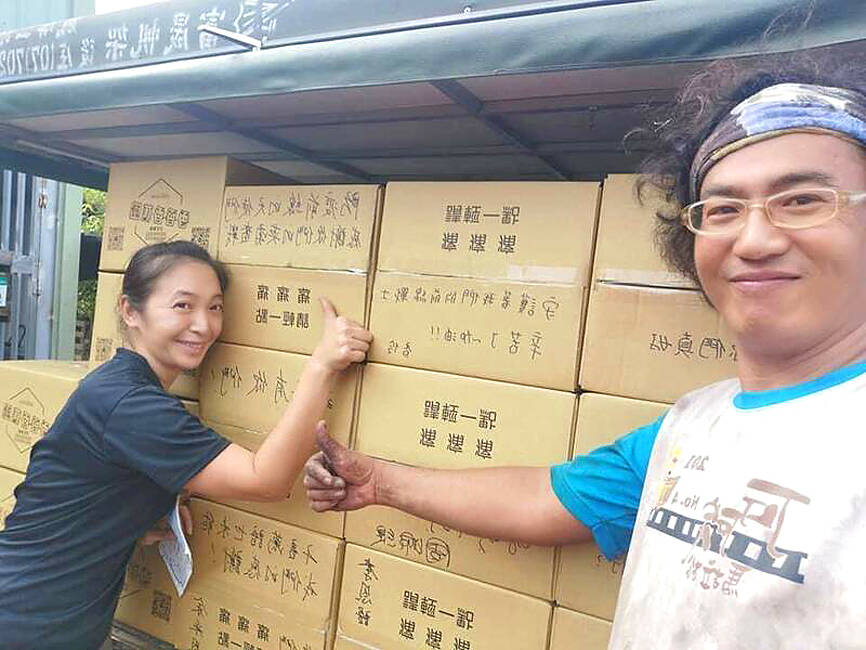
Photo courtesy of Wan Hung
The office said it initially directed the New Taipei City Police Department’s Criminal Investigation Division to investigate Lee and his associates on suspicion of fraud.
An investigation found that Lee and his suspected coconspirators had posed as famous figures such as Nvidia Corp chief executive officer Jensen Huang (黃仁勳), creating fake Facebook accounts to run fan pages and share fraudulent advertisements for investment schemes, prosecutors said.
They allegedly defrauded the public of more than NT$13 million (US$409,759), they said.
Police and prosecutors carried out searches in June last year and summoned the five for questioning, prosecutors said, adding that Lee was released on NT$200,000 bail and restricted from leaving the country or traveling by sea.
Upon examining the evidence, prosecutors also suspected Lee of contravening the National Security Act.
Prosecutors coordinated a joint investigation with the Criminal Investigation Bureau’s High-Tech Crime Center and the Military Police Command in Taipei, with assistance from the Ministry of National Defense.
Lee was detained in December last year and held incommunicado.
Lee traveled to Fuzhou, China, in February last year, where he was allegedly recruited by a Chinese intelligence operative, and agreed to gather, collect and deliver military intelligence in exchange for payment, prosecutors said.
He then instructed an associate, Hsu Yin-hao (徐胤豪), to help obtain files containing more than 3,000 items of personal data, including information on Taiwanese intelligence personnel, military personnel and civilians, they said, adding that Lee sent six of those files to the Chinese intelligence operative in April last year.
In May, he traveled to Guangzhou, China, with an associate to dine with a Chinese military intelligence source and agreed once again to provide sensitive information in exchange for money, prosecutors said.
After returning to Taiwan, Lee instructed another associate to gather personal data and sensitive information on military personnel, they said.
In April last year, Lee created a Telegram group for the Chinese contact and nine other Chinese nationals, where they attempted to recruit active-duty military personnel from Taiwan, prosecutors said.
They attempted to attract recruits by saying that providing information would “help better protect Taiwan” and “deepen Taiwan-US defense cooperation,” prosecutors added.
No military personnel responded and the scheme failed, they said.
However, Lee did obtain information from retired air force serviceman Ko Meng-yu (柯孟妤) sometime before November last year, they said.
Ko was among those indicted yesterday.

‘NO SECURITY RISK’: The Railway Bureau reassured the public that the technicians’ activities were limited to technical guidance and did not involve sensitive systems The Railway Bureau yesterday said it had invited eight Chinese technicians to assist with an airport MRT construction project. The bureau issued the confirmation after an Internet user said Chinese nationals had entered the construction zone of Taiwan Taoyuan International Airport’s Terminal 3 project. They asked why “individuals from an enemy state” were allowed access to such a major national infrastructure project, which raised serious concerns over Taiwan’s industrial safety, sensitive systems and information security. The bureau’s Northern Region Engineering Branch Office said subcontractor Taiwan Handle Industrial Co (台灣手把工業) of the Taoyuan airport MRT’s “Contract No. CU05 Project A14 Station Civil, MEP &

A US uncrewed surface vessel (USV) encountered multiple Chinese warships during an autonomous transit of the Taiwan Strait, US defense company Seasats said in a statement on Wednesday. Seasats announced that a Lightfish USV had completed the first autonomous transit of the Taiwan Strait. Over five days, the USV traversed the entire length of the Strait while constantly monitoring surface vessel traffic, the company said. The Lightfish encountered multiple Chinese warships, one of which was a Chinese People’s Liberation Army Navy (PLAN) Type 056 corvette, it said. The Chinese vessels were operating “well within Taiwan’s exclusive economic zone without transmitting their identity via the
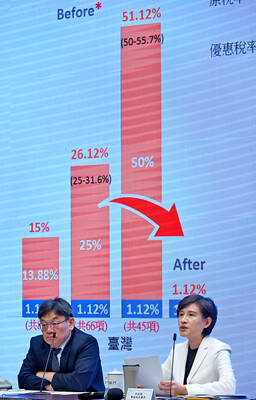
GREATER REACH? Auto parts and wood products would face tariffs of up to 15%, matching those targeting the EU, Japan and South Korea, Vice Premier said The US has announced that preferential tariff treatment for Taiwan’s non-semiconductor Section 232 goods would take effect retroactively from May 1, the Executive Yuan said yesterday. The US government yesterday posted a notice on the Federal Register’s public inspection Web site previewing tariff concessions for Taiwan under a memorandum of understanding (MOU) on Taiwan-US investment after two months of negotiations. The MOU signed on Jan. 15 stipulated three major preferential tariff arrangements: a 15 percent “reciprocal” tariff rate for Taiwan without stacking most-favored nation (MFN) rates; preferential Section 232 treatment for semiconductors and related products; and preferential Section 232 treatment for non-semiconductor

The National Chungshan Institute of Science and Technology yesterday showcased its locally developed variants of the Vision 60 robotic patrol dog, which it plans to deploy on the nation’s outlying territories in the South China Sea. The variants were produced under the Joint Lab project — created by the institute and domestic companies — and assembled with domestically produced motors, lenses and artificial intelligence (AI) systems alongside licensed tech from the US, Missile and Rocket Systems Research Division deputy director Jen Kuo-kang (任國光) told the media event at a military base in Taipei’s Dazhi (大直) area. Taiwan has built up its strengths


 RSS
RSS