

“Compromising with authoritarian regimes comes at the cost of sovereignty and democracy,” President William Lai (賴清德) wrote on Facebook today, ahead of Chinese Nationalist Party (KMT) Chairwoman Cheng Li-wun’s (鄭麗文) meeting with Chinese President Xi Jinping (習近平).
In the past few years, China has continuously carried out “gray zone” harassment and military intimidation in the Taiwan Strait, seriously undermining regional peace and stability, Lai said.
Today marks the 47th anniversary of the US’ Taiwan Relations Act, which together with the Six Assurances, stands as proof of the two nations’ continuing friendship, he said.
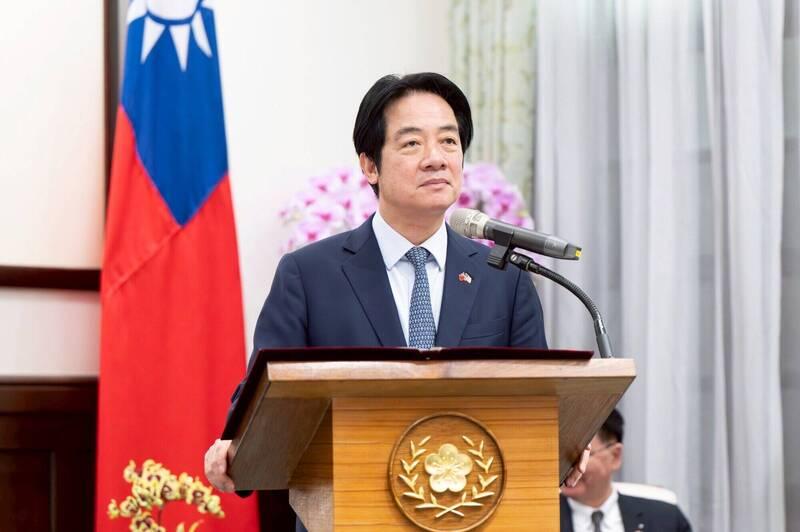
Photo courtesy of the Presidential Office
The relationship reflects a shared commitment to democratic values, freedom and human rights, and serves as a cornerstone of stability and security in the Indo-Pacific region, Lai said.
Taiwan is widely recognized as a beacon of democracy, with a free and diverse society, consistently ranking among the top nations in Asia and occupying a key position along the First Island Chain, he said.
US congressional support for Taiwan’s security and well-being is bipartisan and one of the strongest areas of consensus in Washington, he added.
The world knows that protecting Taiwan is key to protecting freedom and democracy, Lai said.
Cheng is in China on what she has called a “peace” mission and met with Xi today.
“We hold ideals about peace, but they are not unrealistic fantasies; history shows that compromising with authoritarian regimes comes at the cost of sovereignty and democracy — it will not bring freedom, nor will it bring peace,” Lai said.
Peace is achieved through strength, and strength is achieved through long-term, stable investment, he said.
We need to show our determination to defend ourselves to earn our allies’ support, he added.
Taiwan’s national defense spending this year surpassed 3 percent of its GDP, in line with NATO standards, and is expected to reach 5 percent of GDP by 2030, Lai said.
The government has proposed an eight-year, US$40 billion special defense budget to build a “T-Dome,” a multi-layered air defense system, which would enhance asymmetric warfare capabilities, he said.
Taiwan hopes to partner with advanced defense industry nations such as the US to jointly establish a line of defense that safeguards democratic values, he added.
It is regrettable that the special defense budget remains stalled in the Legislative Yuan, with opposition parties boycotting negotiations and delaying a plan backed by about 70 percent of the public and supported by allies, the president said.
Delays weaken Taiwan’s defense capabilities and risk undermining international confidence in its commitment to self-defense, he said.
Facing external military threats and “united front” tactics, ruling and opposition parties should set aside their differences, because national security cannot wait and defense cannot be compromised, Lai said.
“Let us stand united, support the defense budget and show the world that Taiwan has the will, determination and capability to safeguard our hard-earned democracy and freedom,” he said.

PRICE STABILIZATION: The Ministry of Economic Affairs has urged the legislature to support the Cabinet’s supplementary budget for state-owned energy companies State-owned oil supplier CPC Corp, Taiwan (CPC, 台灣中油) on Saturday announced that it would raise domestic gasoline prices by NT$0.7 (US$0.02) per liter and diesel prices by NT$0.6 per liter this week after international crude oil prices rose above US$100 per barrel last week. Formosa Petrochemical Corp (台塑石化) yesterday said that it matched CPC’s price adjustments for this week. The decisions end a six-week period during which CPC and Formosa kept fuel prices in Taiwan unchanged. Retail gasoline prices this week would rise to NT$31.2, NT$32.7 and NT$34.7 per liter for 92, 95 and 98-octane unleaded gasoline respectively at CPC

‘GLOBAL WARNING’: The infiltration is not just a local problem, as Beijing has been deploying the same tactics worldwide against Western democracies, a report said Between 50,000 and 100,000 Chinese spies are operating in Taiwan, far more than the National Security Bureau’s previous estimate of 5,000, German journalist and author Jurgen Kremb said on Monday. Kremb presented his research, titled “The War of Spies: How China’s Intelligence Services Are Infiltrating Taiwan — and What Europe Must Learn from It,” at a joint event held by the Taiwan offices of the Friedrich Naumann Foundation and the European Values Center for Security Policy. The report was published in June in the Ministry of Justice Investigation Bureau’s Prospect & Exploration Monthly (展望與探索月刊). By spies, he said he was referring to informants,
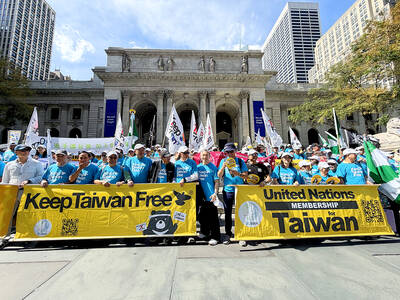
More than 100 Taiwanese-Americans, Taiwanese lawmakers and members of civic groups on Saturday marched through New York City to call for Taiwan’s participation in the UN, with Marshall Island Permanent Representative to the UN John Silk joining the event to show support. Participants chanted: “UN for Taiwan” and “Keep Taiwan Free” as they marched through central Manhattan, passing Times Square and Bryant Park before ending near the New York Public Library. The annual march brought together Taiwanese community groups from across the US East Coast. Silk expressed hope that Taiwan would one day be able to participate in UN meetings

Two aides at independent Legislator May Chin’s (高金素梅) office were ordered detained incommunicado yesterday in a broadening probe into alleged Chinese espionage by Chin’s former chief of staff, Chang Chun-chieh (張俊傑). The move to hold Lin I-chun (林怡君) and current chief of staff Chen Chih-huang (陳智葟) in custody came four days after Chang, indicted on corruption charges, cut off his electronic monitoring wristband and jumped bail. The High Prosecutors’ Office said that it believes Chang had developed a Chinese spy ring, which might have operated for more than a decade, with funding from China, and that Lin and Chen were suspected of


 RSS
RSS