


A tentative ceasefire in the Iran war yesterday staggered under the weight of Israel’s intense bombardment of Beirut, Tehran’s continued chokehold on the Strait of Hormuz and uncertainty over whether negotiators can find common ground on a range of other differences.
Hours after the ceasefire was announced — amid disagreement over whether it included a pause in fighting between Israel and Hezbollah — Israel pounded Beirut with airstrikes, resulting in the deadliest day in the country since the war began on Feb. 28.
Iran and the US — which both declared victory in the wake of the ceasefire announcement — appeared to try to pressure each other.
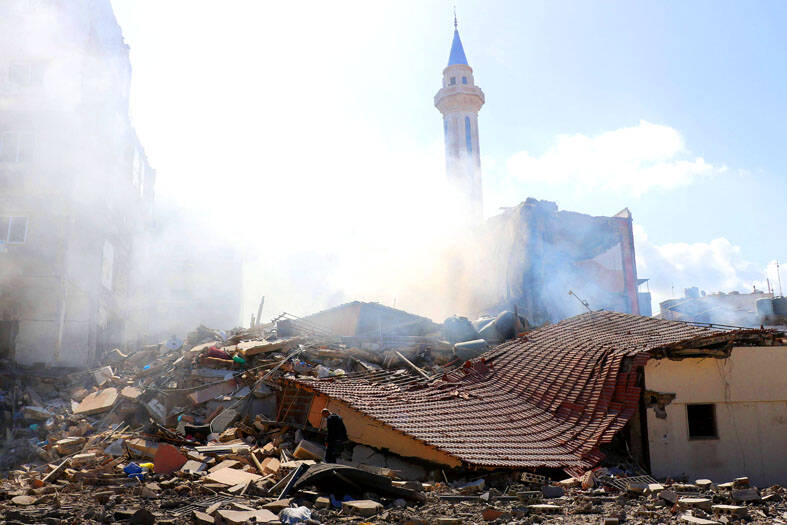
Photo: AFP
Semiofficial news agencies in Iran suggested forces have mined the Strait of Hormuz, a crucial waterway for the world’s oil, the closure of which has proved Tehran’s greatest strategic advantage in the conflict.
Meanwhile, US President Donald Trump warned that US forces would hit Iran even harder than before if it did not fulfill the agreement.
What that agreement is remains in deep dispute. Beyond whether Lebanon is included, there are questions over what will happen to Iran’s stockpile of enriched uranium, how and when normal traffic will resume through the strait and what happens to Iran’s ability to launch missile attacks. The US and Iran are due to meet in Pakistan for talks this weekend.
The Lebanese Ministry of Public Health said at least 203 people were killed and more than 1,000 wounded in widespread Israeli strikes in central Beirut and other areas of Lebanon on Wednesday, when Israel intensified its attacks on the Iran-backed Hezbollah militant group, which joined the war in support of Tehran.
The death toll was the highest for a single day in Lebanon during more than five weeks of renewed war between Israel and Hezbollah.
Iran said Israel was violating the ceasefire agreement, which it has said included a stop to the fighting in Lebanon. Israeli Prime Minister Benjamin Netanyahu and Trump have said it does not.
Iranian Speaker of the Parliament Mohammad Bagher Qalibaf wrote on X that continued Israeli attacks on Hezbollah in Lebanon would “carry explicit and STRONG responses.”
Netanyahu wrote in a social media post that Israel would continue striking Hezbollah “with force, precision and determination.”
Israel yesterday said it killed Ali Yusuf Harshi, an aide to Hezbollah Secretary-General Naim Kassem. Hezbollah did not immediately respond to a request for comment.
A New York-based think tank said that the ceasefire “hovers on the verge of collapse.”
“Even if Lebanon was formally outside the deal, the scale of Israel’s strikes was likely to be viewed as escalatory,” the Soufan Center wrote in an analysis. “Israel’s strikes can be understood both as an effort to drive a wedge between Iran and its proxies and as a response to being allegedly sidelined in the original ceasefire discussions.”
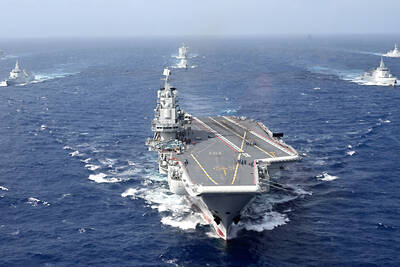
PROVOCATIVE: Chinese Deputy Ambassador to the UN Sun Lei accused Japan of sending military vessels to deliberately provoke tensions in the Taiwan Strait China denounced remarks by Japan and the EU about the South China Sea at a UN Security Council meeting on Monday, and accused Tokyo of provocative behavior in the Taiwan Strait and planning military expansion. Ayano Kunimitsu, a Japanese vice foreign minister, told the Council meeting on maritime security that Tokyo was seriously concerned about the situation in the East China and South China seas, and reiterated Japan’s opposition to any attempt to change the “status quo” by force, and obstruction of freedom of navigation and overflight. Stavros Lambrinidis, head of the EU delegation to the UN, also highlighted South China Sea
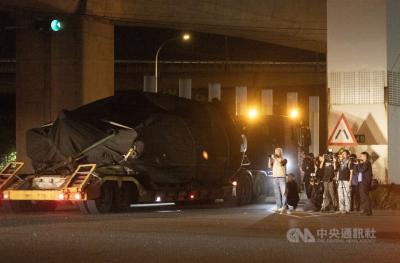
The final batch of 28 M1A2T Abrams tanks purchased from the US arrived at Taipei Port last night and were transported to the Armor Training Command in Hsinchu County’s Hukou Township (湖口), completing the military’s multi-year procurement of 108 of the tanks. Starting at 12:10am today, reporters observed more than a dozen civilian flatbed trailers departing from Taipei Port, each carrying an M1A2T tank covered with black waterproof tarps. Escorted by military vehicles, the convoy traveled via the West Coast Expressway to the Armor Training Command, with police implementing traffic control. The army operates about 1,000 tanks, including CM-11 Brave Tiger
Taiwan Semiconductor Manufacturing Co (TSMC, 台積電), the world’s largest contract chipmaker, said it expects its 2-nanometer (2nm) chip capacity to grow at a compound annual rate of 70 percent from this year to 2028. The projection comes as five fabs begin volume production of 2-nanometer chips this year — two in Hsinchu and three in Kaohsiung — TSMC senior vice president and deputy cochief operating officer Cliff Hou (侯永清) said at the company’s annual technology symposium in Silicon Valley, California, last week. Output in the first year of 2-nanometer production, which began in the fourth quarter of last year, is expected to

Taiwan’s drone exports surged past US$100 million in the first quarter, exceeding last year’s full-year total, with the Czech Republic emerging as the largest buyer, the Ministry of Economic Affairs said. Exports of complete drones reached US$115.85 million in the period, about 1.2 times the total recorded for all of last year, the ministry said in a report. Exports to the Czech Republic accounted for about US$100 million, far outpacing other markets. Poland, last year’s top destination, recorded about US$11.75 million in the first quarter. Taiwan’s drone exports have expanded rapidly in the past few years, with last year’s total


 RSS
RSS