


The Republican Study Committee (RSC) delegation recognizes that the security threats that Taiwan faces are real and firmly believes in the principle of “maintaining peace through strength,” US Representative Zachary Nunn said at a meeting with President William Lai (賴清德) at the Presidential Office in Taipei yesterday.
Taiwan’s democratic system is a deliberate choice that warrants sustained international support, said Nunn, chair of the RSC’s National Security Task Force and head of the delegation.
Nunn described the delegation’s visit as both symbolic and functional: reaffirming US backing while enabling lawmakers to better assess Taiwan’s evolving security challenges.
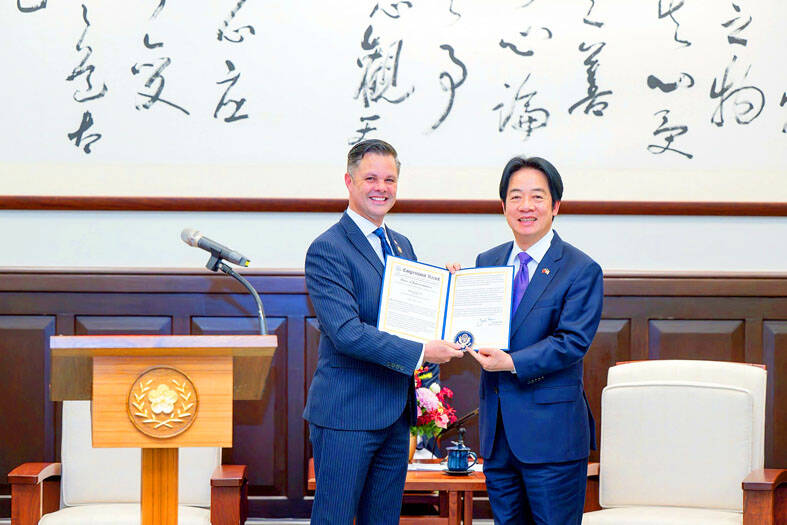
Photo courtesy of the Presidential Office
He reiterated that the “peace through strength” principle could be extended beyond military considerations to include economic policy.
Deepening trade and investment ties constitutes not only sound economic practice, but is also a strategic complement to security cooperation, he said.
Lai said that China’s intensified military exercises and “gray zone” operations around Taiwan have seriously undermined regional peace and stability.
He framed Taiwan’s response as a strategic lesson: deterrence depends on strength, and strength, in turn, is rooted in long-term resilience.
Safeguarding national security is a core government obligation, and concrete policy measures, such as increasing defense spending to as much as 5 percent of GDP by 2030, alongside a proposed eight-year, US$40 billion special act for strengthening economic, social and national security resilience (因應國際情勢強化經濟社會及民生國安韌性特別條例), highlight the government’s commitment to regional stability, Lai said.
On bilateral cooperation, Lai cited provisions in the US National Defense Authorization Act for Fiscal Year 2026 on US-Taiwan joint research and development, particularly in drone and counterdrone technologies, demonstrating how Taiwan-US relations are shifting toward more integrated defense cooperation, evolving beyond a traditional arms-sales framework.
In other news, US Senator Jim Banks, a Republican from Indiana, has arrived in Taiwan for a three-day visit, during which he is to engage in high-level meetings with Lai and other senior officials to discuss US-Taiwan relations, regional security, trade and investment, according to separate statements issued by the Ministry of Foreign Affairs and the American Institute in Taiwan.
The ongoing trip to Taiwan is his first visit to the Asia-Pacific region since assuming his Senate post early last year, the ministry added.
Additional reporting by CNA
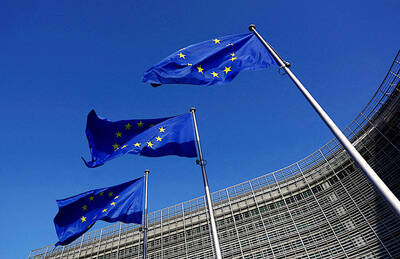
LEVERAGE: China did not ‘need to fire a shot’ to deny Taiwan airspace over Africa when it owns ‘half the continent’s debt,’ a US official said, calling it economic warfare The EU has raised concerns about overflight rights following the delay of President William Lai’s (賴清德) planned state visit to the Kingdom of Eswatini after three African nations denied overflight clearance for his charter at the last minute. Taiwanese allies Paraguay and Saint Kitts and Nevis, as well as several US lawmakers and the Inter-Parliamentary Alliance on China (IPAC) condemned China for allegedly pressuring the countries. Lai was scheduled to fly directly to Taiwan’s only African ally from yesterday to Sunday to celebrate the 40th anniversary of King Mswati III’s accession and his 58th birthday, but Seychelles, Mauritius and Madagascar suddenly revoked
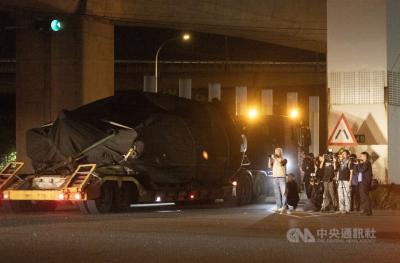
The final batch of 28 M1A2T Abrams tanks purchased from the US arrived at Taipei Port last night and were transported to the Armor Training Command in Hsinchu County’s Hukou Township (湖口), completing the military’s multi-year procurement of 108 of the tanks. Starting at 12:10am today, reporters observed more than a dozen civilian flatbed trailers departing from Taipei Port, each carrying an M1A2T tank covered with black waterproof tarps. Escorted by military vehicles, the convoy traveled via the West Coast Expressway to the Armor Training Command, with police implementing traffic control. The army operates about 1,000 tanks, including CM-11 Brave Tiger
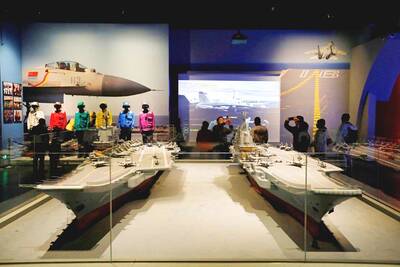
China on Wednesday teased in a video an aircraft carrier that could be its fourth, and the first using nuclear power, while making an allusion to Taiwan and vowing to further build up its islands, as it looks to boost maritime power, secure resources and bolster territorial claims. The video, issued on the eve of the 77th founding anniversary of the Chinese People’s Liberation Army Navy, featured fictional officers with names that are homophones of three commissioned aircraft carriers, the Liaoning (遼寧), Shandong (山東) and Fujian (福建). Titled Into the Deep, it showed a 19-year-old named “Hejian” (何劍) joining the group, sparking
BIG YEAR: The company said it would also release its A12 chip the same year to keep a ‘reliable stream of new silicon technologies’ flowing to its customers Taiwan Semiconductor Manufacturing Co (TSMC, 台積電) yesterday said its newest A13 chip is to enter volume production in 2029 as the chipmaker seeks to hold onto its tech leadership and demand for next-generation chips used in artificial intelligence (AI), high-performance-computing (HPC) and mobile applications. TSMC, the world’s biggest contract chipmaker, also unveiled its A12 chip at its annual technology symposium in Santa Clara, California. The A12 chip, which features TSMC’s super-power-rail technology to provide backside power delivery for AI and HPC applications, is also to enter volume production in 2029, a year after the scheduled release of the A14 chip. The technology moves


 RSS
RSS