


Seoul’s expression of regret over a January drone incursion into Pyongyang is “wise behavior,” the powerful sister of North Korean leader Kim Jong-un said.
Earlier in the day South Korean President Lee Jae-myung expressed regret to Pyongyang over drones sent into the nuclear-armed North earlier this year, actions he called “irresponsible.”
“The ROK president personally expressed regret and talked about a measure for preventing recurrence. Our government appreciated it as very fortunate and wise behavior for its own sake,” Kim Yo-jong said in a statement carried by the Korean Central News Agency, using the official name of South Korea.
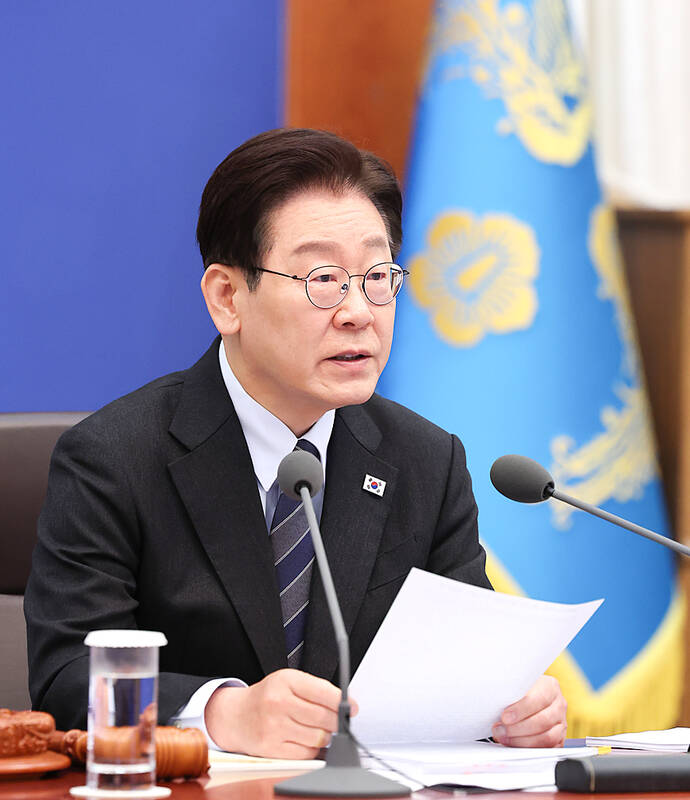
Photo: EPA
Seoul initially denied any official role in the January drone incursion — with authorities suggesting it was the work of civilians — but Lee said a probe had revealed government officials had been involved.
The North warned in February of a “terrible response” if it detects more drones crossing the border from the South, prompting Seoul to investigate the claims.
Pyongyang said it downed a drone carrying “surveillance equipment” in early January. Photographs released by state media showed the wreckage of a winged craft scattered across the ground alongside gray and blue components that allegedly included cameras.
“It has been confirmed that a National Intelligence Service official and an active-duty soldier were involved,” Lee told a Cabinet meeting, adding: “We express regret to the North over the unnecessary military tensions caused by the irresponsible and reckless actions of some individuals.”
He added that South Korea’s constitution bans private individuals from conducting acts that could “provoke the North”.
“Such actions, even when deemed necessary for national strategy, must be approached with extreme caution,” he said.
Kim Yo-jong said her brother had taken Lee’s remark “as a manifestation of a frank and broad-minded man’s attitude,” but warned Seoul to “stop any reckless provocation against the DPRK and refrain from any attempt at contact,” using the initials of the North’s official name.
In other news, South Korean lawmakers yesterday said that North Korea’s test of a solid-fuel rocket engine was intended for intercontinental ballistic missiles (ICBM) built with carbon fiber to extend range and allow for delivery of heavier and possibly multiple warheads.
Last month, Pyongyang conducted a ground test of a solid-fuel rocket engine that analysts believe is being developed for its latest ICBM.
The new engine likely has greater thrust than the previous model it tested in 2024, which was already assessed as capable of striking anywhere in the mainland US, they said.
North Korea has conducted all its longer-range missile launches at a lofted trajectory to splash down the projectiles in the ocean off its east coast or to the east of Japan to test them without flying them for a distance they are designed for.
North Korean media showed the airframe of the missile at the new engine test that was built with carbon fiber, which is lightweight while strong, allowing the projectile to carry multiple warheads, South Korean lawmaker Park Sun-won said.
Park was speaking to reporters following a closed-door briefing by the South Korean National Intelligence Service.
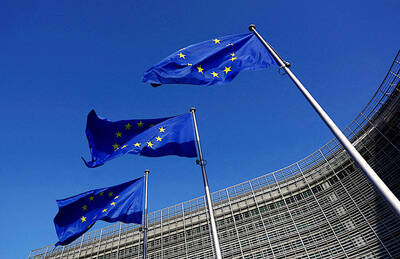
LEVERAGE: China did not ‘need to fire a shot’ to deny Taiwan airspace over Africa when it owns ‘half the continent’s debt,’ a US official said, calling it economic warfare The EU has raised concerns about overflight rights following the delay of President William Lai’s (賴清德) planned state visit to the Kingdom of Eswatini after three African nations denied overflight clearance for his charter at the last minute. Taiwanese allies Paraguay and Saint Kitts and Nevis, as well as several US lawmakers and the Inter-Parliamentary Alliance on China (IPAC) condemned China for allegedly pressuring the countries. Lai was scheduled to fly directly to Taiwan’s only African ally from yesterday to Sunday to celebrate the 40th anniversary of King Mswati III’s accession and his 58th birthday, but Seychelles, Mauritius and Madagascar suddenly revoked
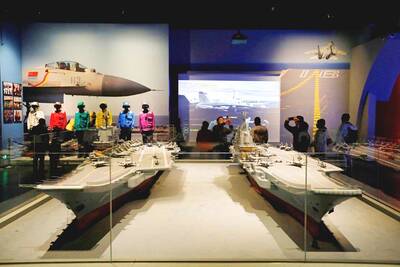
China on Wednesday teased in a video an aircraft carrier that could be its fourth, and the first using nuclear power, while making an allusion to Taiwan and vowing to further build up its islands, as it looks to boost maritime power, secure resources and bolster territorial claims. The video, issued on the eve of the 77th founding anniversary of the Chinese People’s Liberation Army Navy, featured fictional officers with names that are homophones of three commissioned aircraft carriers, the Liaoning (遼寧), Shandong (山東) and Fujian (福建). Titled Into the Deep, it showed a 19-year-old named “Hejian” (何劍) joining the group, sparking

BIG YEAR: The company said it would also release its A12 chip the same year to keep a ‘reliable stream of new silicon technologies’ flowing to its customers Taiwan Semiconductor Manufacturing Co (TSMC, 台積電) yesterday said its newest A13 chip is to enter volume production in 2029 as the chipmaker seeks to hold onto its tech leadership and demand for next-generation chips used in artificial intelligence (AI), high-performance-computing (HPC) and mobile applications. TSMC, the world’s biggest contract chipmaker, also unveiled its A12 chip at its annual technology symposium in Santa Clara, California. The A12 chip, which features TSMC’s super-power-rail technology to provide backside power delivery for AI and HPC applications, is also to enter volume production in 2029, a year after the scheduled release of the A14 chip. The technology moves
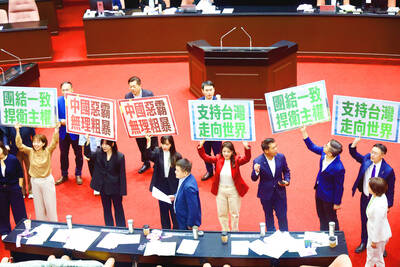
ESWATINI TRIP: The ‘irresponsible actions’ of three African nations set a dangerous precedent and they should be held accountable, a US representative said The US Senate Foreign Relations Committee on Thursday urged Washington not to normalize Chinese pressure, while a US lawmaker called on the US government to hold countries accountable for yielding to Beijing’s pressure to block President William Lai’s (賴清德) planned trip to Eswatini. Lai had been scheduled to visit Eswatini to attend birthday events for King Mswati III of Eswatini this week, but on Tuesday, the eve of his planned departure on Wednesday, the Presidential Office said the trip was “suspended” after the Seychelles, Mauritius and Madagascar unexpectedly withdrew overflight permission. “China reportedly pressured Mauritius, Seychelles, and Madagascar to deny airspace access


 RSS
RSS