


A few weeks ago, I was invited by several churches in and around Oxford to participate in a full-day meeting they had organized to welcome Hong Kong emigres and their families to the area. Nearly all attendees were beneficiaries of the visa scheme introduced by the UK in 2021, which enables Hong Kongers seeking refuge from escalating repression to relocate to the UK and offers them a path to British citizenship. Many had already settled down and were contributing to their new communities.
Many of these expatriates’ professional qualifications stand to make them highly valued members of British society. Many also demonstrated extraordinary entrepreneurial skills and fierce ambition.
One student observed that many of the top spots at their school were now held by new students from Hong Kong. It appears that Hong Kong’s brain drain is Britain’s brain gain.
It is unlikely that anyone in the Hong Kong Government understands why this outflow is occurring, but it is the inevitable outcome of the Chinese Communist Party’s (CCP) effort to control Hong Kong without the input of its residents.
Naturally, those I spoke with were sad that they had been driven into exile by the establishment of a police state. Hong Kong was a remarkable and widely admired global territory — beautiful, prosperous and inclusive. It had outstanding public services, a police force that garnered broad public support, a vibrant civil society and young people whose love for democratic values far surpassed any conceivable regard for Chinese communism.
Young people’s desire to live in a free and diverse society underscores the contrast between Chinese cultural values and the CCP’s oppressive regime. China’s leaders have consistently failed to acknowledge this reality, revealing the regime’s inability to reform itself, let alone establish an appealing sociopolitical model.
During the gathering at Oxford, when I asked people why they had left Hong Kong, they pointed to their children. Departing had been a painful experience for many, but they were determined not to allow their children to grow up in a society that neither understood the meaning of freedom, nor recognized its citizens’ right to learn about their own history and stay informed about global events.
This illustrates China’s ongoing failure to understand Hong Kong.
While rewriting the school textbooks of the children whose ambitions they were stifling, CCP officials adamantly refused to acknowledge that Hong Kong had ever been a British colony. In their view, it had merely been an occupied territory, but they were reluctant to specify who had occupied it.
The vast majority of Hong Kongers are either refugees or the descendants of refugees from communist China. They fled the horrors of the Cultural Revolution, Mao Zedong’s (毛澤東) Great Famine that claimed the lives of 20 million to 40 million people and forced some to resort to cannibalism, and the economically disastrous “Great Leap Forward.”
While there are valid questions about the UK’s historic relationship with Hong Kong, many Hong Kongers sought refuge from Chinese communism in the colony.
The most recent exodus was triggered by the Chinese government’s comprehensive and vengeful crackdown on the territory’s democratic freedoms and rule of law. Over the past three years, Hong Kong’s puppet government has eagerly enforced Beijing’s oppressive measures.
In yet another violation of the Joint Declaration between China and the UK, which was intended to ensure that Hong Kong’s autonomy and way of life would be safeguarded until 2047, Hong Kong Chief Executive John Lee’s (李家超) puppet administration has enacted its own repressive national security legislation. The new law, known as Article 23, came into force on March 23 after being pushed through the rubber-stamp Legislative Council, along with a series of other oppressive measures. Ostensibly, it aims to curb treasonous or seditious activities. In reality, the law’s goal is to suppress any remaining democratic activism in the territory, and sever all contact between freedom advocates and the outside world.
The legislation also takes aim at so-called “soft resistance,” although the precise meaning of this term remains unclear. Some of the offenses are so vaguely defined that they allow the authorities to detain virtually anyone they want on fabricated or absurd charges. For example, one could be arrested for keeping an old copy of the pro-democracy newspaper Apple Daily, which was forced to shut down in 2021, and showing it to a friend in their own home. There is even uncertainty about whether Catholics could be prosecuted for things they reveal during confession.
The introduction of Hong Kong’s new national security legislation has been roundly condemned by the UK, the EU and the US. In Washington, there is growing pressure to update the US Department of State’s travel advisories to alert individuals and companies about the potential risks of visiting Hong Kong or doing business there. The economic consequences of such a move are clear — more people would leave, and fewer companies would consider establishing operations in the territory.
None of this should come as a surprise. This latest crackdown illustrates the CCP’s idea of the rule of law, which American China academic Perry Link called the “anaconda in the chandelier” — citizens do not know when or how the state will crack down on them; they just know that it will.
The CCP’s anaconda has now been exported to Hong Kong, but if the economies of China and Hong Kong start to falter (as seems to be the case today), perhaps people will realize that they must throttle the snake before it chokes the life out of them.
Chris Patten, the last British governor of Hong Kong and a former EU commissioner for external affairs, is chancellor of the University of Oxford.
Copyright: Project Syndicate
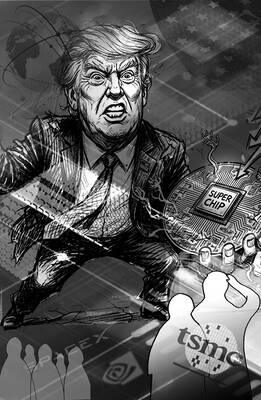
The White House’s decision to take a 9.9 percent stake in Intel Corp is looking like very shrewd business indeed. Since the government bought in at US$20.47 a share last August, the US chipmaker’s surging stock price has delivered the US a US$43 billion return. One of the reasons the investment has so far proved so sound is that the White House has made sure of it. According to The Wall Street Journal, Howard personally pushed deals on Intel’s behalf with some of the most lucrative clients imaginable. They include Nvidia Corp, the company at the heart of the AI
The Ministry of the Interior, working with the navy and coast guard, is organizing Taiwan’s first joint exercise simulating escort tankers carrying liquefied natural gas (LNG) and oil through a Chinese blockade. The drills simulate fuel transport along three maritime corridors leading toward Japan, the Philippines and the US. Deputy Minister of the Interior Sawyer Mars (馬士元) said that a blockade of the Taiwan Strait would amount to “almost a 100 percent blockade of the regional energy supply.” Minister of National Defense Wellington Koo said planning to counter a blockade is standard practice in Taipei. While the exercise is limited in
A single photograph can cut through a lot of noise, but it can also be used to misrepresent the truth. At the very least, it can concentrate the mind on something that requires further investigation. On Monday last week, Ma Ying-jeou Foundation CEO Tai Hsia-ling (戴遐齡) and former National Security Council secretary-general King Pu-tsung (金溥聰) held a news conference in which they showed a photograph of former foundation CEO Hsiao Hsu-tsen (蕭旭岑), now Chinese Nationalist Party (KMT) deputy chairman. In the image Hsiao is seated next to Xiamen Taiwan Businessmen Association chairman Han Ying-huan (韓螢煥). The two men were holding
I first met Professor Ray Jiing (井迎瑞) as a film and documentary student at Shih Hsin University’s (SHU) Department of Radio Television and Film in 1988. The following year, he went on to become the director of the Chinese Taipei Film Archive — forerunner of the Taiwan Film and Audiovisual Institute (TFAI). Over his eight-year tenure, Jiing rescued and restored over 200 classic Taiwanese films. In 1997, he established the Graduate Institute of Studies in Documentary and Film Archiving at Tainan National University of the Arts (TNNUA), and I joined the program in his third cohort of students. Beyond a


 RSS
RSS