


Four astronauts on Wednesday blasted off aboard a massive NASA rocket on a journey around the moon, the first crewed lunar flyby in more than 50 years.
With a thunderous roar, the enormous orange-and-white rocket carried three Americans and one Canadian away from Florida’s Kennedy Space Center at about 6:35pm.
NASA teams and spectators alike were ecstatic as the spacecraft ascended into a radiant sky atop a cascade of flames.
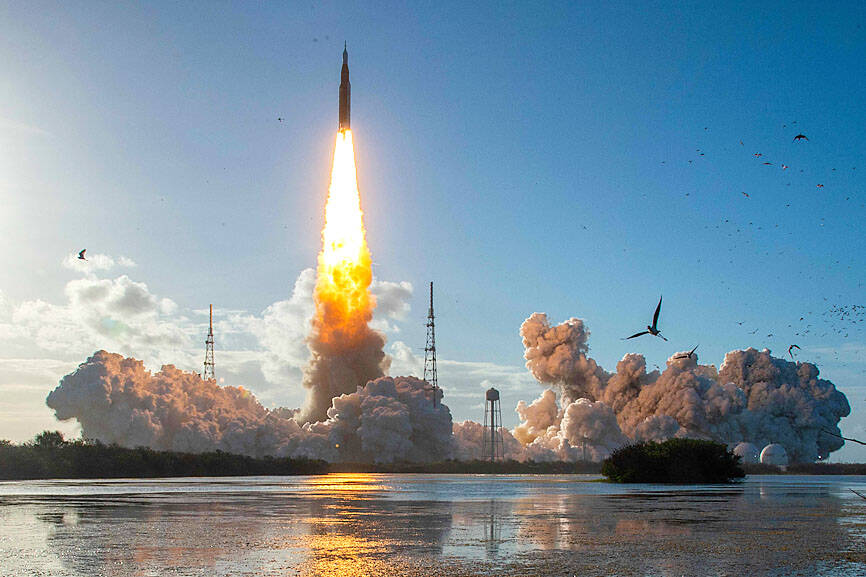
Photo: AFP
The team, who donned bright orange suits with blue trim as the mission began, is: Americans Reid Wiseman, Victor Glover and Christina Koch, along with Canadian Jeremy Hansen.
“We have a beautiful moonrise. We’re headed right at it,” said Wiseman, the mission commander.
US President Donald Trump praised “our brave astronauts,” calling the successful launch “quite something” at the top of a televised address.
The astronauts entered orbit around the Earth, where they were to perform checks to ensure the reliability and safety of the spacecraft, which has never carried humans before.
They successfully completed “proximity operations” demonstrations, which tested how their Orion capsule can move relative to another spacecraft and included maneuvers that mimic what would be needed to dock with a lunar lander.
“Great flying with you, Houston. Nice vehicle,” said Glover, the pilot.
Early on teams identified a number of kinks to work out, including “a controller issue with the toilet when they spun it up,” said Amit Kshatriya, NASA’s associate administrator, during a post-launch briefing.
“We’re just getting started,” Kshatriya added.
The astronauts were “safe, they’re secure and they’re in great spirits,” NASA Administrator Jared Isaacman said. “NASA is back in the business of sending people to the moon.”

A signaling system malfunction disrupted high-speed rail (HSR) services beginning at 8am today, with trains temporarily reduced to three northbound and three southbound trains per hour as authorities conduct inspections. The malfunction occurred on a section of track in Miaoli County during pre-operation checks early this morning, forcing northbound and southbound trains to use a single track, the HSR operator said. The regular schedule has been replaced with three hourly trains offering only nonreserved seating in each direction, stopping at every station, it said, adding that business class cars would still have reserved seating. Departures from terminal stations are scheduled at the top

Taiwan is still in the process of assessing the possibility of recruiting workers from Eswatini, the Ministry of Foreign Affairs said yesterday, adding that its goal is to help Eswatini upgrade its vocational training centers. If there are plans to recruit workers from Eswatini, safeguarding national security, protecting public health and ensuring the employment rights of Taiwanese would be prerequisites, Department of West Asian and African Affairs Director-General Yen Chia-liang (顏嘉良) told a news conference. Key considerations would also include filling labor shortages in specific industries, and fostering bilateral professional and technical exchanges, he said. Yen was asked about the progress of labor

A US uncrewed surface vessel (USV) encountered multiple Chinese warships during an autonomous transit of the Taiwan Strait, US defense company Seasats said in a statement on Wednesday. Seasats announced that a Lightfish USV had completed the first autonomous transit of the Taiwan Strait. Over five days, the USV traversed the entire length of the Strait while constantly monitoring surface vessel traffic, the company said. The Lightfish encountered multiple Chinese warships, one of which was a Chinese People’s Liberation Army Navy (PLAN) Type 056 corvette, it said. The Chinese vessels were operating “well within Taiwan’s exclusive economic zone without transmitting their identity via the

VERBOSE VESSELS: A CGA cutter and a China Coast Guard exchanged verbal barbs for more than a day in Taiwanese-controlled waters before the Chinese vessel left The Taiwanese and Chinese coast guards had a standoff near the strategically located Pratas Islands (Dongsha Islands, 東沙群島) in the north of the South China Sea, the Coast Guard Administration (CGA) said yesterday. The two sides engaged in intense radio exchanges over sovereignty claims during the 33-hour standoff. China Coast Guard vessel 3501 eventually left the restricted waters, 26.6 nautical miles (49.2km) west of the Pratas Islands, at 5pm yesterday, the CGA said. Lying approximately between southern Taiwan and Hong Kong, the Taiwan-controlled Pratas are seen by some security experts as vulnerable to Chinese attack due to their distance — more than


 RSS
RSS