


Japanese Prime Minister Sanae Takaichi and French President Emmanuel Macron on Wednesday issued a joint statement emphasizing the importance of peace and stability in the Taiwan Strait, and called for the peaceful resolution of cross-strait issues.
According to Japan’s Nikkei Shimbun, the two leaders exchanged views on China, North Korea and the Indo-Pacific region.
In November last year, Takaichi said an attack on Taiwan could prompt the deployment of Japan’s Self-Defense Forces if the situation posed an existential threat to Japan.
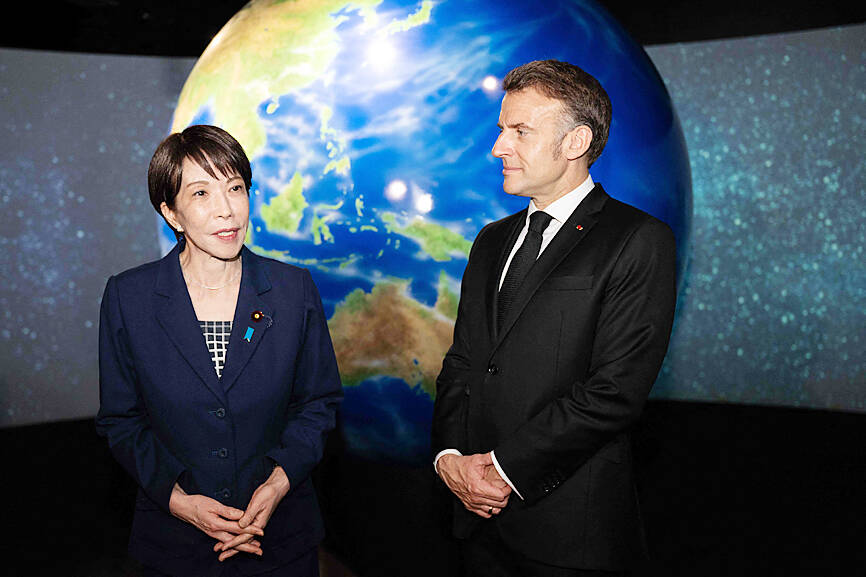
Photo: AFP
Beijing interpreted the remarks as suggesting Japan might intervene militarily in the Taiwan Strait, contributing to the deterioration of ties between Tokyo and Beijing.
The Yomiuri Shimbun reported that Takaichi and Macron also discussed the Middle East, agreeing on the importance of ensuring safe maritime passage through the Strait of Hormuz and maintaining stability in oil markets.
Both sides agreed to remain in close contact to help facilitate a resolution to tensions in the region, the report said.
“The security of Europe, the Atlantic and the Indo-Pacific are closely linked, and the Middle East is an urgent issue shared by Japan and France,” Takaichi said at the start of the meeting.
Macron said the two countries share core values, including support for a rules-based international order grounded in multilateral cooperation.
The visit marked Macron’s second trip to Japan since the G7 summit in Hiroshima in May 2023.
The joint statement also emphasized the need to bolster supply chains for critical minerals.
While it did not mention China by name, the statement expressed concern about some countries tightening restrictions on exports of key materials.
It said a roadmap would be developed to enhance economic security, including joint initiatives to ensure stable supplies of resources such as rare earths.
The two sides also agreed to cooperate on nuclear energy, including next-generation reactor technologies.

A signaling system malfunction disrupted high-speed rail (HSR) services beginning at 8am today, with trains temporarily reduced to three northbound and three southbound trains per hour as authorities conduct inspections. The malfunction occurred on a section of track in Miaoli County during pre-operation checks early this morning, forcing northbound and southbound trains to use a single track, the HSR operator said. The regular schedule has been replaced with three hourly trains offering only nonreserved seating in each direction, stopping at every station, it said, adding that business class cars would still have reserved seating. Departures from terminal stations are scheduled at the top

Taiwan is still in the process of assessing the possibility of recruiting workers from Eswatini, the Ministry of Foreign Affairs said yesterday, adding that its goal is to help Eswatini upgrade its vocational training centers. If there are plans to recruit workers from Eswatini, safeguarding national security, protecting public health and ensuring the employment rights of Taiwanese would be prerequisites, Department of West Asian and African Affairs Director-General Yen Chia-liang (顏嘉良) told a news conference. Key considerations would also include filling labor shortages in specific industries, and fostering bilateral professional and technical exchanges, he said. Yen was asked about the progress of labor

A US uncrewed surface vessel (USV) encountered multiple Chinese warships during an autonomous transit of the Taiwan Strait, US defense company Seasats said in a statement on Wednesday. Seasats announced that a Lightfish USV had completed the first autonomous transit of the Taiwan Strait. Over five days, the USV traversed the entire length of the Strait while constantly monitoring surface vessel traffic, the company said. The Lightfish encountered multiple Chinese warships, one of which was a Chinese People’s Liberation Army Navy (PLAN) Type 056 corvette, it said. The Chinese vessels were operating “well within Taiwan’s exclusive economic zone without transmitting their identity via the

VERBOSE VESSELS: A CGA cutter and a China Coast Guard exchanged verbal barbs for more than a day in Taiwanese-controlled waters before the Chinese vessel left The Taiwanese and Chinese coast guards had a standoff near the strategically located Pratas Islands (Dongsha Islands, 東沙群島) in the north of the South China Sea, the Coast Guard Administration (CGA) said yesterday. The two sides engaged in intense radio exchanges over sovereignty claims during the 33-hour standoff. China Coast Guard vessel 3501 eventually left the restricted waters, 26.6 nautical miles (49.2km) west of the Pratas Islands, at 5pm yesterday, the CGA said. Lying approximately between southern Taiwan and Hong Kong, the Taiwan-controlled Pratas are seen by some security experts as vulnerable to Chinese attack due to their distance — more than


 RSS
RSS