


Ticket prices for public transportation would remain unchanged for now, despite rising fuel prices, the Executive Yuan said yesterday, as the government seeks to stabilize consumer prices.
The Ministry of Transportation and Communications would ensure that the high-speed railway, Taiwan Railway Corp (台鐵), MRT and public bus services would not increase their fares, Vice Premier Cheng Li-chun (鄭麗君) told a news conference after a weekly Cabinet meeting.
The adjustment of domestic flight fares would be postponed as well, Cheng said.
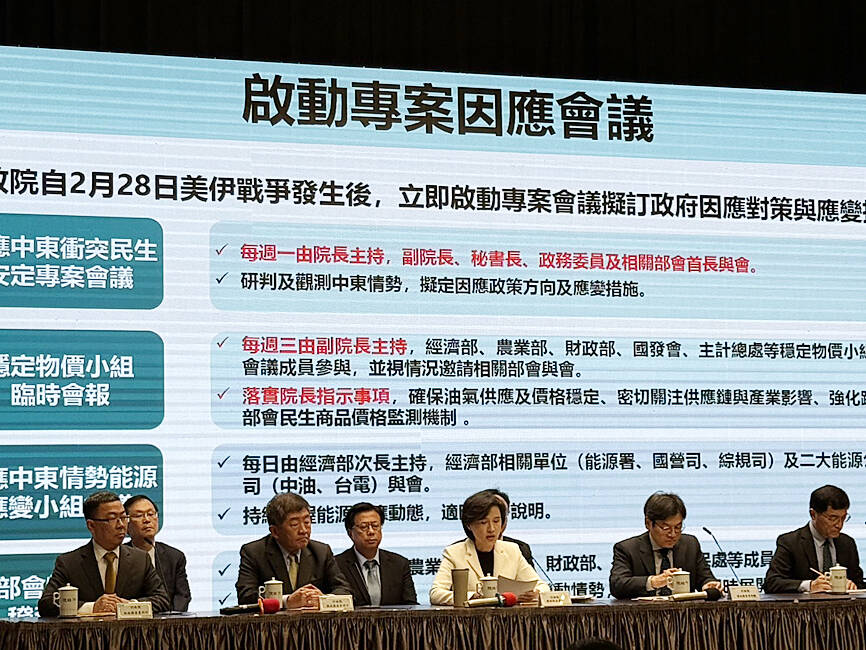
Photo: Chung Li-hua, Taipei Times
Premier Cho Jung-tai (卓榮泰) has been presiding over a meeting every Monday on livelihood stability measures since the US and Israel launched a war on Iran, with Cabinet officials at the meetings providing updates on developments in the war and proposing response measures.
Cheng on Wednesdays convenes an ad hoc task force to monitor consumer prices, the Ministry of Economic Affairs holds daily meetings to respond to changes in fuel prices and the Ministry of Justice frequently holds interagency joint price inspection task force meetings.
CPC Corp, Taiwan (台灣中油) on Fridays briefs Cho on the latest oil prices before announcing any changes to prices in Taiwan to the public on Saturdays.
Cheng said that the government’s response measures are in seven categories.
First, the government would protect the safety of Taiwanese at home and overseas, she said, adding that as of yesterday, 5,289 Taiwanese had returned home from the Middle East since the war began.
Second, the government has kept oil and liquified natural gas (LNG) inventory levels above regulatory standards, she said.
“Natural gas shipments for this month and next month have been fully scheduled,” Cheng said. “For LNG supply in June, 15 shipments are required, of which 10 have been procured.”
For July and August, sources of LNG outside the Middle East would be increased, she said.
Third, to stabilize consumer prices, the government has been monitoring prices of food items from 38 brands, including Taiwanese omelets, hamburgers, fried chicken, potstickers, beef noodle soup, boxed lunches with chicken drumsticks, boxed lunches with pork chops, braised pork with rice, hot pot with pork, chicken soup, ramen with pork bone soup, Americano coffee, black tea, stinky tofu and buffets, she said.
Three food brands have raised their prices since the war began, she added.
Fourth, the government would implement four mechanisms to ensure supply chain stability: increasing production at petrochemical factories; prioritizing supply to domestic manufacturers; pursuing increased production and allocation among midstream and downstream firms; and strictly cracking down on hoarding and price gouging, Cheng said.
“We would also ensure smooth imports of light oil and increased production of ethylene from CPC Corp, Taiwan to maintain plastic supplies,” she said.
The state-run petrochemical firm is to ramp up ethylene production to 79,000 tonnes this month and 90,000 tonnes next month, she said.
Fifth, aside from the Joint Price Inspection Task Force, the Taiwan High Prosecutors’ Office has also launched a platform to investigate livelihood-related crimes, she said, adding that the Fair Trade Commission is investigating pricing and supplies of plastic bags.
Sixth, the government is monitoring how the war is affecting stock and foreign exchange markets, Cheng said.
“Taiwan’s stock market decline is moderate compared with major Asian countries, with the fundamentals remaining sound,” she said.
Seventh, officials at the central and local governments are coordinating on industrial supply chain adjustments and monitoring price fluctuations, with Executive Yuan Secretary-General Xavier Chang (張惇涵) serving as liaison, Cheng said.

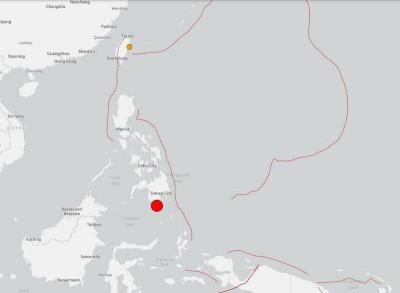
A magnitude 7.8 earthquake struck off the southern coast of Mindanao in the Philippines at 7:38am today, prompting the US Tsunami Warning System to issue an alert for neighboring countries, including Taiwan. The system issued a purple alert indicating a "tsunami threat." The potential threat zone includes Taiwan, the Philippines, Papua New Guinea, Yap and Palau. There were no immediate reports of major damage in the Philippines or Indonesia. The quake struck at a depth of 10km, said the German Research Centre for Geosciences, which had earlier pegged the earthquake at magnitude 8.2. Phivolcs, the Philippine agency, said the quake was magnitude 7 and

RESILIENCE: Taiwan plays a key role in semiconductors, energy, information infrastructure and advanced manufacturing, AIT Director Raymond Greene said Taiwan’s continued investment in deterrence and resilience remains vital, especially in uncrewed systems and other emerging technologies, American Institute in Taiwan (AIT) Director Raymond Greene said yesterday. Greene made the remarks at the annual National Strategic Summit on Supply Chain Resilience held by the Research Institute for Democracy, Society and Emerging Technology (DSET), a government-backed think tank. As Taiwan last year became the US’ fourth-largest trading partner and supply chain security is becoming more important, cooperation in emerging technologies continues to deepen between the two countries, he said. The US is committed to accelerating innovation, building key infrastructure, strengthening cooperation

The National Chungshan Institute of Science and Technology yesterday showcased its locally developed variants of the Vision 60 robotic patrol dog, which it plans to deploy on the nation’s outlying territories in the South China Sea. The variants were produced under the Joint Lab project — created by the institute and domestic companies — and assembled with domestically produced motors, lenses and artificial intelligence (AI) systems alongside licensed tech from the US, Missile and Rocket Systems Research Division deputy director Jen Kuo-kang (任國光) told the media event at a military base in Taipei’s Dazhi (大直) area. Taiwan has built up its strengths

RIGHT DIRECTION: Taiwan’s efforts to prevent forced labor include a proposal to ‘fully prohibit’ employers from withholding workers’ documents, an official said Taiwan is to establish a mechanism to restrict imports of goods linked to forced labor, the Executive Yuan said yesterday, after the US proposed imposing additional tariffs on Taiwanese goods over labor concerns. “The Ministry of Labor and the Ministry of Economic Affairs are to establish an interministerial review procedure,” Executive Yuan spokesperson Michelle Lee (李慧芝) said at a news briefing in Taipei. “The government is to use the Foreign Trade Act [貿易法] as the legal basis to restrict imports of goods produced with forced labor” and bring its supply chain governance more in line with international standards on human rights, resilience


 RSS
RSS