


A bipartisan delegation from the US Senate yesterday reiterated the importance of passing a sufficient defense budget, as Taiwan requires robust asymmetric rather than baseline capabilities to deter aggression.
The visiting group included US Senate Committee on Foreign Relations members Jeanne Shaheen and John Curtis, Senate Taiwan Caucus cochair Thom Tillis and Senate Committee on Armed Services senior member Jacky Rosen.
After meeting with President William Lai (賴清德), Vice President Hsiao Bi-khim (蕭美琴) and government officials, and visiting the Chungshan Institute of Science and Technology on Monday, the delegation yesterday visited private-sector companies and non-governmental organizations, before making a brief stop at Taipei Guest House for a news conference, followed by a visit to the legislature.

Photo: Liu Hsin-de, Taipei Times
At the news conference, Shaheen said their visit to Taiwan had been “very productive,” and she believes the US-Taiwan partnership is more important than ever, as the stability of the Indo-Pacific region and the global economy depends on it.
“Taiwan must continue to take bold steps to build its defensive capabilities,” she said. “It’s crucial that all parties in Taiwan come together to approve robust supplementary defense spending, a package that enables not only purchases of critical American equipment, but also asymmetric capabilities that are produced right here in Taiwan.”
Strengthening deterrence in the Taiwan Strait requires capabilities that are fit for modern warfare, which is a mix of US systems and Taiwan’s own systems, she said.
Taiwan has developed into an innovation hub focused on drones and missile defense, but needs additional resources, she added.
“The bipartisan support that underpins US-Taiwan relations is rock solid,” Shaheen said, adding that it has spanned decades and transcended political changes in Washington, so she is confident that it would continue for decades to come.
Sharing his personal observation of having lived in Taiwan as a young man in 1979 under Martial Law to seeing Taiwan’s vast prosperity and flourishing democracy today, Curtis said the US-Taiwan relationship has changed dramatically to that of “two partners.”
He said he strongly feels that Taiwan should pass the special defense budget, as it sends the message of Taiwan “carrying their weight” and “picking up their end of the stick.”
Tillis said Taiwan is “an extraordinary example of how democracy and free markets can free a people and create such an innovative society,” and has become a major influence in global economics and trade.
“It’s vitally important to make sure that you protect this precious gift that you’ve been given, the wonderful results that come from this generation and the generation before you,” he said.
He said Russia’s illegal war in Ukraine has shown that Ukraine defended its territory well, not only through a constellation of conventional kinetic capabilities, but also through the “asymmetrical capabilities that they have developed and become extraordinary at in terms of manufacturing and deploying on the battlefield.”
“Taiwan has already determined and developed capabilities that — if they have the funding at scale — can create a dimension on the battlefield and uncertainty that really even goes beyond some of the conventional weapons,” he said.
Tillis said Taiwan should not make the mistake of underfunding baseline capabilities, as that could be identified by an adversary as a vulnerability: That Taiwan cannot create the level of uncertainty that comes through asymmetrical capabilities.
Rosen said she was “consistently impressed by the resilience, the determination and the innovation of the Taiwanese people” during her first trip to Taiwan.
“Around the world, we’ve learned that deterrence — grounded in credible, responsible defense investments — helps us preserve stability,” Rosen said.
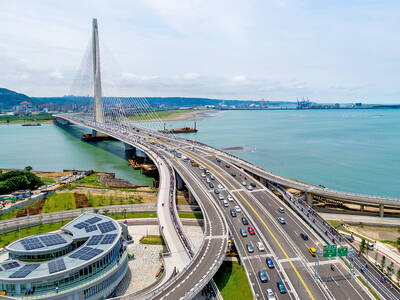
The Ministry of Transportation and Communications yesterday inaugurated the Danjiang Bridge across the Tamsui River in New Taipei City, saying that the structure would be an architectural icon and traffic artery for Taiwan. Feted as a major engineering achievement, the Danjiang Bridge is 920m long, 211m tall at the top of its pylon, and is the longest single-pylon asymmetric cable-stayed bridge in the world, the government’s Web site for the structure said. It was designed by late Iraqi-British architect Zaha Hadid. The structure, with a maximum deck of 70m, accommodates road and light rail traffic, and affords a 200m navigation channel for boats,
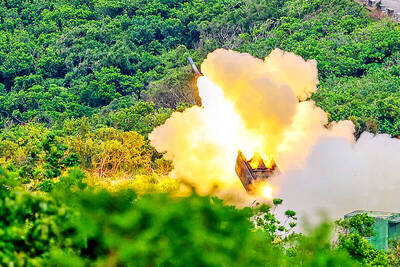
PRECISION STRIKES: The most significant reason to deploy HIMARS to outlying islands is to establish a ‘dead zone’ that the PLA would not dare enter, a source said A High Mobility Artillery Rocket System (HIMARS) would be deployed to Penghu County and Dongyin Island (東引) in Lienchiang County (Matsu) to force the Chinese military to retreat at least 100km from the coastline, a military source said yesterday. Taiwan has been procuring HIMARS and Army Tactical Missile Systems (ATACMS) from the US in batches. Once all batches have been delivered, Taiwan would possess 111 HIMARS units and 504 ATACMS, which have a range of 300km. Considering that “offense is the best defense,” the military plans to forward-deploy the systems to outlying islands such as Penghu and Dongyin so that

WHAT WAS ALL THAT FOR? Jaw Shaw-kong said that Cheng Li-wen had pushed for more drastic cuts and attacked him, just for the outcome to be nearly identical to his bill The legislature yesterday passed a supplementary budget bill to fund the purchase of separate packages of US military equipment, with the combined amount of spending capped at NT$780 billion (US$24.8 billion). The Chinese Nationalist Party (KMT) and Taiwan People’s Party (TPP) used their legislative majority to pass the bill, which runs until 2033 and has two main funding provisions. One was for NT$300 billion of arms sales already approved by the US for Taiwan on Dec. 17 last year, the other was for NT$480 billion for another arms package expected to be announced by Washington. The bill, which fell short of the NT$1.25

‘CLEAR MESSAGE’: The bill would set up an interagency ‘tiger team’ to review sanctions tools and other economic options to help deter any Chinese aggression toward Taiwan US Representative Young Kim has introduced a bill to deter Chinese aggression against Taiwan, calling for an interagency “tiger team” to preplan coordinated sanctions and economic measures in response to possible Chinese military or political action against Taiwan. “[Chinese President] Xi Jinping [習近平] has directed the People’s Liberation Army to be ready to invade Taiwan by 2027. China has a plan. America should have one too,” Kim said in a news release on Thursday last week. She introduced the “Deter PRC [People’s Republic of China] aggression against Taiwan act” to “ensure the US has a coordinated sanctions strategy ready should


 RSS
RSS