


Iran’s parliament speaker yesterday accused the US of plotting a ground attack despite talking about diplomacy, after a US warship with about 3,500 military personnel arrived in the Middle East.
Iranian Parliamentary Speaker Mohammad Bagher Ghalibaf’s comments come after more than a month of aerial bombardment of Iran by US and Israeli forces and ahead of talks between key regional players today.
The war has escalated into a regional conflagration as Iran has retaliated with attacks on Gulf states, sending energy markets into a tailspin and threatening the world economy.
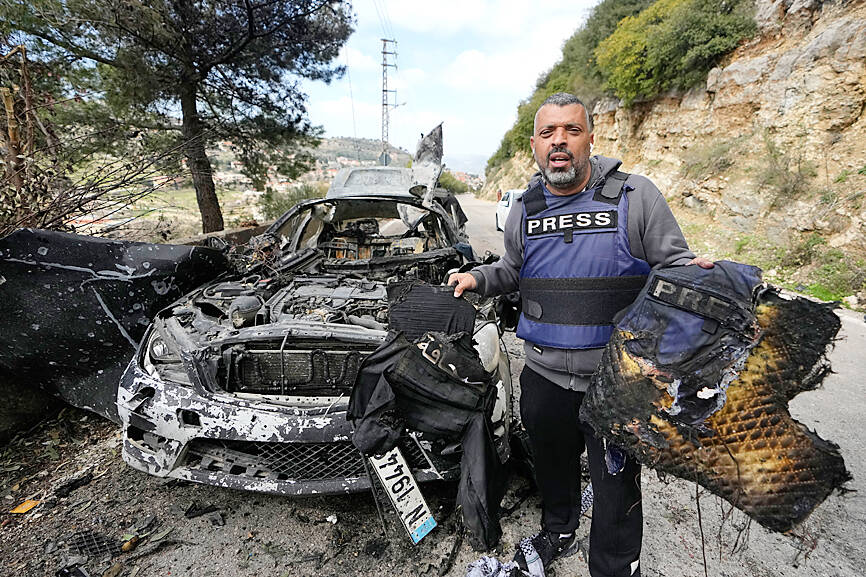
Photo: AP
“The enemy publicly sends messages of negotiation and dialogue while secretly planning a ground attack,” Ghalibaf said in a statement carried by the official IRNA news agency.
“Our men are waiting for the arrival of the American soldiers on the ground to set them on fire, and punish their regional allies once and for all,” he added.
The USS Tripoli, an amphibious assault ship carrying about 3,500 Marines and sailors, on Friday arrived in the Middle East.
The Washington Post reported that the Pentagon was preparing plans for weeks of ground operations — potentially including raids on Kharg Island and sites near the Strait of Hormuz — although US President Donald Trump has yet to approve any deployment.
Pakistan is to host today foreign ministers from Saudi Arabia, Turkey and Egypt in Islamabad for talks on the crisis.
As the specter of a widening conflict grew, Yemen’s Houthis on Saturday claimed their first attack of the war, firing “a barrage of cruise missiles and drones” at strategic sites in Israel.
The attacks raised concern about the war spreading to the Red Sea, with Saudi Arabia rerouting much of its oil exports there to avoid Hormuz.
On another front, Israeli attacks have continued in Lebanon, which was drawn into the war when Tehran-backed Hezbollah fired rockets at Israel on March 2. On Saturday, the Israeli military killed three journalists in the south.

‘NO SECURITY RISK’: The Railway Bureau reassured the public that the technicians’ activities were limited to technical guidance and did not involve sensitive systems The Railway Bureau yesterday said it had invited eight Chinese technicians to assist with an airport MRT construction project. The bureau issued the confirmation after an Internet user said Chinese nationals had entered the construction zone of Taiwan Taoyuan International Airport’s Terminal 3 project. They asked why “individuals from an enemy state” were allowed access to such a major national infrastructure project, which raised serious concerns over Taiwan’s industrial safety, sensitive systems and information security. The bureau’s Northern Region Engineering Branch Office said subcontractor Taiwan Handle Industrial Co (台灣手把工業) of the Taoyuan airport MRT’s “Contract No. CU05 Project A14 Station Civil, MEP &

A US uncrewed surface vessel (USV) encountered multiple Chinese warships during an autonomous transit of the Taiwan Strait, US defense company Seasats said in a statement on Wednesday. Seasats announced that a Lightfish USV had completed the first autonomous transit of the Taiwan Strait. Over five days, the USV traversed the entire length of the Strait while constantly monitoring surface vessel traffic, the company said. The Lightfish encountered multiple Chinese warships, one of which was a Chinese People’s Liberation Army Navy (PLAN) Type 056 corvette, it said. The Chinese vessels were operating “well within Taiwan’s exclusive economic zone without transmitting their identity via the
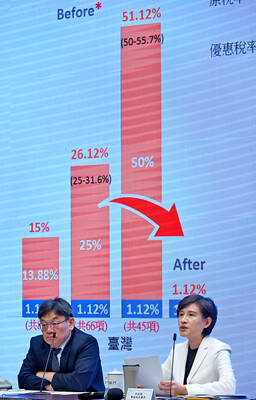
GREATER REACH? Auto parts and wood products would face tariffs of up to 15%, matching those targeting the EU, Japan and South Korea, Vice Premier said The US has announced that preferential tariff treatment for Taiwan’s non-semiconductor Section 232 goods would take effect retroactively from May 1, the Executive Yuan said yesterday. The US government yesterday posted a notice on the Federal Register’s public inspection Web site previewing tariff concessions for Taiwan under a memorandum of understanding (MOU) on Taiwan-US investment after two months of negotiations. The MOU signed on Jan. 15 stipulated three major preferential tariff arrangements: a 15 percent “reciprocal” tariff rate for Taiwan without stacking most-favored nation (MFN) rates; preferential Section 232 treatment for semiconductors and related products; and preferential Section 232 treatment for non-semiconductor

The National Chungshan Institute of Science and Technology yesterday showcased its locally developed variants of the Vision 60 robotic patrol dog, which it plans to deploy on the nation’s outlying territories in the South China Sea. The variants were produced under the Joint Lab project — created by the institute and domestic companies — and assembled with domestically produced motors, lenses and artificial intelligence (AI) systems alongside licensed tech from the US, Missile and Rocket Systems Research Division deputy director Jen Kuo-kang (任國光) told the media event at a military base in Taipei’s Dazhi (大直) area. Taiwan has built up its strengths


 RSS
RSS