


The European Parliament on Thursday passed a report calling for closer cooperation with like-minded partners, including Taiwan, to build a resilient web of trusted connectivity.
The European Commission and the EU high representative for foreign affairs and security policy in 2021 launched the Global Gateway, a strategic initiative to boost sustainable and high-quality infrastructure investments worldwide aimed at operating as a transparent and values-based alternative to other global infrastructure initiatives such as China’s Belt and Road Initiative.
Four years after its inception and one year into the current European Commission’s term, the European Parliament has been reviewing the progress of the initiative. It on Thursday passed a resolution on a progress report.
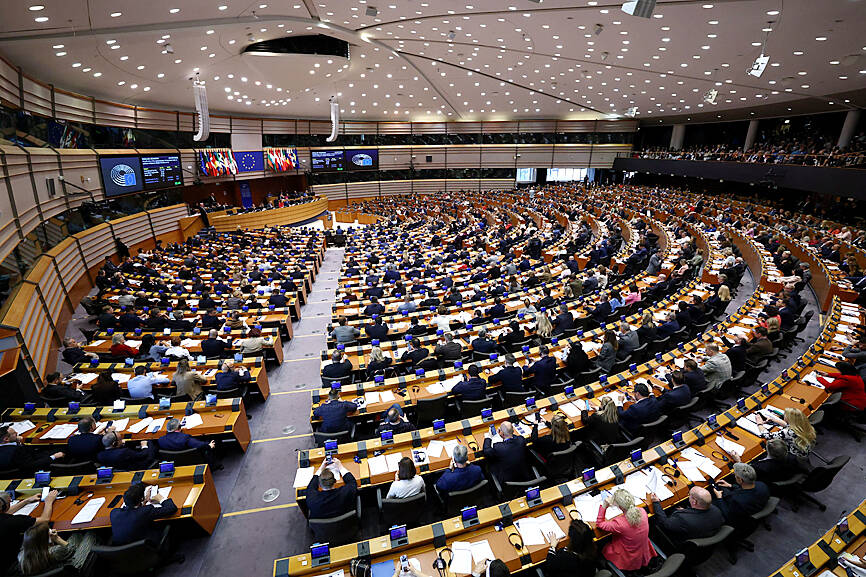
Photo: Reuters
The resolution was passed with 371 votes (62 percent) in favor, 146 (24 percent) against, and 80 abstentions.
The Global Gateway strategy aims to become “EU’s flagship framework for sustainable connectivity and global investment, and as an alternative to China’s Belt and Road Initiative,” the report said.
It said the initiative “calls for closer cooperation with like-minded partners with a view to building a resilient web of trusted connectivity, especially, but not exclusively, partners such as the United Kingdom, Canada, Japan, Australia, New Zealand, the Republic of Korea, India and Taiwan.”
In an environment of increased geopolitical rivalry and uncertainty, the Global Gateway initiative can boost smart, clean and secure links between the bloc and its partners, the report said, adding that it can help restore Europe’s industrial competitiveness, while reducing its dependencies in critical sectors and counterbalancing China’s growing global influence.
The Ministry of Foreign Affairs (MOFA) yesterday said that as authoritarian regimes leverage non-transparent lending and infrastructure projects to extend their global reach, it would deepen cooperation with the EU and other like-minded countries through its “integrated diplomacy” framework, and jointly promote a cooperation model consistent with democratic values.
It also said that it welcomed and appreciated a joint statement by German and Australian defense ministries released on Thursday, adding that it “underscored the importance of peace and stability across the Taiwan Strait, and reaffirmed their shared opposition to any unilateral action to change the status quo.”
The joint statement was issued after Australian Deputy Prime Minister and Minister for Defence Richard Marles met with German Minister of Defense Boris Pistorius in Canberra.
Taiwan, Australia and Germany are like-minded partners that share universal values such as democracy, freedom and the rule of law, MOFA said.
“The joint statement issued by these two nations once again demonstrates that maintaining peace and stability in the Taiwan Strait, the South China Sea and the broader Indo-Pacific region has become a matter of international consensus,” it added.


RESILIENCE: Taiwan plays a key role in semiconductors, energy, information infrastructure and advanced manufacturing, AIT Director Raymond Greene said Taiwan’s continued investment in deterrence and resilience remains vital, especially in uncrewed systems and other emerging technologies, American Institute in Taiwan (AIT) Director Raymond Greene said yesterday. Greene made the remarks at the annual National Strategic Summit on Supply Chain Resilience held by the Research Institute for Democracy, Society and Emerging Technology (DSET), a government-backed think tank. As Taiwan last year became the US’ fourth-largest trading partner and supply chain security is becoming more important, cooperation in emerging technologies continues to deepen between the two countries, he said. The US is committed to accelerating innovation, building key infrastructure, strengthening cooperation

The National Chungshan Institute of Science and Technology yesterday showcased its locally developed variants of the Vision 60 robotic patrol dog, which it plans to deploy on the nation’s outlying territories in the South China Sea. The variants were produced under the Joint Lab project — created by the institute and domestic companies — and assembled with domestically produced motors, lenses and artificial intelligence (AI) systems alongside licensed tech from the US, Missile and Rocket Systems Research Division deputy director Jen Kuo-kang (任國光) told the media event at a military base in Taipei’s Dazhi (大直) area. Taiwan has built up its strengths

RIGHT DIRECTION: Taiwan’s efforts to prevent forced labor include a proposal to ‘fully prohibit’ employers from withholding workers’ documents, an official said Taiwan is to establish a mechanism to restrict imports of goods linked to forced labor, the Executive Yuan said yesterday, after the US proposed imposing additional tariffs on Taiwanese goods over labor concerns. “The Ministry of Labor and the Ministry of Economic Affairs are to establish an interministerial review procedure,” Executive Yuan spokesperson Michelle Lee (李慧芝) said at a news briefing in Taipei. “The government is to use the Foreign Trade Act [貿易法] as the legal basis to restrict imports of goods produced with forced labor” and bring its supply chain governance more in line with international standards on human rights, resilience

NOT IMMEDIATE: Taiwan has a chance to appeal the proposed 10 percent tariff before it starts, while other countries face a 12.5 percent tariff from the trade office Taiwan is among 60 economies determined by the US to have failed to impose or enforce a ban on the importation of goods produced with forced labor, according to a notice released on Tuesday by the Office of the US Trade Representative (USTR), which proposed imposing an additional 10 percent or more tariff on them. The USTR in a statement said that following an investigation, it had determined under Section 301 of the Trade Act of 1974 that the failure of the 60 economies to impose and effectively enforce a prohibition on the importation of goods produced with forced labor is


 RSS
RSS