


The Water Resources Agency (WRA) has imposed rationing and authorized unallocated water reserves for household use until July, after the driest winter in 75 years in Taiwan’s western region.
Reservoirs south of the Hsinchu-Yilan line this winter reported between 7 and 37 percent of rainfall compared with the same period last year, sparking a water shortage, the agency said in a news release after the weekly Cabinet meeting.
Rainfall at Hsinchu County’s Baoshan Reservoir 1 (寶山第一水庫) and Baoshan Reservoir 2 (寶山第二水庫), and Miaoli County’s Liyutan Reservoir (鯉魚潭水庫) were at 60 to 80 percent of the level recorded during a severe drought in 2021, it said.
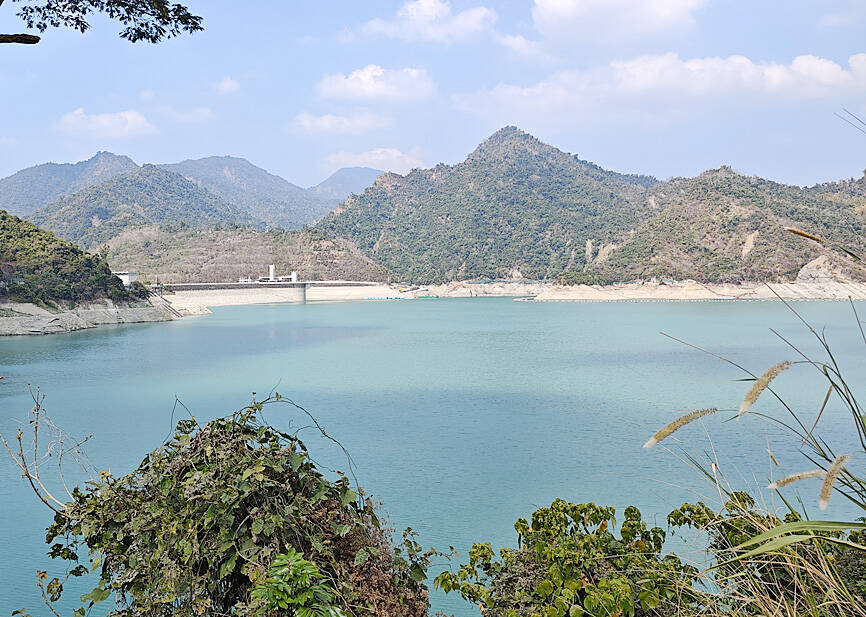
Photo: Wu Chun-feng, Taipei Times
The shortages affect water supplies for chipmaking hub Hsinchu County and industrial center Taichung, the agency said.
The WRA has activated emergency measures to facilitate the diversion of water resources from unaffected regions and reduce wastage, policies that are to remain in force until July, it said.
Private industries are voluntarily reducing their water usage by up to 7 percent, the maximum amount that could be spared without adverse effects on production, the agency said.
State-owned enterprises and government offices have ceased unnecessary water use and farmers are enacting irrigation methods that save water, it said.
The pressure in water mains designated for household use is being reduced between 10pm and 5am, it said.
Measures to distribute water resources across regional lines, dam outflow controls, increased utilization of river runoffs and recycling, and regulations aimed at reducing irrigation wastage have been in place since June last year, the agency said.
The measures enabled Taiwan to tap into 810 million tonnes of water, equivalent to four times the capacity of Shihmen Reservoir (石門水庫), it said, adding that 232,000 tonnes are daily diverted to Hsinchu.
Pipelines that were built under the Forward-Looking Infrastructure Development Plan have transported 390 million tonnes of water between the nation’s catchment systems in response to the shortage, the agency said.
The government response to the crisis has bought time for the nation’s reservoirs to meet current levels of demand for water, it said.
The agency outlined long-term plans for Taiwan’s water supply resilience, laying pipelines linking the Liyutan Reservoir to Taichung’s Shihkang Dam (石岡壩), and desalination plants Hsinchu County and Tainan.
The pipeline project is expected to completed on schedule in late June, while the agency aims to accelerate the construction of the desalination plants, it said.
The government is striving to prevent zoned water rationing for domestic use before the end of June, Premier Cho Jung-tai (卓榮泰) said yesterday.
Drought prevention requires a united effort from the entire nation, encompassing industrial, agricultural and domestic water use, he said.
The National Science and Technology Council and the Ministry of Economic Affairs should continue urging science and industrial parks to improve their water conservation efforts, while the ministry should step up public awareness campaigns on water conservation, Cho added.
Additional reporting by Chung Li-hua

‘NO SECURITY RISK’: The Railway Bureau reassured the public that the technicians’ activities were limited to technical guidance and did not involve sensitive systems The Railway Bureau yesterday said it had invited eight Chinese technicians to assist with an airport MRT construction project. The bureau issued the confirmation after an Internet user said Chinese nationals had entered the construction zone of Taiwan Taoyuan International Airport’s Terminal 3 project. They asked why “individuals from an enemy state” were allowed access to such a major national infrastructure project, which raised serious concerns over Taiwan’s industrial safety, sensitive systems and information security. The bureau’s Northern Region Engineering Branch Office said subcontractor Taiwan Handle Industrial Co (台灣手把工業) of the Taoyuan airport MRT’s “Contract No. CU05 Project A14 Station Civil, MEP &

The National Chungshan Institute of Science and Technology yesterday showcased its locally developed variants of the Vision 60 robotic patrol dog, which it plans to deploy on the nation’s outlying territories in the South China Sea. The variants were produced under the Joint Lab project — created by the institute and domestic companies — and assembled with domestically produced motors, lenses and artificial intelligence (AI) systems alongside licensed tech from the US, Missile and Rocket Systems Research Division deputy director Jen Kuo-kang (任國光) told the media event at a military base in Taipei’s Dazhi (大直) area. Taiwan has built up its strengths

TIT-FOR-TAT: The US allegedly revoked the visa of a Chinese national working at Xinhua News Agency in the US in response to Beijing’s expulsion of Vivian Wang The Presidential Office yesterday condemned China for expelling a New York Times correspondent from Beijing following the newspaper’s interview with President William Lai (賴清德), saying the move highlighted Beijing’s suppression of press freedom and its threat to international news media. Taiwan has noted a series of recent incidents in which Beijing used similar tactics to “threaten and pressure international media outlets and journalists,” Presidential Office spokeswoman Karen Kuo (郭雅慧) said in a statement. “This concerns not only press freedom and freedom of expression, but also the safety of journalists, and Taiwan and relevant partners are paying close attention to the situation,” she
NOT IMMEDIATE: Taiwan has a chance to appeal the proposed 10 percent tariff before it starts, while other countries face a 12.5 percent tariff from the trade office Taiwan is among 60 economies determined by the US to have failed to impose or enforce a ban on the importation of goods produced with forced labor, according to a notice released on Tuesday by the Office of the US Trade Representative (USTR), which proposed imposing an additional 10 percent or more tariff on them. The USTR in a statement said that following an investigation, it had determined under Section 301 of the Trade Act of 1974 that the failure of the 60 economies to impose and effectively enforce a prohibition on the importation of goods produced with forced labor is


 RSS
RSS