


Leftists retained control of France’s three largest cities while the far right failed to take any major urban centers in Sunday’s municipal elections, closely watched for an indication of next year’s presidential race.
The far right won several medium-sized southern enclaves, but failed to capture any major prizes in the local polls, despite predictions.
Most of France’s almost 35,000 villages, towns and boroughs elected municipal leaders in a first round last weekend, but the races went to run-offs in about 1,500 communes, including bigger urban centers.
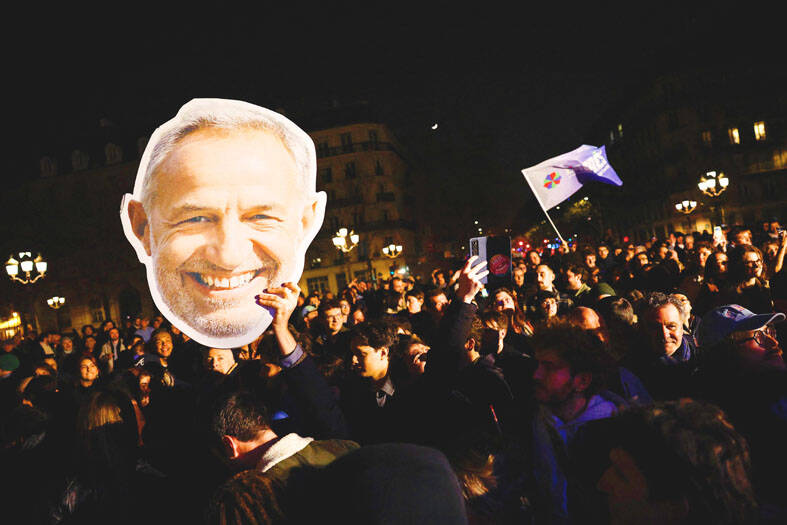
Photo: AFP
In the capital, 48-year-old civil servant Emmanuel Gregoire’s victory extends the Socialists’ quarter-century rule of Paris. Second-largest city Marseille, where leftist incumbent Benoit Payan presented himself as a bulwark against the far-right National Rally (RN), comfortably re-elected its mayor, and in Lyon, the Greens’ Gregory Doucet narrowly prevailed over former soccer club owner Jean-Michel Aulas, who had been favored in the polls. Businessman Aulas denounced “irregularities” and said he would be filing an appeal.
In Paris, the deputy to outgoing Mayor Anne Hidalgo celebrated his victory on Sunday by hopping on one of the city’s iconic rental bikes to cycle to city hall.
“Paris has decided to stay true to its history,” a beaming Gregoire told a cheering crowd, as he won the Socialists a fifth consecutive term in the city of 2 million people.
He pledged to stand up to the right and far right in the run-up to next year’s election.
“The battle for France will be fierce,” he said. “Paris will be the heart of the resistance against this alliance of the right, which seeks to take away what we hold most precious and fragile: the simple joy of living together.”
The Socialists also kept Lille and Rennes and took Pau in the southwest from centrist former French prime minister Francois Bayrou. Another ex-prime minister, centrist Edouard Philippe, was re-elected by the northern port city of Le Havre.
Philippe, who has already declared his candidacy for the presidential race, is seen as one of the strongest opponents to the RN’s potential pick — Marine Le Pen, 57, or her 30-year-old lieutenant Jordan Bardella.
“There are reasons to hope,” Philippe told supporters.
“We, the people of Le Havre, say this to the French today: Yes, there are reasons to hope in our creative and ambitious youth, capable of imagining and building a new world that is more respectful of human beings than our own, more mindful of our planet and our future,” he said.
Le Pen’s party failed to score big wins in the south, with a right-wing candidate beating the RN in the naval port city of Toulon.
But the far-right party claimed a number of smaller areas, including Carcassonne, Menton and Cannes.
An ally of the far right, Eric Ciotti, won in the southern city of Nice, France’s fifth largest.
RN party leader Bardella claimed Nice as a win for his own party.
“Tonight’s successes are just the beginning,” he said.
“The RN and its allies have never had so many elected representatives across French territory,” he added.
An RN mayor was re-elected last Sunday in the southern city of Perpignan, which has 120,000 inhabitants.
The decision by the Socialists and Greens to ally with the hard left failed to bear much fruit, including in Toulouse, France’s fourth-largest city.
There, the France Unbowed (LFI) party lost to the right, exit polls showed.
However, the hard left saw a mayor elected in the economically depressed city of Roubaix on the Belgian border.
An LFI mayor also won in the Paris suburb of Saint-Denis of about 150,000 residents last week.
Overall election turnout stood at 57 percent, the country’s lowest in local polls bar the COVID-19 pandemic-affected last edition in 2020.

‘NO SECURITY RISK’: The Railway Bureau reassured the public that the technicians’ activities were limited to technical guidance and did not involve sensitive systems The Railway Bureau yesterday said it had invited eight Chinese technicians to assist with an airport MRT construction project. The bureau issued the confirmation after an Internet user said Chinese nationals had entered the construction zone of Taiwan Taoyuan International Airport’s Terminal 3 project. They asked why “individuals from an enemy state” were allowed access to such a major national infrastructure project, which raised serious concerns over Taiwan’s industrial safety, sensitive systems and information security. The bureau’s Northern Region Engineering Branch Office said subcontractor Taiwan Handle Industrial Co (台灣手把工業) of the Taoyuan airport MRT’s “Contract No. CU05 Project A14 Station Civil, MEP &

A US uncrewed surface vessel (USV) encountered multiple Chinese warships during an autonomous transit of the Taiwan Strait, US defense company Seasats said in a statement on Wednesday. Seasats announced that a Lightfish USV had completed the first autonomous transit of the Taiwan Strait. Over five days, the USV traversed the entire length of the Strait while constantly monitoring surface vessel traffic, the company said. The Lightfish encountered multiple Chinese warships, one of which was a Chinese People’s Liberation Army Navy (PLAN) Type 056 corvette, it said. The Chinese vessels were operating “well within Taiwan’s exclusive economic zone without transmitting their identity via the
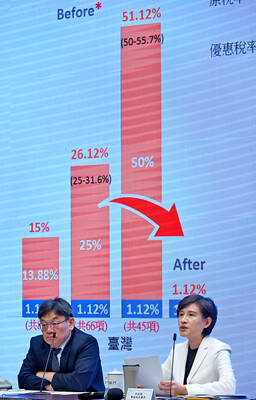
GREATER REACH? Auto parts and wood products would face tariffs of up to 15%, matching those targeting the EU, Japan and South Korea, Vice Premier said The US has announced that preferential tariff treatment for Taiwan’s non-semiconductor Section 232 goods would take effect retroactively from May 1, the Executive Yuan said yesterday. The US government yesterday posted a notice on the Federal Register’s public inspection Web site previewing tariff concessions for Taiwan under a memorandum of understanding (MOU) on Taiwan-US investment after two months of negotiations. The MOU signed on Jan. 15 stipulated three major preferential tariff arrangements: a 15 percent “reciprocal” tariff rate for Taiwan without stacking most-favored nation (MFN) rates; preferential Section 232 treatment for semiconductors and related products; and preferential Section 232 treatment for non-semiconductor

The National Chungshan Institute of Science and Technology yesterday showcased its locally developed variants of the Vision 60 robotic patrol dog, which it plans to deploy on the nation’s outlying territories in the South China Sea. The variants were produced under the Joint Lab project — created by the institute and domestic companies — and assembled with domestically produced motors, lenses and artificial intelligence (AI) systems alongside licensed tech from the US, Missile and Rocket Systems Research Division deputy director Jen Kuo-kang (任國光) told the media event at a military base in Taipei’s Dazhi (大直) area. Taiwan has built up its strengths


 RSS
RSS