


The US’ war against Iran has not delayed shipments of weapons to Taiwan or changed US policy toward the nation, officials from US President Donald Trump’s administration told the US Congress on Tuesday, despite the demands of the intense air campaign.
“Have we delayed moving things to Taiwan? We haven’t,” US Deputy Assistant Secretary of State for Political-Military Affairs Stanley Brown told a US House of Representatives Committee on Foreign Affairs hearing on Reforming American Defense Sales.
The US and Israel began strikes against Iran on Feb. 28, a campaign that has raised concerns among US officials that the US defense industry would be unable to keep up with demand and could be forced to slow shipments to buyers such as Taiwan.
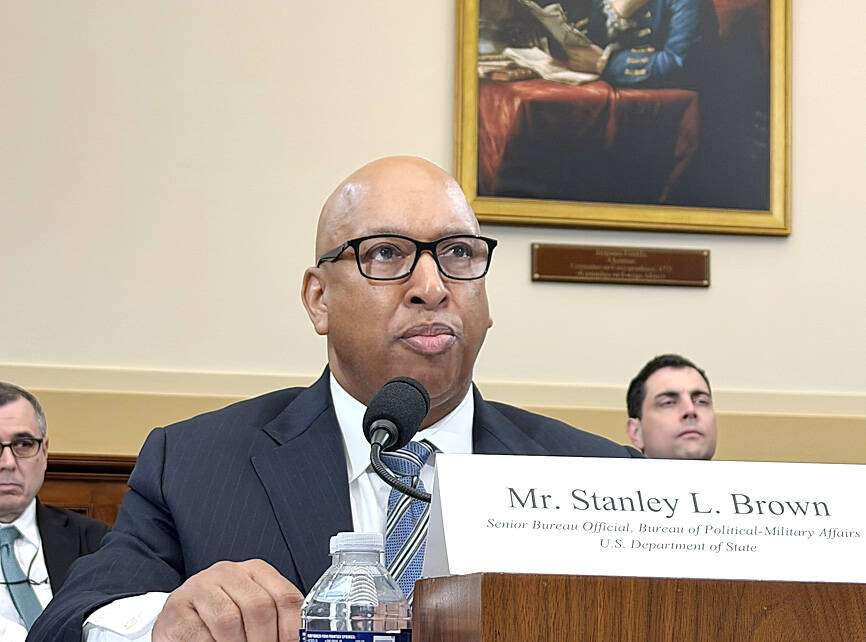
Photo: CNA
There was already a multibillion-dollar backlog of US arms shipments to Taiwan before the Iran war started.
The US administration was looking at ways to expedite shipments, Brown said, without providing specifics.
Several members of the committee raised concerns about Taiwan during the hearing, which took place on the day Trump said he was postponing a highly anticipated trip to Beijing to meet with Chinese President Xi Jinping (習近平).
Taiwan was one of the issues expected to be discussed by the two leaders.
Reuters last week reported that a major US arms package for Taiwan that included advanced interceptor missiles was ready for Trump’s approval and could be signed after his trip to China.
With a price tag of about US$14 billion, the arms deal would be the largest ever for the nation.
It was not immediately clear whether the trip’s delay would affect the timing of the arms deal.
At the hearing, US Representative Brian Mast, the committee’s chairman, and other Republicans accused Democrats of delaying crucial assistance to important allies as they face international threats.
Taiwan still has priority for delivery of Harpoon Coastal Defense Systems (HCDS), despite concerns that Saudi Arabia had jumped ahead, US Defense Security Cooperation Agency Director Michael Miller said in response to US Representative Keith Self’s question over whether Riyadh had priority over Taiwan for the anti-ship missiles.
Miller said that the guidance he signed in 2023 on implementing arms sales was to prioritize Taiwan above all requirements and that guidance remained effective.
“So, in the matter of whether there was a competition between provision of Harpoons to Saudi Arabia or to Taiwan, Taiwan would take priority,” Miller said.
“That is also a capability they’re working to provide to them,” he added.
In October 2020, the US government announced that it approved a possible sale to Taiwan of up to 100 HCDS batteries and related equipment for approximately US$2.37 billion.
The HCDS sales package, including up to 400 RGM-84L-4 Harpoon Block II Surface Launched Missiles and four RTM-84L-4 Harpoon Block II Exercise Missiles, was scheduled to arrive in Taiwan by 2028.
Brown added that the “six assurances” regarding Taiwan remained unchanged.
“I’m not aware of any move to change the six assurances. As part of ... the Three Joint Communiques [and] six assurances, we have stated that we will provide Taiwan what they need for their own self-defense,” he said.
The “six assurances” include pledges not to set a date for ending arms sales to Taiwan and not to consult with China on arms sales.
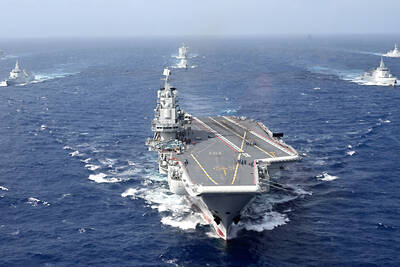
PROVOCATIVE: Chinese Deputy Ambassador to the UN Sun Lei accused Japan of sending military vessels to deliberately provoke tensions in the Taiwan Strait China denounced remarks by Japan and the EU about the South China Sea at a UN Security Council meeting on Monday, and accused Tokyo of provocative behavior in the Taiwan Strait and planning military expansion. Ayano Kunimitsu, a Japanese vice foreign minister, told the Council meeting on maritime security that Tokyo was seriously concerned about the situation in the East China and South China seas, and reiterated Japan’s opposition to any attempt to change the “status quo” by force, and obstruction of freedom of navigation and overflight. Stavros Lambrinidis, head of the EU delegation to the UN, also highlighted South China Sea
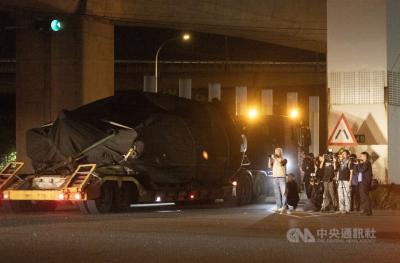
The final batch of 28 M1A2T Abrams tanks purchased from the US arrived at Taipei Port last night and were transported to the Armor Training Command in Hsinchu County’s Hukou Township (湖口), completing the military’s multi-year procurement of 108 of the tanks. Starting at 12:10am today, reporters observed more than a dozen civilian flatbed trailers departing from Taipei Port, each carrying an M1A2T tank covered with black waterproof tarps. Escorted by military vehicles, the convoy traveled via the West Coast Expressway to the Armor Training Command, with police implementing traffic control. The army operates about 1,000 tanks, including CM-11 Brave Tiger
Taiwan Semiconductor Manufacturing Co (TSMC, 台積電), the world’s largest contract chipmaker, said it expects its 2-nanometer (2nm) chip capacity to grow at a compound annual rate of 70 percent from this year to 2028. The projection comes as five fabs begin volume production of 2-nanometer chips this year — two in Hsinchu and three in Kaohsiung — TSMC senior vice president and deputy cochief operating officer Cliff Hou (侯永清) said at the company’s annual technology symposium in Silicon Valley, California, last week. Output in the first year of 2-nanometer production, which began in the fourth quarter of last year, is expected to
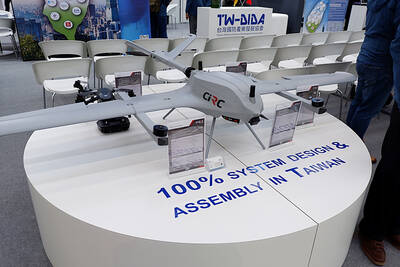
Taiwan’s drone exports surged past US$100 million in the first quarter, exceeding last year’s full-year total, with the Czech Republic emerging as the largest buyer, the Ministry of Economic Affairs said. Exports of complete drones reached US$115.85 million in the period, about 1.2 times the total recorded for all of last year, the ministry said in a report. Exports to the Czech Republic accounted for about US$100 million, far outpacing other markets. Poland, last year’s top destination, recorded about US$11.75 million in the first quarter. Taiwan’s drone exports have expanded rapidly in the past few years, with last year’s total


 RSS
RSS