


The military plans to complete the integration of the first domestically produced regional air defense system by next year, with Tien Kung III, Tieng Kung IV and the land-based variant of the Tien Chien II, the Ministry of National Defense (MND) and the Chungshan Institute of Science and Technology (CSIST) said in a report submitted to the Legislative Yuan.
Once Taiwan’s domestically produced air defense system is fully integrated, it would be further linked through the US’ Integrated Battle Command System to coordinate with newly purchased US-made Patriot III and NASAMS air defense systems, the report said, adding that the large-scale integration aims to realize the “T-Dome” defense plan, providing multi-layered, multi-missile protection.
The ministry urged the legislature to fund domestically produced air defense missiles via a proposed NT$1.25 trillion (US$39.16 billion) special defense budget.
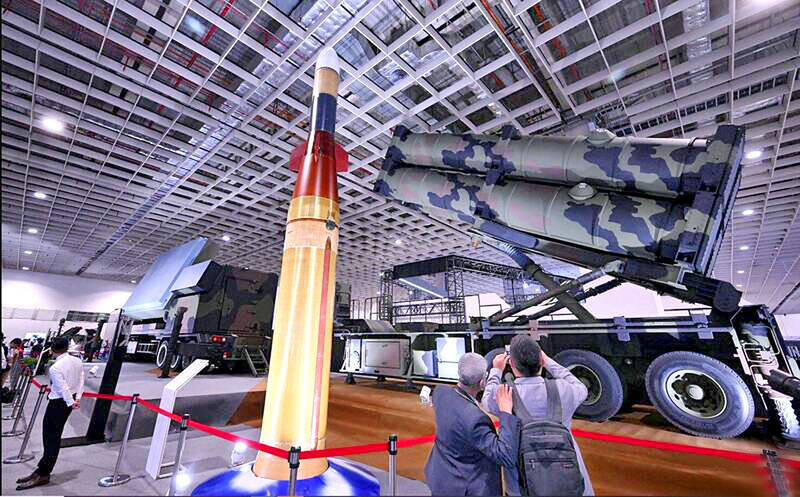
Photo: Taipei Times
Tien Kung IV missiles, a product of the CSIST’s Chiang Kung program, are among the world’s most capable interceptors, the ministry said.
The system, with an interception altitude of 70km, is in the same class as the US-made Terminal High Altitude Area Defense and the Israeli Arrow-2, it said.
The Tien Kung IV forms the outermost layer of T-Dome, the government’s proposed multi-layered air defense system deploying advanced and legacy interceptors with an integrated command system, the ministry said.
The advanced interceptor’s active electronically scanned array radar system, which was developed with US technical assistance, achieves a detection range and precision superior to other Taiwanese-made air defense systems, it said.
The report also made a reference to three unidentified types of indigenously developed missiles that the ministry plans to mass-produce by drawing from the annual defense budget.
Defense officials and lawmakers with knowledge of the matter confirmed on condition of anonymity that the three systems were understood to be the Sea Oryx short-range air defense missile, the Ching Tien hypersonic land-attack missile and an unknown ballistic missile.
Little is known about the Ching Tien hypersonic missile beyond its supposed maximum range of 2,000km.
The Hsiung Feng III anti-ship and land attack missile is undergoing testing, and its inclusion in the annual budget for next year could not be clarified until July, sources said.
Defense officials told lawmakers that the government’s version of the special defense budget includes funds to manufacture Tien Kung IV missiles, and Albatross II surveillance and reconnaissance drones, as well as uncrewed kamikaze boats, while the Chinese Nationalist Party’s (KMT) version of the bill excludes them.
The Executive Yuan would allocate NT$36.1 billion for the Tien Kung IV, NT$16.8 billion for the Albatross II and NT$28 billion for the remote-control boats, taking up 7.2 percent of the government’s version of the bill.
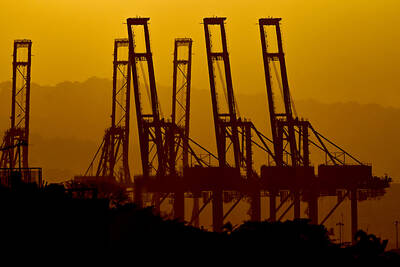
A subsidiary of a Hong Kong-based company that has lost control of two critical ports on the Panama Canal said it is seeking US$2 billion of compensation in damages from Panama over its “illegal” takeover of the ports. Panama Ports Co, a unit of Hong Kong’s CK Hutchison Holdings (長江和記實業), on Friday said in a statement that it is demanding the sum under international arbitration proceedings that it had already started. The Panamanian government last week seized control of the Balboa and Cristobal ports on each end of the Panama Canal, after the country’s Supreme Court declared earlier that a concession allowing
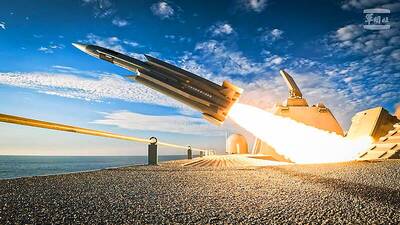
DETERRENCE: With 1,000 indigenous Hsiung Feng II and III missiles and 400 Harpoon missiles, the nation would boast the highest anti-ship missile density in the world With Taiwan wrapping up mass production of Hsiung Feng II and III missiles by December and an influx of Harpoon missiles from the US, Taiwan would have the highest density of anti-ship missiles in the world, a source said yesterday. Taiwan is to wrap up mass production of the indigenous anti-ship missiles by the end of year, as the Chungshan Institute of Science and Technology has been meeting production targets ahead of schedule, a defense official with knowledge of the matter said. Combined with the 400 Harpoon anti-ship missiles Taiwan expects to receive from the US by 2028, the nation would have

POSSIBILITIES EMERGE: With Taiwan’s victory and Japan’s narrow win over Australia, Taiwan now have a chance to advance if South Korea also beat the Aussies Taiwan has high hopes that the national baseball team would advance to the World Baseball Classic (WBC) quarter-finals after clinching a crucial 5-4 victory over South Korea in a nail-biting extra-inning game at the Tokyo Dome yesterday. Boosted by three home runs — two solo shots by Yu Chang (張育成) and Cheng Tsung-che (鄭宗哲) and a two-run homer by Stuart Fairchild — the triumph gave Taiwan a much-needed second victory in the five-team Pool C, where only the top two finishers would advance to the knockout stage in Miami, Florida. Entering extra innings with the game tied at four apiece, Taiwan scored
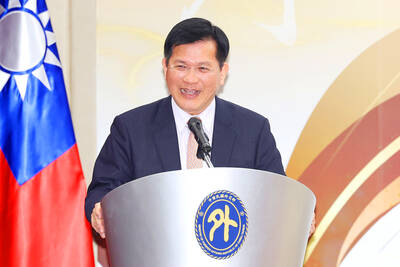
MISSION OF PEACE: The foreign minister urged Beijing to respect Taiwan’s existence as an independent nation, and work together to ensure peace and stability in the region Minister of Foreign Affairs Lin Chia-lung (林佳龍) yesterday rejected Chinese Minister of Foreign Affairs Wang Yi’s (王毅) comments about Taiwan, criticizing China as a “troublemaker” in the international community and a disruptor of cross-strait peace. Speaking at a news conference on the sidelines of the Chinese National People’s Congress, Wang said that Taiwan has always been a territory of China and that it would be impossible for it to become its own country. The “return” of Taiwan to China was the natural outcome of the Chinese people’s resistance against Japan in World War II, and that any pursuit of independence was “doomed


 RSS
RSS