


Chinese Nationalist Party (KMT) Legislative Speaker Han Kuo-yu (韓國瑜) yesterday vowed to back the status of a lawmaker who allegedly failed to renounce her Chinese citizenship.
Han read out a statement following the breakdown of interparty negotiations at the legislature, saying that the KMT would support Taiwan People’s Party (TPP) Legislator Li Zhenxiu’s (李貞秀) right to take office.
“Since the caucuses are unable to reach an agreement amid disputes of law and fact, we should respect Li’s right to assume her seat ... until such time that the facts are verified and the justice system arrives at an ultimate judgement,” he said.
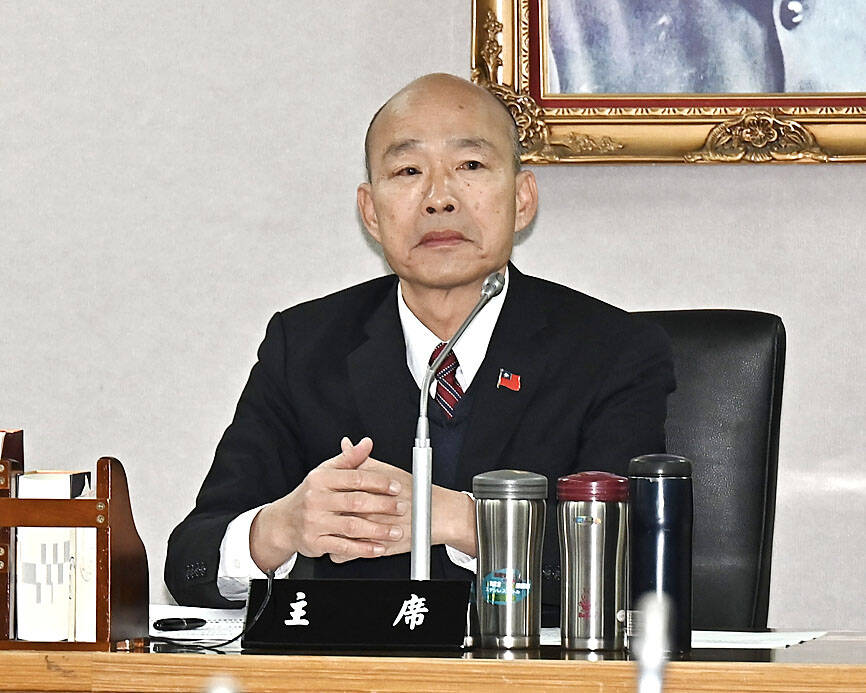
Photo: Tu Chien-rong, Taipei Times
During negotiations earlier in the day, Executive Yuan officials said that Li failed to fulfill multiple qualifying conditions to become a lawmaker and take office.
Minister of the Interior Liu Shyh-fang (劉世芳) said that Li did not renounce her Chinese citizenship in writing the day before being sworn in, citing Article 20 of the Nationality Act (國籍法).
The Ministry of the Interior has not received any filing from Li and the responsibility to disqualify lawmakers falls on the Legislative Yuan, she said.
The ministry has asked Legislative Yuan Secretary-General Chester Chou’s (周萬來) office, the Central Election Commission and the Mainland Affairs Council for Li’s filings certifying her renunciation of Chinese citizenship, to no avail, Liu said.
Li’s entry into the legislators-at-large candidate list in the 2023 election contravened Article 21 of the Act Governing Relations Between the People of the Taiwan Area and the Mainland Area (臺灣地區與大陸地區人民關係條例), Mainland Affairs Council Minister Chiu Chui-cheng (邱垂正) said.
A Chinese national may obtain household registration in Taiwan, but not qualify for elected office if they hold a valid household registration in China, he said.
People with valid household registrations in China are considered “people of the Mainland Area” under the law, a disqualifying condition for holding office, Chiu said, adding that the article also applies to Taiwanese nationals.
People from the Chinese area must continuously have a registered household in Taiwan for 10 years before registering to run for office, he said.
Li obtained Taiwanese residency in 1999, but did not submit proof of relinquishing household registration in China until March last year, he said.
The Executive Yuan has confirmed that Li never submitted documents to the Straits Exchange Foundation or the National Immigration Agency certifying that her Chinese residency has been revoked, he said.
Li’s entry into the TPP’s list of legislator-at-large candidates was also not accompanied by the required documents, Chiu said.
Li’s failure to complete the required changes in residency and the government’s decision not to recognize her as a lawmaker is based on the law, he said.
Removing Li from the legislature does not deprive her of an essential political right if she is not qualified to hold a seat to begin with, Democratic Progressive Party (DPP) caucus chief executive Chuang Jui-hsiung (莊瑞雄) said.
Citing Legislative Yuan Personnel Department head Huang Jui-yueh’s (黃瑞月) statements during the negotiation, DPP Legislator Fan Yun (范雲) said that Li made untruthful declarations in three documents submitted to the legislature, giving the body ample authority to act.
KMT caucus deputy secretary-general Hsu Yu-chen (許宇甄) said that Article 11 of the Additional Articles of the Constitution stipulates that “people of the Mainland Area” are not foreigners under the Nationality Act, contrary to the Ministry of the Interior’s stance.
The Act Governing Relations Between the People of the Taiwan Area and the Mainland Area does not authorize the government to demand a Chinese spouse to surrender their Chinese citizenship, he said.
The executive branch’s demand is an overreach that infringes on the constitutional and legal limits placed on its power, Hsu said.
TPP caucus whip Jacky Chen (陳清龍) thanked Han for his support, saying the speaker’s decision would protect the rights of every lawmaker in office.
The Executive Yuan should answer whether it deems Chinese spouses foreigners governed under the Nationality Act, which is not a view supported by the Constitution, Chen added.
The spat between the Cabinet and opposition lawmakers over the matter is a political fight posing as a legal problem, he said.

‘NO SECURITY RISK’: The Railway Bureau reassured the public that the technicians’ activities were limited to technical guidance and did not involve sensitive systems The Railway Bureau yesterday said it had invited eight Chinese technicians to assist with an airport MRT construction project. The bureau issued the confirmation after an Internet user said Chinese nationals had entered the construction zone of Taiwan Taoyuan International Airport’s Terminal 3 project. They asked why “individuals from an enemy state” were allowed access to such a major national infrastructure project, which raised serious concerns over Taiwan’s industrial safety, sensitive systems and information security. The bureau’s Northern Region Engineering Branch Office said subcontractor Taiwan Handle Industrial Co (台灣手把工業) of the Taoyuan airport MRT’s “Contract No. CU05 Project A14 Station Civil, MEP &

The National Chungshan Institute of Science and Technology yesterday showcased its locally developed variants of the Vision 60 robotic patrol dog, which it plans to deploy on the nation’s outlying territories in the South China Sea. The variants were produced under the Joint Lab project — created by the institute and domestic companies — and assembled with domestically produced motors, lenses and artificial intelligence (AI) systems alongside licensed tech from the US, Missile and Rocket Systems Research Division deputy director Jen Kuo-kang (任國光) told the media event at a military base in Taipei’s Dazhi (大直) area. Taiwan has built up its strengths

TIT-FOR-TAT: The US allegedly revoked the visa of a Chinese national working at Xinhua News Agency in the US in response to Beijing’s expulsion of Vivian Wang The Presidential Office yesterday condemned China for expelling a New York Times correspondent from Beijing following the newspaper’s interview with President William Lai (賴清德), saying the move highlighted Beijing’s suppression of press freedom and its threat to international news media. Taiwan has noted a series of recent incidents in which Beijing used similar tactics to “threaten and pressure international media outlets and journalists,” Presidential Office spokeswoman Karen Kuo (郭雅慧) said in a statement. “This concerns not only press freedom and freedom of expression, but also the safety of journalists, and Taiwan and relevant partners are paying close attention to the situation,” she

NOT IMMEDIATE: Taiwan has a chance to appeal the proposed 10 percent tariff before it starts, while other countries face a 12.5 percent tariff from the trade office Taiwan is among 60 economies determined by the US to have failed to impose or enforce a ban on the importation of goods produced with forced labor, according to a notice released on Tuesday by the Office of the US Trade Representative (USTR), which proposed imposing an additional 10 percent or more tariff on them. The USTR in a statement said that following an investigation, it had determined under Section 301 of the Trade Act of 1974 that the failure of the 60 economies to impose and effectively enforce a prohibition on the importation of goods produced with forced labor is


 RSS
RSS