


Taiwan received a letter of acceptance (LOA) for High Mobility Artillery Rocket Systems (HIMARS) from the US on Friday last week, which must be authorized by the Legislative Yuan and signed before March 26 to ensure the systems can be obtained on time, Minister of National Defense Wellington Koo (顧立雄) said today.
The HIMARS case is particularly time-sensitive and starting the schedule earlier would allow the systems to be obtained sooner, he said.
Further delays could have a significant impact, so the ministry hopes the legislature would authorize the signing as soon as possible, he added.
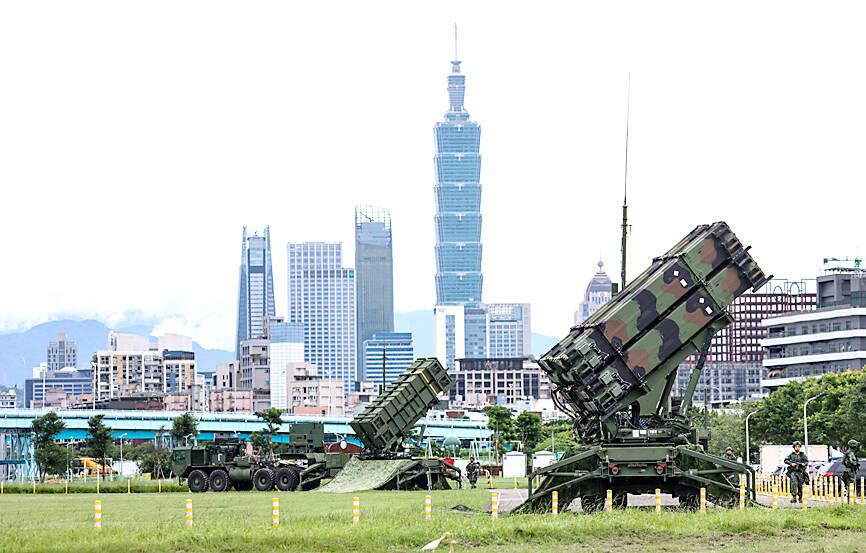
Photo: Cheng I-hwa, AFP
The 82 HIMARS at a cost of US$4.05 billion were included in a US$11.1 billion arms package the US approved for Taiwan on Dec. 17.
That package also covered Javelin missiles, Altius-700M and Altius-600 drones, TOW missiles, M109A7 self-propelled howitzers, C5ISR integrated technology systems, Harpoon missile follow-on support and helicopter parts.
Five of these items are covered in the Executive Yuan’s special defense budget that has been repeatedly blocked by opposition parties in the legislature.
Taiwan has now received LOAs for four out of five of these items.
The Ministry of National Defense previously said it had received LOAs for the TOW missiles, Javelin anti-armor missiles and M109A7 self-propelled howitzers.
As those letters are valid until Sunday, the ministry said it hopes the Legislative Yuan would grant prior authorization for their signing.
The ministry is still awaiting an LOA for the Altius-700M and Altius-600 drones.
The offer expires if the buyer does not sign the LOA by the deadline, and the deal needs to be reviewed again.
LOAs specify the costs, authorizes the sale and outlines terms for foreign military sales.
A special budget of NT$1.25 trillion (US$39.31 billion) was proposed by the Cabinet to cover the acquisition of domestic and foreign-made weapons systems over the next eight years, but opposition parties have only approved NT$400 billion in funding for the purchase of weapons in the US$11.1 billion arms package.
However, finding agreement on the LOAs with upcoming deadlines may happen before the funding bills are reconciled.
A motion submitted by the Taiwan People's Party to authorize the ministry to sign the first three LOAs advanced to a second reading on Friday, but cross-caucus negotiations would have to be held for the motion to advance further.
Meanwhile, Koo also denied media reports that MQ-9B SeaGuardian drone deliveries had been delayed and said no weapons deliveries have been postponed due to the conflict in the Middle East.
Taiwan has ordered four MQ-9B surveillance drones from the US, originally scheduled for delivery last year.
The timeline has since been pushed back to this year and next.
Air force Chief of Staff Lee Ching-jan (李慶然) told the legislature in November that the first batch of MQ-9B drones is scheduled to arrive in the third quarter of this year.
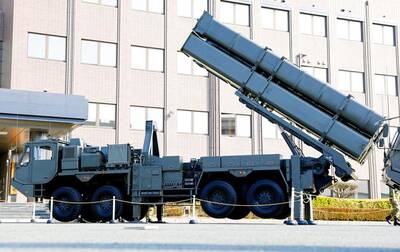
Japan has deployed long-range missiles in a southwestern region near China, the Japanese defense minister said yesterday, at a time when ties with Beijing are at their lowest in recent years. The missiles were installed in Kumamoto in the southern region of Kyushu, as Japan is attempting to shore up its military capacity as China steps up naval activity in the East China Sea. “Standoff defense capabilities enable us to counter the threat of enemy forces attempting to invade our country ... while ensuring the safety of our personnel,” Japanese Minister of Defense Shinjiro Koizumi said. “This is an extremely important initiative for

Chinese Nationalist Party (KMT) Chairwoman Cheng Li-wun (鄭麗文) today accepted an invitation from Chinese President Xi Jinping (習近平) to lead a delegation to China next month, saying she hopes to promote the peaceful development of cross-strait relations and bring stability to the Taiwan Strait. “I am grateful and happy to accept this invitation,” Cheng said in a statement from the KMT chairperson’s office. Cheng said she hopes both sides can work together to promote the peaceful development of cross-strait relations, enhance exchange and cooperation, bring stability to the Taiwan Strait and improve people’s livelihoods. At today's news conference, Cheng said any efforts to
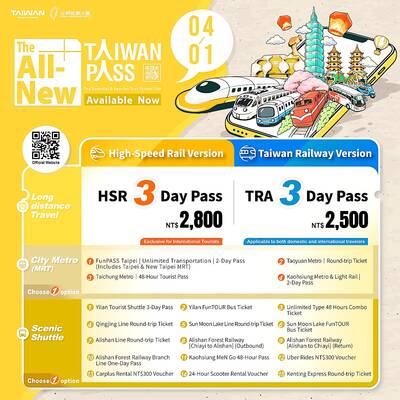
MORE POPULAR: Taiwan Pass sales increased by 59 percent during the first quarter compared with the same period last year, the Tourism Administration said The Tourism Administration yesterday said that it has streamlined the Taiwan Pass, with two versions available for purchase beginning today. The tourism agency has made the pass available to international tourists since 2024, allowing them to access the high-speed rail, Taiwan Railway Corp services, four MRT systems and four Taiwan Tourist Shuttles. Previously, five types of Taiwan Pass were available, but some tourists have said that the offerings were too complicated. The agency said only two types of Taiwan Pass would be available, starting from a three-day pass with the high-speed rail and a three-day pass with Taiwan Railway Corp. The former costs NT$2,800

The nation’s fastest supercomputer, Nano 4 (晶創26), is scheduled to be launched in the third quarter, and would be used to train large language models in finance and national defense sectors, the National Center for High-Performance Computing (NCHC) said. The supercomputer, which would operate at about 86.05 petaflops, is being tested at a new cloud computing center in the Southern Taiwan Science Park in Tainan. The exterior of the server cabinet features chip circuitry patterns overlaid with a map of Taiwan, highlighting the nation’s central position in the semiconductor industry. The center also houses Taiwania 2, Taiwania 3, Forerunner 1 and


 RSS
RSS