


Taiwan would leverage its edge in advanced semiconductor manufacturing to build key supply chain partnerships with like-minded countries and secure a strategic role in the global quantum ecosystem, President William Lai (賴清德) told a news conference held by the National Science and Technology Council (NSTC) in Hsinchu yesterday.
The NSTC unveiled Phase 2 of the National Strategy for High-Speed Quantum Computing, which Lai said marks “Taiwan’s quantum technology moving from basic research to practical applications.”
Industry representatives from domestic and international companies, including Wistron Corp (緯創), Hermes Epitek Corp (漢民), Compal Electronics Inc (仁寶) and Finland-based IQM, also attended.
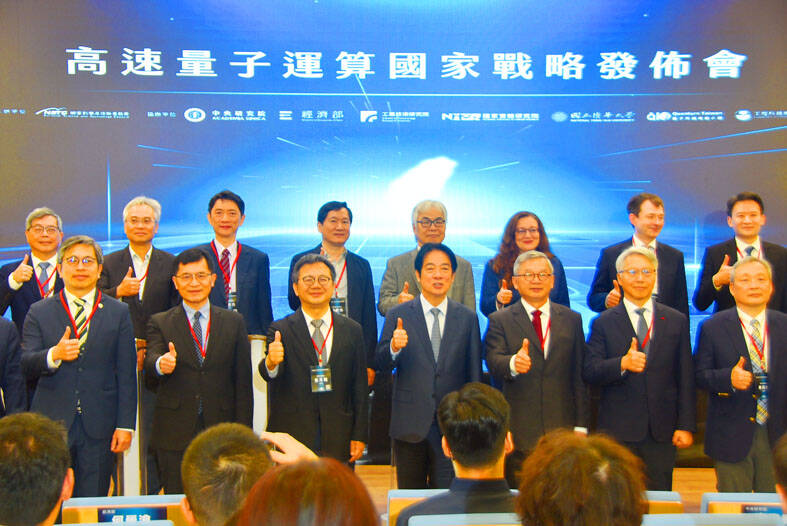
Photo: Wu Po-hsuan, Taipei Times
The quantum initiative is a key component of the government’s 10 Major AI Infrastructure Projects, as the development of quantum computing is closely tied to semiconductor manufacturing, Lai said.
The program is also the second stage of a national strategic plan being carried out by the National Quantum Consortium, a collective of 20 research teams, NSTC Minister Wu Cheng-wen (吳誠文) said.
Phase 1 involved the development of competitive superconducting qubit chips, silicon-based spin qubits, and low-temperature readout and control modules, Wu said, adding that the advances demonstrate that Taiwan has the potential for a fully self-sustained supply chain, from chip design and manufacturing to packaging, and key control and readout modules.
The strategy consists of four key components: launch a verification platform in northern Taiwan, establish a high-performance quantum computing center in southern Taiwan, develop supply chains for the industry, and invite international partners to jointly develop software and systems, Wu said.
The effort aims to improve hardware to achieve fault-tolerant quantum computing and to collaborate with Taiwan-friendly democratic partners on next-generation high-speed quantum computing frameworks, he said.
High-speed quantum computing would require the integration of central processing units, graphics processing units and quantum processing units, Wu said.
Lai pledged support for Phase 2 of the quantum technology initiative, calling for collaboration between industry, the government, academia and researchers.
“The nation needs you, and you must give your all to research and development,” he said, adding that quantum technology capabilities, talent development and quantum cybersecurity would be developed to ensure Taiwan’s digital resilience.
“Taiwan aims to establish key partnerships with like-minded countries to secure a critical position in the global high-speed quantum computing ecosystem,” Lai said.
He also invited international quantum teams to collaborate with Taiwan to accelerate the development and commercialization of high-speed quantum computing systems.
Consortium convener Felix Gwo (果尚志) said the wave of technological change is rare and advances in artificial intelligence would make quantum computing increasingly important.
The consortium, integrated and launched in 2021, has achieved its first-phase goals, including the development of quantum computers, quantum communication and quantum software, Gwo said, adding that Academia Sinica has completed a 20-qubit superconducting quantum computer.
The goals for the next five years of Phase 2 include advancements in hardware, aiming to achieve fault-tolerant quantum computing and expanding software capabilities to improve practical industry applications, he said.
There are also plans for international collaboration, ensuring that Taiwan’s quantum research becomes a partner in the quantum ecosystem, he said.
Additional reporting by Hung An-chi

‘NO SECURITY RISK’: The Railway Bureau reassured the public that the technicians’ activities were limited to technical guidance and did not involve sensitive systems The Railway Bureau yesterday said it had invited eight Chinese technicians to assist with an airport MRT construction project. The bureau issued the confirmation after an Internet user said Chinese nationals had entered the construction zone of Taiwan Taoyuan International Airport’s Terminal 3 project. They asked why “individuals from an enemy state” were allowed access to such a major national infrastructure project, which raised serious concerns over Taiwan’s industrial safety, sensitive systems and information security. The bureau’s Northern Region Engineering Branch Office said subcontractor Taiwan Handle Industrial Co (台灣手把工業) of the Taoyuan airport MRT’s “Contract No. CU05 Project A14 Station Civil, MEP &

A US uncrewed surface vessel (USV) encountered multiple Chinese warships during an autonomous transit of the Taiwan Strait, US defense company Seasats said in a statement on Wednesday. Seasats announced that a Lightfish USV had completed the first autonomous transit of the Taiwan Strait. Over five days, the USV traversed the entire length of the Strait while constantly monitoring surface vessel traffic, the company said. The Lightfish encountered multiple Chinese warships, one of which was a Chinese People’s Liberation Army Navy (PLAN) Type 056 corvette, it said. The Chinese vessels were operating “well within Taiwan’s exclusive economic zone without transmitting their identity via the
GREATER REACH? Auto parts and wood products would face tariffs of up to 15%, matching those targeting the EU, Japan and South Korea, Vice Premier said The US has announced that preferential tariff treatment for Taiwan’s non-semiconductor Section 232 goods would take effect retroactively from May 1, the Executive Yuan said yesterday. The US government yesterday posted a notice on the Federal Register’s public inspection Web site previewing tariff concessions for Taiwan under a memorandum of understanding (MOU) on Taiwan-US investment after two months of negotiations. The MOU signed on Jan. 15 stipulated three major preferential tariff arrangements: a 15 percent “reciprocal” tariff rate for Taiwan without stacking most-favored nation (MFN) rates; preferential Section 232 treatment for semiconductors and related products; and preferential Section 232 treatment for non-semiconductor

The National Chungshan Institute of Science and Technology yesterday showcased its locally developed variants of the Vision 60 robotic patrol dog, which it plans to deploy on the nation’s outlying territories in the South China Sea. The variants were produced under the Joint Lab project — created by the institute and domestic companies — and assembled with domestically produced motors, lenses and artificial intelligence (AI) systems alongside licensed tech from the US, Missile and Rocket Systems Research Division deputy director Jen Kuo-kang (任國光) told the media event at a military base in Taipei’s Dazhi (大直) area. Taiwan has built up its strengths


 RSS
RSS