


The US is “ahead of the problem” of low munitions amid its war with Iran and the primary focus of the US armed forces is on creating an effective denial defense along the first island chain, US Undersecretary of Defense Elbridge Colby told the US Senate Armed Services Committee on Tuesday when asked about the potential implications for Taiwan.
Asked in a hearing discussing the US National Defense Strategy whether the US is making progress on industrial-based munitions and whether potential adversaries of Taiwan would feel that it would be the moment to make a move on the nation in light of reports the US is running low on munitions, Colby said that the US needs to work hard on the defense industrial base, but that “nobody should get the wrong impression” and that the US is “ahead of the problem.”
“Our president has got the will and resolve to use the American military. He’s not afraid of it,” he said.
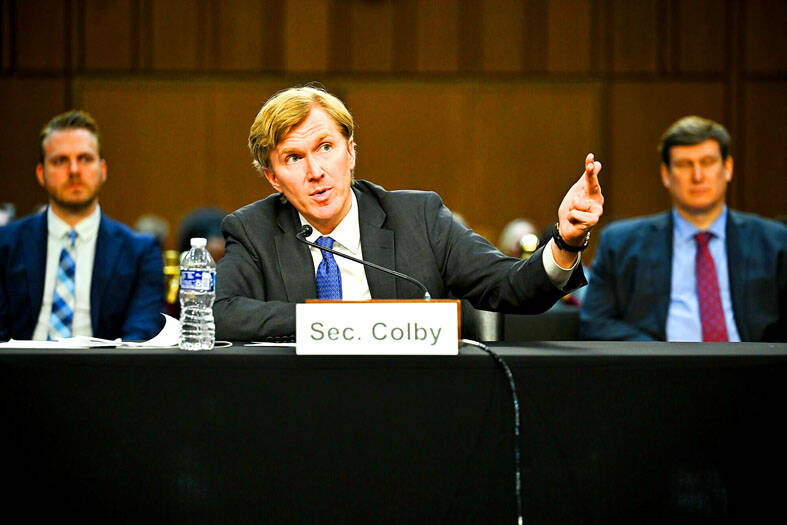
Photo: Bloomberg
Regarding how the war would affect US interests in the Indo-Pacific region, Colby said that Washington would play an important role in the Middle East militarily, but with
Israel, US Gulf partners and European allies being more assertive, the US would still be able to focus on the first island chain.
“We are also focused on delivering military hard power readiness, not only to US forces, but also to allies and partners, with less focus on significant rhetorical statements,” Colby said.
Asked by US Senator Roger Wicker, chairman of the committee, why the defense strategy failed to mention Taiwan specifically and instead mentioned only the first island chain, Colby said the US is focused on creating an effective denial defense along the first island chain, adding that last year’s report elaborated on that, including a reference to Taiwan.
“Hence deterring a conflict over Taiwan, ideally by preserving military overmatch, is a priority,” he said.
“We will also maintain our long-standing declaratory policy on Taiwan, meaning that the United States does not support any unilateral change to the status quo in the Taiwan Strait,” he added.
Colby said that the guidelines of US President Donald Trump’s administration are to be “strong, clear, but quiet,” adding that the guidelines meant the buildup of effective denial defense along the first island chain.
The US Congress has played an important role over the past year in facilitating significant arms sales to Taiwan, and that this was an important part of the Trump administration’s policies, Colby said.
The US Department of State on Dec. 18 last year notified Congress of arms sales to Taiwan valued at about US$11.1 billion, including M109A7 self-propelled howitzers, High Mobility Artillery Rocket Systems tactical mission network software, equipment and services.

A signaling system malfunction disrupted high-speed rail (HSR) services beginning at 8am today, with trains temporarily reduced to three northbound and three southbound trains per hour as authorities conduct inspections. The malfunction occurred on a section of track in Miaoli County during pre-operation checks early this morning, forcing northbound and southbound trains to use a single track, the HSR operator said. The regular schedule has been replaced with three hourly trains offering only nonreserved seating in each direction, stopping at every station, it said, adding that business class cars would still have reserved seating. Departures from terminal stations are scheduled at the top

Taiwan is still in the process of assessing the possibility of recruiting workers from Eswatini, the Ministry of Foreign Affairs said yesterday, adding that its goal is to help Eswatini upgrade its vocational training centers. If there are plans to recruit workers from Eswatini, safeguarding national security, protecting public health and ensuring the employment rights of Taiwanese would be prerequisites, Department of West Asian and African Affairs Director-General Yen Chia-liang (顏嘉良) told a news conference. Key considerations would also include filling labor shortages in specific industries, and fostering bilateral professional and technical exchanges, he said. Yen was asked about the progress of labor

VERBOSE VESSELS: A CGA cutter and a China Coast Guard exchanged verbal barbs for more than a day in Taiwanese-controlled waters before the Chinese vessel left The Taiwanese and Chinese coast guards had a standoff near the strategically located Pratas Islands (Dongsha Islands, 東沙群島) in the north of the South China Sea, the Coast Guard Administration (CGA) said yesterday. The two sides engaged in intense radio exchanges over sovereignty claims during the 33-hour standoff. China Coast Guard vessel 3501 eventually left the restricted waters, 26.6 nautical miles (49.2km) west of the Pratas Islands, at 5pm yesterday, the CGA said. Lying approximately between southern Taiwan and Hong Kong, the Taiwan-controlled Pratas are seen by some security experts as vulnerable to Chinese attack due to their distance — more than

A US uncrewed surface vessel (USV) encountered multiple Chinese warships during an autonomous transit of the Taiwan Strait, US defense company Seasats said in a statement on Wednesday. Seasats announced that a Lightfish USV had completed the first autonomous transit of the Taiwan Strait. Over five days, the USV traversed the entire length of the Strait while constantly monitoring surface vessel traffic, the company said. The Lightfish encountered multiple Chinese warships, one of which was a Chinese People’s Liberation Army Navy (PLAN) Type 056 corvette, it said. The Chinese vessels were operating “well within Taiwan’s exclusive economic zone without transmitting their identity via the


 RSS
RSS