


The death of Iranian Supreme Leader Ayatollah Ali Khamenei, who was killed on Saturday in airstrikes on Iran carried out by the US and Israel, could allow Washington to shift its strategic focus to the Indo-Pacific region, a Taiwanese defense researcher said yesterday.
The US and Israel on Saturday conducted coordinated strikes against Iran, reporting that Khamenei was killed in the attacks — a claim later confirmed by Iranian state media.
Su Tzu-yun (蘇紫雲), director of the Defense Strategy and Resource Research Institute, part of the Institute for National Defense and Security Research, said Washington’s strategic objective is not the Middle East itself, but to swiftly stabilize the region so it can redirect its primary strategic focus to the Indo-Pacific region and impose structural pressure on Beijing.
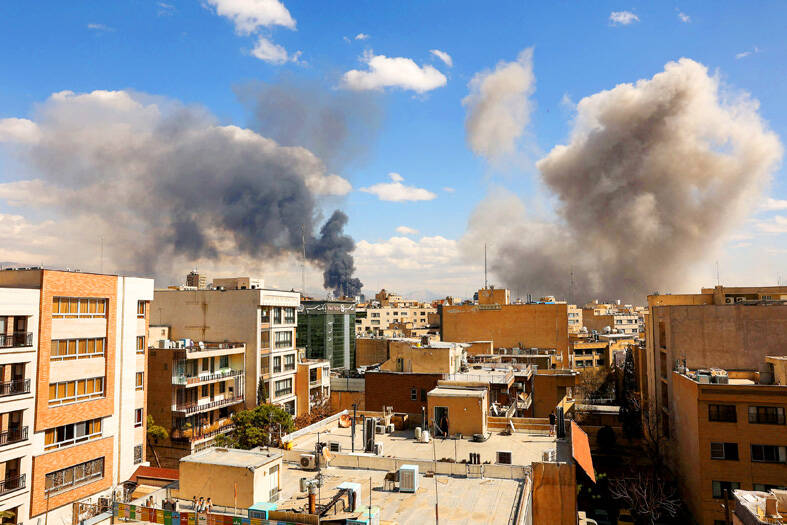
Photo: West Asia News Agency via Reuters
Su said that beyond pulling Iran’s “nuclear fangs,” Khamenei’s death raises the possibility of regime change, which could trigger a broader “reordering of the Middle Eastern order” with significant second and third-order effects for Beijing.
“If US-Israeli military operations achieve substantial suppression of Iran, the regional security architecture would be reshaped,” he said. “For Beijing, this would mean simultaneous constraints on its energy security, diplomacy, military cooperation and strategic timelines.”
With the Middle East stabilized, US “strategic freedom of action” would expand, enabling Washington to allocate more resources to the Indo-Pacific to counter China — effectively giving US President Donald Trump greater leverage in a scheduled summit with Chinese President Xi Jinping (習近平), he said.
A weakened Iran would deprive Beijing of a key Middle East partner in any anti-US alignment, Su said.
“During previous periods of US retrenchment from the region, Beijing expanded its influence, with Iran serving both as a node to circumvent US sanctions and as a land corridor under the Belt and Road Initiative,” he said. “If Iran is effectively removed as a strategic lever, Beijing’s room for maneuver in the Middle East would shrink considerably.”
Su added that Chinese-exported air defense systems — including the JY-10/26 radar series, Hongqi-7 and 9B surface-to-air missiles and the ‘Shennong Shield’ laser system — were shown to be ineffective, having been destroyed by US strikes during the campaign.
Washington’s broader strategy follows three principles: lowering costs in secondary theaters, encouraging allies to strengthen their defense capabilities and concentrating resources on countering China, he said.
For Beijing, the developments in Iran represent a geopolitical setback, while a strengthening democratic alignment could impose structural constraints on Chinese expansionism, Su said.
Chang Wu-yue (張五岳), director of Tunghai University’s Center for Mainland China and Regional Development Research, said yesterday that a series of abrupt US actions — including the abduction of then Venezuelan president Nicolas Maduro, the confirmed killing of Khamenei and prior US involvement in port operations linked to the Panama Canal — are indirectly aimed at countering China’s global influence.
Venezuela and Iran are major oil-producing states with close ties to Beijing, he said.
Separately, China had exercised significant influence over operations at the Panama Canal through a lease on two ports held by Hong Kong-based CK Hutchison Holdings, until Panamanian President Jose Raul Mulino on Monday last week ordered the temporary occupation of the ports.
Chang cautioned against assuming the US would apply similar precision strikes against China as it did against Venezuela and Iran.
China’s possession of nuclear weapons and its distinct geopolitical position make the situations fundamentally different, he said.
While Beijing is likely to draw lessons from recent events, US strikes on Iran should not be interpreted as a template for action against China.
Some academics had previously suggested that Taiwan could become a bargaining chip in talks between Xi and Trump. However, Chang said there is no need for concern, adding that recent US actions indicate the likelihood of Washington abandoning support for Taiwan is diminishing.
With a leaders’ meeting expected in early next month, time constraints and domestic pressures on both sides make sweeping agreements on trade or Taiwan unlikely, he said.

A signaling system malfunction disrupted high-speed rail (HSR) services beginning at 8am today, with trains temporarily reduced to three northbound and three southbound trains per hour as authorities conduct inspections. The malfunction occurred on a section of track in Miaoli County during pre-operation checks early this morning, forcing northbound and southbound trains to use a single track, the HSR operator said. The regular schedule has been replaced with three hourly trains offering only nonreserved seating in each direction, stopping at every station, it said, adding that business class cars would still have reserved seating. Departures from terminal stations are scheduled at the top

Taiwan is still in the process of assessing the possibility of recruiting workers from Eswatini, the Ministry of Foreign Affairs said yesterday, adding that its goal is to help Eswatini upgrade its vocational training centers. If there are plans to recruit workers from Eswatini, safeguarding national security, protecting public health and ensuring the employment rights of Taiwanese would be prerequisites, Department of West Asian and African Affairs Director-General Yen Chia-liang (顏嘉良) told a news conference. Key considerations would also include filling labor shortages in specific industries, and fostering bilateral professional and technical exchanges, he said. Yen was asked about the progress of labor

A US uncrewed surface vessel (USV) encountered multiple Chinese warships during an autonomous transit of the Taiwan Strait, US defense company Seasats said in a statement on Wednesday. Seasats announced that a Lightfish USV had completed the first autonomous transit of the Taiwan Strait. Over five days, the USV traversed the entire length of the Strait while constantly monitoring surface vessel traffic, the company said. The Lightfish encountered multiple Chinese warships, one of which was a Chinese People’s Liberation Army Navy (PLAN) Type 056 corvette, it said. The Chinese vessels were operating “well within Taiwan’s exclusive economic zone without transmitting their identity via the

VERBOSE VESSELS: A CGA cutter and a China Coast Guard exchanged verbal barbs for more than a day in Taiwanese-controlled waters before the Chinese vessel left The Taiwanese and Chinese coast guards had a standoff near the strategically located Pratas Islands (Dongsha Islands, 東沙群島) in the north of the South China Sea, the Coast Guard Administration (CGA) said yesterday. The two sides engaged in intense radio exchanges over sovereignty claims during the 33-hour standoff. China Coast Guard vessel 3501 eventually left the restricted waters, 26.6 nautical miles (49.2km) west of the Pratas Islands, at 5pm yesterday, the CGA said. Lying approximately between southern Taiwan and Hong Kong, the Taiwan-controlled Pratas are seen by some security experts as vulnerable to Chinese attack due to their distance — more than


 RSS
RSS