


Only under a democratic system, in which the public is sovereign, can a nation prevent the state apparatus from harming its citizens, President William Lai (賴清德) said yesterday at an event to mark the 79th anniversary of the 228 Incident at the National 228 Incident Memorial Ceremony in Kaohsiung.
The 228 Incident refers to a crackdown launched by the then-Chinese Nationalist Party (KMT) regime against civilian demonstrators following an incident in Taipei on Feb. 27, 1947.
It marked the beginning of what is known as the 228 Massacre and led to the White Terror era, which saw thousands of Taiwanese arrested, imprisoned and executed.
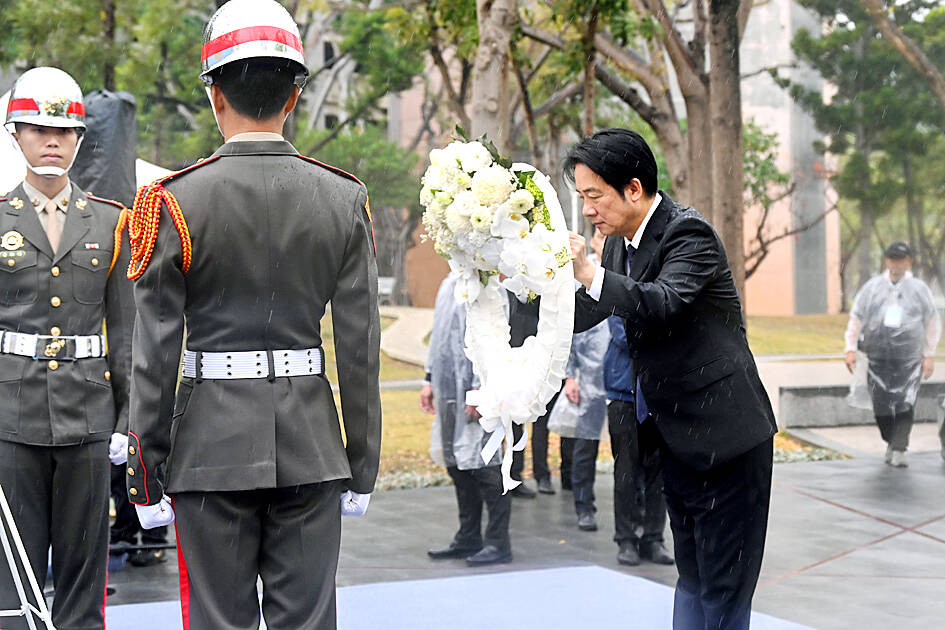
Photo: Lee Hui-chou, Taipei Times
China has attempted to annex Taiwan using various methods, Lai said.
As president, his primary mission is to protect the people, unite political blocs and the public, avoid regressing, and ensure that the public has the right to decide its future, he said.
“While peace is invaluable, it must be grounded in ideals, not illusions,” he said. “Only peace backed by strength is true peace. Surrendering sovereignty under the guise of peace talks to advance unification is not real peace. It would only suppress democracy, harm human rights and lead to endless problems.”
The Restoration of Victims’ Rights Infringed by Illegal Acts of the State During the Period of Authoritarian Rule Foundation last year issued more than 1,500 honorary recovery certificates, Lai said, adding that the certificates are part of the government’s effort to deliver delayed justice and fairness to the people who died in the White Terror and their families.
The Ministry of Culture has begun a review process to preserve more “locations of transitional justice significance,” he said, adding that the site of the Lin (林) family murders in what is today Gikong Presbyterian Church in Taipei’s Daan District (大安) has been approved as one of the sites.
The Lin family murders refers to the killings of the mother and twin daughters of political activist Lin I-hsiung (林義雄) at their home on Feb. 28, 1980, while Lin was imprisoned over the pro-democracy Kaohsiung Incident.
The murders are one of the most high-profile homicide cases in modern Taiwanese history and is unsolved.
Lai devoted part of his speech to the issue of historical records that could help uncover the truth behind the Lin family murders, an apparent response to controversy surrounding an unreleased film about the case, titled Murder of the Century (世紀血案).
The National Security Bureau last month declassified more than 50,000 martial law-era political records, he said, adding that the material was identified after the bureau spent 16 months manually sorting through more than 1 million archival records.
Combined with archives declassified since Taiwan’s first transition of power in 2000, the bureau has transferred 140,000 unredacted political records to the National Archives Administration for public review, Lai said.
However, “archives about the Lin family case are incomplete and much of the oral history has proven unreliable or fabricated,” he said.
“That intelligence files could be so brazenly and systematically destroyed during the one-party-state era raises the question: Who had the power to destroy the records? Who could have ordered intelligence units to obstruct the judicial investigation? Only the government in power had that kind of authority,” he said.
Separately yesterday, Vice President Hsiao Bi-khim (蕭美琴) spoke during a memorial service at Gikong Presbyterian Church to mark the 46th anniversary of the Lin family murders, stressing the importance of understanding history.
“Understanding the past gives us the strength to face the future and cherish this land more deeply. It is our responsibility to safeguard this path of democracy — one paved with lives, blood and tears,” she said.

A signaling system malfunction disrupted high-speed rail (HSR) services beginning at 8am today, with trains temporarily reduced to three northbound and three southbound trains per hour as authorities conduct inspections. The malfunction occurred on a section of track in Miaoli County during pre-operation checks early this morning, forcing northbound and southbound trains to use a single track, the HSR operator said. The regular schedule has been replaced with three hourly trains offering only nonreserved seating in each direction, stopping at every station, it said, adding that business class cars would still have reserved seating. Departures from terminal stations are scheduled at the top

Taiwan is still in the process of assessing the possibility of recruiting workers from Eswatini, the Ministry of Foreign Affairs said yesterday, adding that its goal is to help Eswatini upgrade its vocational training centers. If there are plans to recruit workers from Eswatini, safeguarding national security, protecting public health and ensuring the employment rights of Taiwanese would be prerequisites, Department of West Asian and African Affairs Director-General Yen Chia-liang (顏嘉良) told a news conference. Key considerations would also include filling labor shortages in specific industries, and fostering bilateral professional and technical exchanges, he said. Yen was asked about the progress of labor

VERBOSE VESSELS: A CGA cutter and a China Coast Guard exchanged verbal barbs for more than a day in Taiwanese-controlled waters before the Chinese vessel left The Taiwanese and Chinese coast guards had a standoff near the strategically located Pratas Islands (Dongsha Islands, 東沙群島) in the north of the South China Sea, the Coast Guard Administration (CGA) said yesterday. The two sides engaged in intense radio exchanges over sovereignty claims during the 33-hour standoff. China Coast Guard vessel 3501 eventually left the restricted waters, 26.6 nautical miles (49.2km) west of the Pratas Islands, at 5pm yesterday, the CGA said. Lying approximately between southern Taiwan and Hong Kong, the Taiwan-controlled Pratas are seen by some security experts as vulnerable to Chinese attack due to their distance — more than

A US uncrewed surface vessel (USV) encountered multiple Chinese warships during an autonomous transit of the Taiwan Strait, US defense company Seasats said in a statement on Wednesday. Seasats announced that a Lightfish USV had completed the first autonomous transit of the Taiwan Strait. Over five days, the USV traversed the entire length of the Strait while constantly monitoring surface vessel traffic, the company said. The Lightfish encountered multiple Chinese warships, one of which was a Chinese People’s Liberation Army Navy (PLAN) Type 056 corvette, it said. The Chinese vessels were operating “well within Taiwan’s exclusive economic zone without transmitting their identity via the


 RSS
RSS