


Until China-born Taiwan People’s Party (TPP) Legislator Li Zhenxiu’s (李貞秀) eligibility to serve in public office has been confirmed, government agencies should not provide her with any information, confidential or otherwise, Premier Cho Jung-tai (卓榮泰) said yesterday.
Li, who was born in China, but has lived in Taiwan for more than three decades, has faced scrutiny over whether she is eligible to serve as a lawmaker.
Although she has a Taiwanese passport and claimed she had renounced her Chinese household registration in 1993, Li said that China declined her request to renounce her Chinese citizenship in March last year, raising questions as to whether she is eligible to serve in public office.
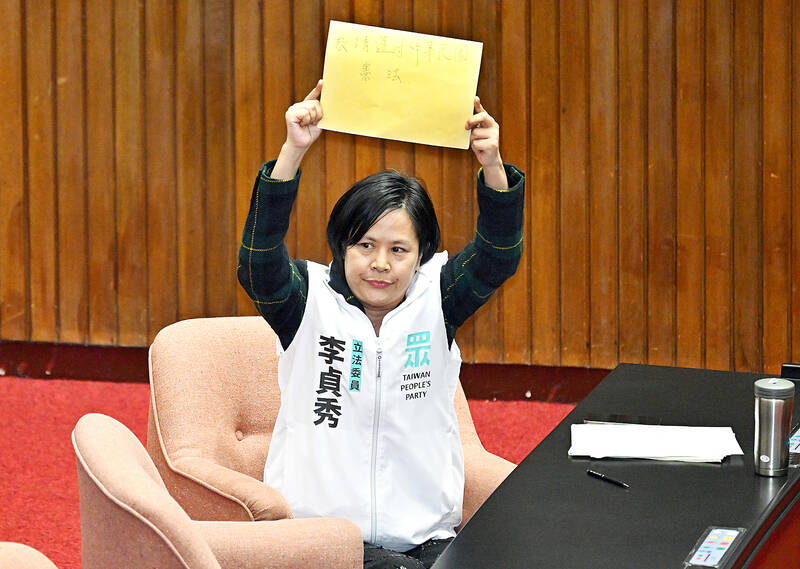
Photo: Liao Chen-huei, Taipei Times
Under Article 20 of the Nationality Act (國籍法), people who hold other nationalities are prohibited from serving in public office. Public officials must renounce other citizenships before taking office and complete their renunciation with documentary proof within one year of assuming office.
It is also unclear whether she could serve due to regulations under the Act Governing Relations Between the People of the Taiwan Area and the Mainland Area (臺灣地區與大陸地區人民關係條例), which stipulates that Chinese nationals are only eligible to run for public office after they have been a naturalized Taiwanese citizen for at least 10 years.
Although Li submitted evidence that she canceled her Chinese household registration in 1993, the Mainland Affairs Council (MAC) said the format and content of the certificate were “unusual” and it had never seen such wording before.
Therefore, it would only recognize the date the certificate was submitted to the National Immigration Agency, which was in March last year, the council said.
MAC Minister Chiu Chui-cheng (邱垂正) earlier this month said the 10-year registered citizenship requirement under the cross-strait act should be calculated from the date a person fully completes the naturalization process — namely, after obtaining a residency certificate and a Taiwan national ID card, and submitting proof of having renounced their Chinese citizenship.
The council on Tuesday said the ultimate decision about whether to accept Li’s qualifications lies with the Legislative Yuan, although the Cabinet has made its concerns clear.
Following yesterday morning’s Cabinet meeting, Executive Yuan spokeswoman Michelle Lee (李慧芝) said that Cho advised lawmakers at a meeting earlier this week to exercise caution when sharing information with Li, as her qualifications are still awaiting confirmation.
Li’s case is unclear under both the Nationality Act and the cross-strait act, Cho said, advising all ministries to refrain from providing her any information, confidential or otherwise.
MAC Deputy Minister Liang Wen-chieh (梁文傑) yesterday said the premier’s warning was understandable and should be followed accordingly.
“If you suspect that someone is not a real police officer, would you still accept their request for interrogation, and even allow them to enter and search your house?” Liang said.
“So far, we still have doubts about Li’s qualifications to serve as a legislator in Taiwan. As the premier has clearly stated his position on the matter, all administrative agencies in the Cabinet should follow his recommendation. No government agency should act independently,” he added.
Former TPP chairman Ko Wen-je (柯文哲) yesterday reiterated that Li is a qualified public official whose eligibility was reviewed and approved by the Central Election Commission and who was issued a certificate of election.
Ko also said that if Cho intends to keep questioning Li’s status as a legislator, he should state plainly whether “Chinese spouses are foreigners,” and clarify whether “Chinese spouses who hold Taiwan ID cards have political rights.”
“If Cho is willing to say so openly, we’ll have Li step down,” Ko said.
Additional reporting by Shelley Shan and Chen Chih-cheng

A signaling system malfunction disrupted high-speed rail (HSR) services beginning at 8am today, with trains temporarily reduced to three northbound and three southbound trains per hour as authorities conduct inspections. The malfunction occurred on a section of track in Miaoli County during pre-operation checks early this morning, forcing northbound and southbound trains to use a single track, the HSR operator said. The regular schedule has been replaced with three hourly trains offering only nonreserved seating in each direction, stopping at every station, it said, adding that business class cars would still have reserved seating. Departures from terminal stations are scheduled at the top
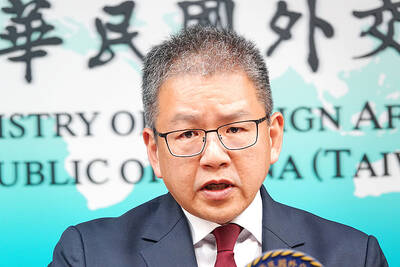
Taiwan is still in the process of assessing the possibility of recruiting workers from Eswatini, the Ministry of Foreign Affairs said yesterday, adding that its goal is to help Eswatini upgrade its vocational training centers. If there are plans to recruit workers from Eswatini, safeguarding national security, protecting public health and ensuring the employment rights of Taiwanese would be prerequisites, Department of West Asian and African Affairs Director-General Yen Chia-liang (顏嘉良) told a news conference. Key considerations would also include filling labor shortages in specific industries, and fostering bilateral professional and technical exchanges, he said. Yen was asked about the progress of labor

VERBOSE VESSELS: A CGA cutter and a China Coast Guard exchanged verbal barbs for more than a day in Taiwanese-controlled waters before the Chinese vessel left The Taiwanese and Chinese coast guards had a standoff near the strategically located Pratas Islands (Dongsha Islands, 東沙群島) in the north of the South China Sea, the Coast Guard Administration (CGA) said yesterday. The two sides engaged in intense radio exchanges over sovereignty claims during the 33-hour standoff. China Coast Guard vessel 3501 eventually left the restricted waters, 26.6 nautical miles (49.2km) west of the Pratas Islands, at 5pm yesterday, the CGA said. Lying approximately between southern Taiwan and Hong Kong, the Taiwan-controlled Pratas are seen by some security experts as vulnerable to Chinese attack due to their distance — more than

A US uncrewed surface vessel (USV) encountered multiple Chinese warships during an autonomous transit of the Taiwan Strait, US defense company Seasats said in a statement on Wednesday. Seasats announced that a Lightfish USV had completed the first autonomous transit of the Taiwan Strait. Over five days, the USV traversed the entire length of the Strait while constantly monitoring surface vessel traffic, the company said. The Lightfish encountered multiple Chinese warships, one of which was a Chinese People’s Liberation Army Navy (PLAN) Type 056 corvette, it said. The Chinese vessels were operating “well within Taiwan’s exclusive economic zone without transmitting their identity via the


 RSS
RSS