


German Chancellor Friedrich Merz yesterday urged Chinese firms to step up investment in Germany, but also called on Beijing to reduce market distortions as he began a visit aimed at resetting relations between the world’s second and third-largest economies.
On his first visit to China as chancellor, Merz, who was accompanied by a large business delegation, told Chinese President Xi Jinping (習近平) that he wanted to deepen economic ties with China, Germany’s largest trading partner last year.
“There are challenges, which we should talk about today, but the framework in which we operate is exceptionally good and we have worked together very well over the past decades,” he said.
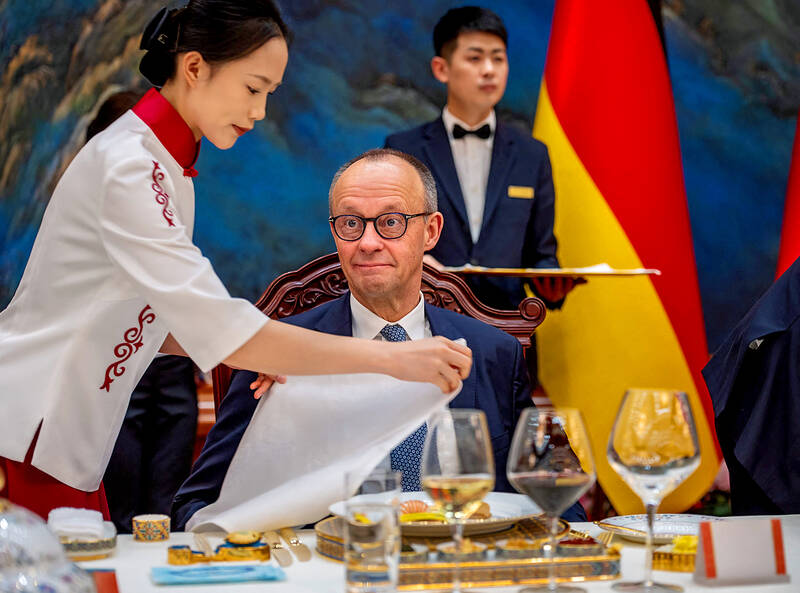
Photo: Reuters
Xi, who has sought to position China as a reliable partner in an increasingly unpredictable world, welcomed the comments from Merz, who faces a tough balancing act of redefining an economic relationship that is increasingly unfavorable to German interests.
“The more turbulent and intertwined the world becomes, the more China and Germany need to strengthen strategic communication and enhance strategic mutual trust,” he said.
In an earlier meeting with Chinese Premier Li Qiang (李強), Merz said there were “very specific concerns regarding our cooperation, which we want to improve and make fair.”
“We want Chinese investment in Germany,” Merz said at a business event attended by senior German and Chinese business leaders from the tech and auto sectors.
Li called on both sides to work together to safeguard multilateralism and free trade, in a comment seen as a reference to US President Donald Trump’s trade war.
“China and Germany, as two of the world’s largest economies and major countries with important influence, should strengthen our confidence in cooperation, jointly safeguard multilateralism and free trade, and strive to build a more just and fair global governance system,” Li said.
Despite their calls for deeper engagement, the agreements Merz and Li formalized after their meeting were narrowly targeted and in industries peripheral to both economies.
The five documents signed covered continued efforts in climate change and green transition, cooperation in animal disease prevention and a poultry products protocol, as well as sports collaboration agreements for soccer and table tennis.
That paled in comparison with Canada and the UK, which respectively signed eight and 12 documents with China last month during visits by Canadian Prime Minister Mark Carney and British Prime Minister Keir Starmer.

‘NO SECURITY RISK’: The Railway Bureau reassured the public that the technicians’ activities were limited to technical guidance and did not involve sensitive systems The Railway Bureau yesterday said it had invited eight Chinese technicians to assist with an airport MRT construction project. The bureau issued the confirmation after an Internet user said Chinese nationals had entered the construction zone of Taiwan Taoyuan International Airport’s Terminal 3 project. They asked why “individuals from an enemy state” were allowed access to such a major national infrastructure project, which raised serious concerns over Taiwan’s industrial safety, sensitive systems and information security. The bureau’s Northern Region Engineering Branch Office said subcontractor Taiwan Handle Industrial Co (台灣手把工業) of the Taoyuan airport MRT’s “Contract No. CU05 Project A14 Station Civil, MEP &

A US uncrewed surface vessel (USV) encountered multiple Chinese warships during an autonomous transit of the Taiwan Strait, US defense company Seasats said in a statement on Wednesday. Seasats announced that a Lightfish USV had completed the first autonomous transit of the Taiwan Strait. Over five days, the USV traversed the entire length of the Strait while constantly monitoring surface vessel traffic, the company said. The Lightfish encountered multiple Chinese warships, one of which was a Chinese People’s Liberation Army Navy (PLAN) Type 056 corvette, it said. The Chinese vessels were operating “well within Taiwan’s exclusive economic zone without transmitting their identity via the
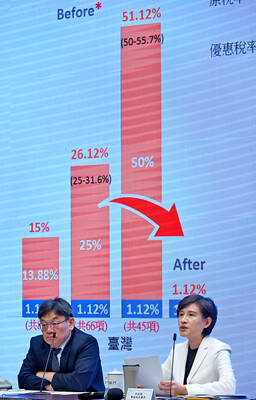
GREATER REACH? Auto parts and wood products would face tariffs of up to 15%, matching those targeting the EU, Japan and South Korea, Vice Premier said The US has announced that preferential tariff treatment for Taiwan’s non-semiconductor Section 232 goods would take effect retroactively from May 1, the Executive Yuan said yesterday. The US government yesterday posted a notice on the Federal Register’s public inspection Web site previewing tariff concessions for Taiwan under a memorandum of understanding (MOU) on Taiwan-US investment after two months of negotiations. The MOU signed on Jan. 15 stipulated three major preferential tariff arrangements: a 15 percent “reciprocal” tariff rate for Taiwan without stacking most-favored nation (MFN) rates; preferential Section 232 treatment for semiconductors and related products; and preferential Section 232 treatment for non-semiconductor

The National Chungshan Institute of Science and Technology yesterday showcased its locally developed variants of the Vision 60 robotic patrol dog, which it plans to deploy on the nation’s outlying territories in the South China Sea. The variants were produced under the Joint Lab project — created by the institute and domestic companies — and assembled with domestically produced motors, lenses and artificial intelligence (AI) systems alongside licensed tech from the US, Missile and Rocket Systems Research Division deputy director Jen Kuo-kang (任國光) told the media event at a military base in Taipei’s Dazhi (大直) area. Taiwan has built up its strengths


 RSS
RSS