


US President Donald Trump was expected to use his State of the Union address yesterday to champion his immigration crackdowns, his slashing of the federal government, his push to preserve widespread tariffs that the Supreme Court just struck down and his ability to direct quick-hit military actions around the world, including in Iran and Venezuela.
The Republican hoped he could convince increasingly wary Americans that his policies had improved their lives while ensuring that the US economy was stronger than many believe — and that they should vote for more of the same in November.
The balancing act of celebrating his whirlwind first year back in the White House while making a convincing case for his party in midterm races where he personally would not be on the ballot is a tall order for any president, but it could prove especially delicate for Trump, given how happy he is to veer off script and ignore carefully crafted messaging.
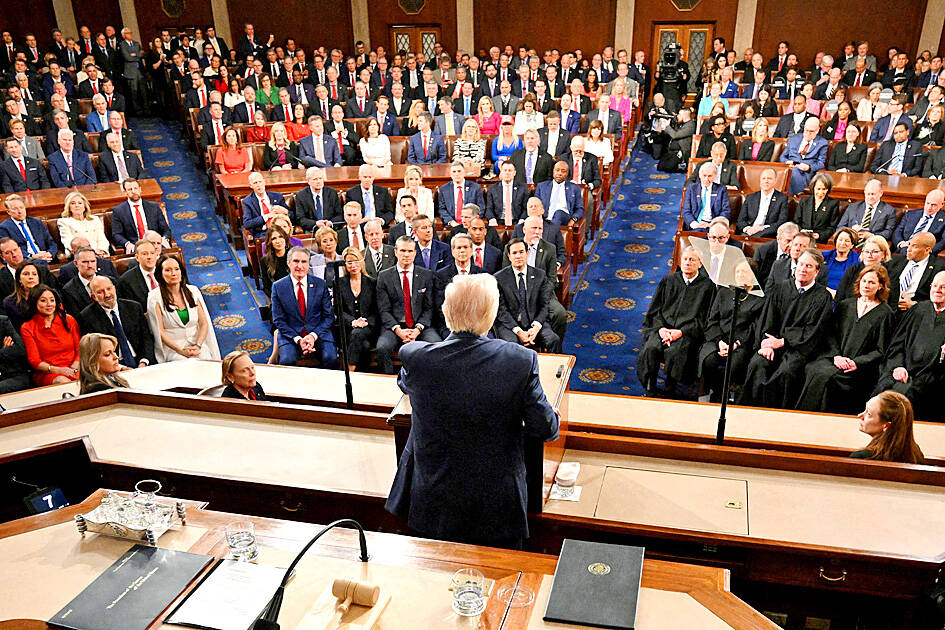
Photo: Reuters
A main theme would be that the country is booming with a rise in domestic manufacturing and new jobs, despite many Americans not feeling that way.
“It’s going to be a long speech, because we have so much to talk about,” said Trump, who promised a heavy dose of talk about the economy.
The president was also expected to decry the Supreme Court ruling against his signature tariff policies and talk about his attempts to maneuver around that decision without depending on Congress or spooking financial markets.
He was also likely to urge lawmakers to increase military funding and tighten voter identification requirements, while defending immigration operations that have drawn bipartisan criticism following the shooting deaths of two US citizens.
Jeff Shesol, a former speechwriter for former US president Bill Clinton, said Trump has typically used State of the Union addresses to offer more conventional tones than his usual bombast — but he was still apt to exaggerate repeatedly.
“His job, for the sake of his party, is to show the silver lining,” Shesol said. “But if he’s going to insist that the silver lining is gold, no one’s buying it. And it will be a very difficult position on the campaign trail for Republicans to defend.”
Trump’s lack of messaging discipline has been on display after concerns about high costs of living helped propel Democratic wins around the country on Election Day in November last year.
The White House subsequently promised that the president would travel the country nearly every week to reassure Americans he was taking affordability seriously.
However, Trump has spent more time blaming Democrats and scoffing at the notion that kitchen-table issues demand attention.
Trump instead boasts of having tamed inflation and says he has the economy humming given that the Dow Jones Industrial Average recently exceeded 50,000 points for the first time.
However, such gains do not feel tangible to those without stock portfolios. There are persistent fears that tariffs stoked higher prices, which could eventually hurt the economy and job creation.
Economic growth slowed the last three months of last year.
Waldman, now president of the Brennan Center for Justice, which advocates for democracy, civil liberties and fair elections, said previous presidents faced similar instances of “economic disquiet.”
That created a question of “how much do you sell vs feeling the pain of the electorate,” he said.
Shesol said that Trump has “always believed — going back to his real estate days — that he can sell anyone on anything.”
“He’s still doing that. But the problem is, you can’t tell somebody who has lost their job and can’t get a new one that things are going great,” Shesol said. “He can’t sell people on a reality that for them, and frankly for most Americans, does not exist.”
It is potentially politically perilous ahead of November elections that could deliver congressional wins to Democrats, just as 2018’s “blue wave” created a strong check to his administration during his first term.
Several Democrats in Congress planned to slip yesterday’s speech in protest, instead attending a rally known as the “People’s State of the Union” on Washington’s National Mall.

Japan has deployed long-range missiles in a southwestern region near China, the Japanese defense minister said yesterday, at a time when ties with Beijing are at their lowest in recent years. The missiles were installed in Kumamoto in the southern region of Kyushu, as Japan is attempting to shore up its military capacity as China steps up naval activity in the East China Sea. “Standoff defense capabilities enable us to counter the threat of enemy forces attempting to invade our country ... while ensuring the safety of our personnel,” Japanese Minister of Defense Shinjiro Koizumi said. “This is an extremely important initiative for
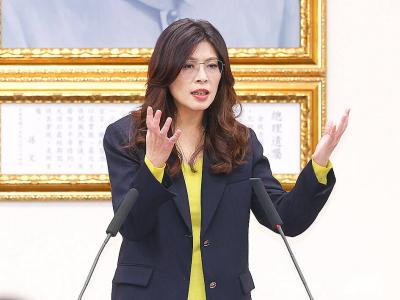
Chinese Nationalist Party (KMT) Chairwoman Cheng Li-wun (鄭麗文) today accepted an invitation from Chinese President Xi Jinping (習近平) to lead a delegation to China next month, saying she hopes to promote the peaceful development of cross-strait relations and bring stability to the Taiwan Strait. “I am grateful and happy to accept this invitation,” Cheng said in a statement from the KMT chairperson’s office. Cheng said she hopes both sides can work together to promote the peaceful development of cross-strait relations, enhance exchange and cooperation, bring stability to the Taiwan Strait and improve people’s livelihoods. At today's news conference, Cheng said any efforts to

MORE POPULAR: Taiwan Pass sales increased by 59 percent during the first quarter compared with the same period last year, the Tourism Administration said The Tourism Administration yesterday said that it has streamlined the Taiwan Pass, with two versions available for purchase beginning today. The tourism agency has made the pass available to international tourists since 2024, allowing them to access the high-speed rail, Taiwan Railway Corp services, four MRT systems and four Taiwan Tourist Shuttles. Previously, five types of Taiwan Pass were available, but some tourists have said that the offerings were too complicated. The agency said only two types of Taiwan Pass would be available, starting from a three-day pass with the high-speed rail and a three-day pass with Taiwan Railway Corp. The former costs NT$2,800

The nation’s fastest supercomputer, Nano 4 (晶創26), is scheduled to be launched in the third quarter, and would be used to train large language models in finance and national defense sectors, the National Center for High-Performance Computing (NCHC) said. The supercomputer, which would operate at about 86.05 petaflops, is being tested at a new cloud computing center in the Southern Taiwan Science Park in Tainan. The exterior of the server cabinet features chip circuitry patterns overlaid with a map of Taiwan, highlighting the nation’s central position in the semiconductor industry. The center also houses Taiwania 2, Taiwania 3, Forerunner 1 and


 RSS
RSS