


School was yesterday canceled in several Mexican states and local and foreign governments alike warned their citizens to stay inside, as widespread violence erupted following the army’s killing of the powerful leader of the Jalisco New Generation Cartel (CJNG).
Nemesio Ruben Oseguera Cervantes, known as “El Mencho,” was the boss of one of the fastest-growing criminal networks in Mexico, notorious for trafficking fentanyl, methamphetamine and cocaine to the US, and staging brazen attacks against government officials who challenged it.
He was killed during a shoot-out in his home state of Jalisco, as the Mexican military attempted to capture him. Cartel members responded with violence across the country, blocking roads and setting fire to vehicles.
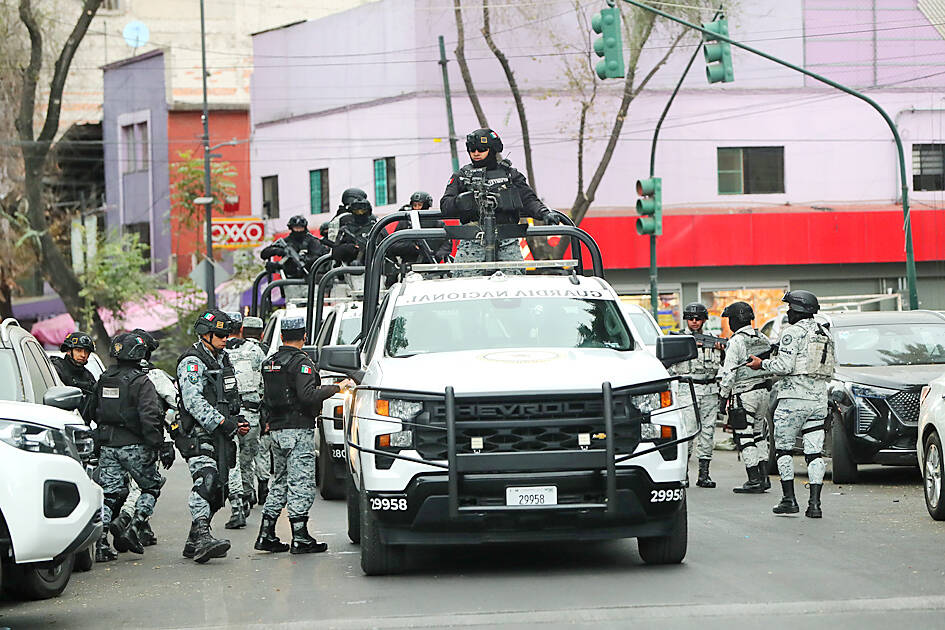
Photo: EPA
Mexican President Claudia Sheinbaum urged calm and authorities announced late on Sunday they had cleared most of the more than 250 cartel roadblocks across 20 states.
The White House confirmed that the US provided intelligence support to the operation to capture the cartel leader and applauded Mexico’s army for taking down a man who was one of the most wanted criminals in both countries.
Mexico hoped the death of the world’s biggest fentanyl traffickers would ease the pressure from US President Donald Trump’s administration to do more against the cartels, but many remained hunkered down and on edge as they waited to see the powerful cartel’s reaction.
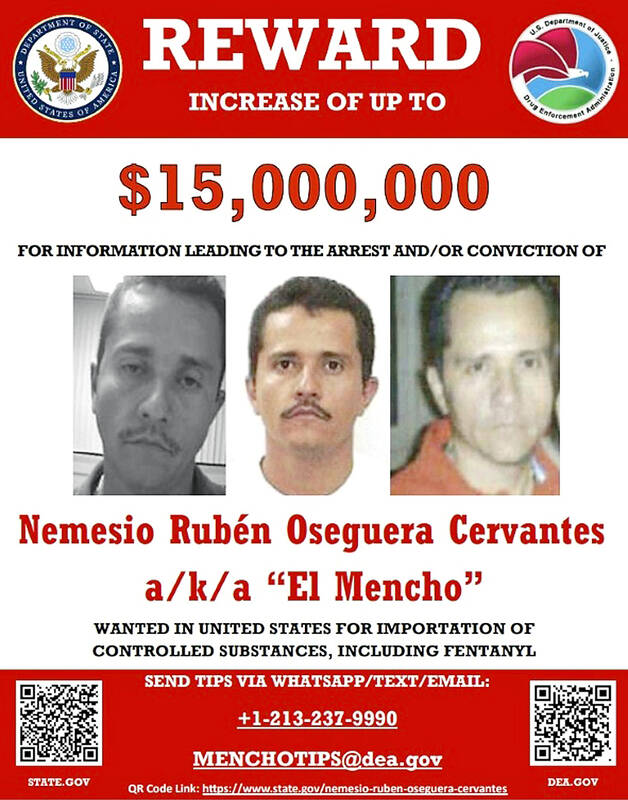
Photo courtesy of the US State Department via AFP
Guadalajara, the capital of Jalisco state and Mexico’s second-largest city, was almost completely shut down on Sunday as fearful residents stayed home.
Passengers arriving to the city’s international airport on Sunday night were told it was operating with limited personnel because of the burst of violence.
Authorities in Jalisco, Michoacan and Guanajuato reported at least 14 other people killed on Sunday, including seven National Guard troops.
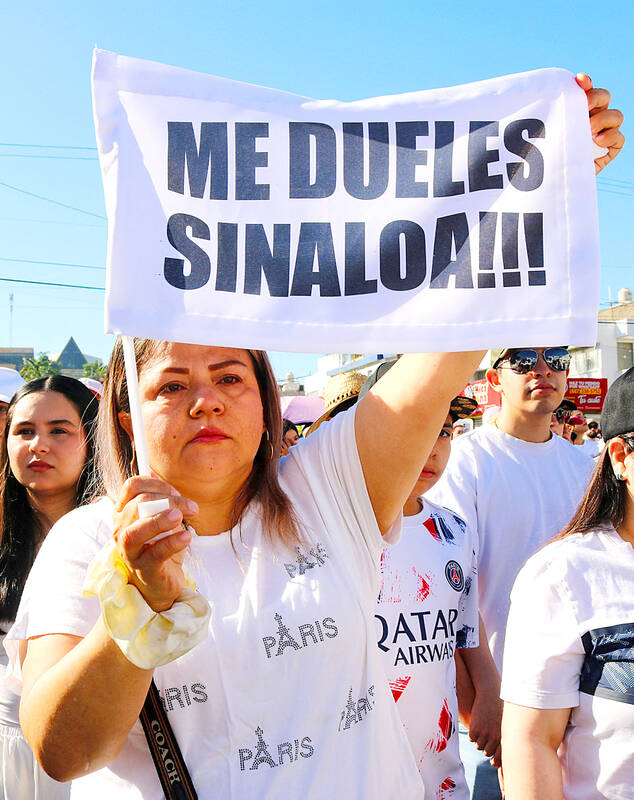
Photo: Reuters
Videos circulating on social media showed tourists in Puerto Vallarta walking on the beach with smoke rising in the distance.
In another part of the airport a group of elderly Mexicans gathered, discussing how to get home.
“We better all go together,” one said. “Go with God.”
David Mora, Mexico analyst for International Crisis Group, said the capture and outburst of violence mark a point of inflection in Sheinbaum’s push to crack down on cartels and relieve US pressures.
Trump has demanded Mexico do more to fight the smuggling of the often-deadly drug fentanyl, threatening to impose more tariffs or take unilateral military action if the country does not show results.
There were early signs that Mexico’s efforts were well received by the US.
US Ambassador Ron Johnson recognized the success of the Mexican armed forces and their sacrifice in a statement late on Sunday.
He added that “under the leadership of President Trump and President Sheinbaum, bilateral cooperation has reached unprecedented levels.”
However, it might also pave the way for more violence as rival criminal groups take advantage of the blow dealt to the CJNG, Mora said.
“This might be a moment in which those other groups see that the cartel is weakened and want to seize the opportunity for them to expand control and to gain control over Cartel Jalisco in those states,” he said.
“Ever since President Sheinbaum has been in power, the army has been way more confrontational, combative against criminal groups in Mexico,” Mora said. “This is signaling to the US that if we keep cooperating, sharing intelligence, Mexico can do it, we don’t need US troops on Mexican soil.”
Oseguera Cervantes, who was wounded in the operation to capture him on Sunday in Tapalpa, Jalisco, about a two-hour drive southwest of Guadalajara, died while being flown to Mexico City, the defense department said in a statement.
During the operation, troops came under fire and killed four people at the location. Three more people, including Oseguera Cervantes, were wounded and later died, the statement said.
White House Press Secretary Karoline Leavitt said via X that the US government provided intelligence support for the operation.
“‘El Mencho’ was a top target for the Mexican and United States government as one of the top traffickers of fentanyl into our homeland,” she wrote.
She commended Mexico’s military for its work.
The US Department of State had offered a reward of up to US$15 million for information leading to the arrest of El Mencho. The CJNG is one of the most powerful and fastest growing criminal organizations in Mexico and began operating around 2009.
In February last year, the Trump administration designated the cartel as a foreign terrorist organization.
Sheinbaum has criticized the “kingpin” strategy of previous administrations that took out cartel leaders, only to trigger explosions of violence as cartels fractured.
While she has remained popular in Mexico, security is a persistent concern and since Trump took office a year ago, she has been under tremendous pressure to show results against drug trafficking.
Taiwan has arranged for about 8 million barrels of crude oil, or about one-third of its monthly needs, to be shipped from the Red Sea this month to bypass the Strait of Hormuz and ease domestic supply pressures, CPC Corp, Taiwan (CPC, 台灣中油) said yesterday. The state-run oil company has worked with Middle Eastern suppliers to secure routes other than the Strait of Hormuz, through which about 20 percent of the world’s oil and liquefied natural gas typically passes, CPC chairman Fang Jeng-zen (方振仁) said at a meeting of the legislature’s Economics Committee in Taipei. Suppliers in Saudi Arabia have indicated they

South Korea has adjusted its electronic arrival card system to no longer list Taiwan as a part of China, a move that the Ministry of Foreign Affairs said would help facilitate exchanges between the two sides. South Korea previously listed “Taiwan” as “Taiwan (China)” in the drop-down menus of its online arrival card system, where people had to fill out where they came from and their next destination. The ministry had requested South Korea make a revision and said it would change South Korea’s name on Taiwan’s online immigration system from “Republic of Korea” to “Korea (South),” should the issue not be

CCP ‘PAWN’? Beijing could use the KMT chairwoman’s visit to signal to the world that many people in Taiwan support the ‘one China’ principle, an academic said Chinese Nationalist Party (KMT) Chairwoman Cheng Li-wun (鄭麗文) yesterday arrived in China for a “peace” mission and potential meeting with Chinese President Xi Jinping (習近平), while a Taiwanese minister detailed the number of Chinese warships currently deployed around the nation. Cheng is visiting at a time of increased Chinese military pressure on Taiwan, as the opposition-dominated Legislative Yuan stalls a government plan for US$40 billion in extra defense spending. Speaking to reporters before going to the airport, Cheng said she was going on a “historic journey for peace,” but added that some people felt uneasy about her trip. “If you truly love Taiwan,

Tainan, Taipei and New Taipei City recorded the highest fines nationwide for illegal accommodations in the first quarter of this year, with fines issued in the three cities each exceeding NT$7 million (US$220,639), Tourism Administration data showed. Among them, Taipei had the highest number of illegal short-term rental units, with 410. There were 3,280 legally registered hotels nationwide in the first quarter, down by 14 properties, or 0.43 percent, from a year earlier, likely indicating operators exiting the market, the agency said. However, the number of unregistered properties rose to 1,174, including 314 illegal hotels and 860 illegal short-term rental


 RSS
RSS