


The Executive Yuan in a policy report submitted to the legislature has underscored efforts to expand Taiwan’s domestic defense industry, particularly in shipbuilding, as new vessels were delivered to the military.
Defense technology research prioritizes uncrewed systems and counter-reconnaissance and surveillance capabilities, as well as atmospheric and hydrological research, naval vessel construction, cybersecurity, missile systems and other innovative, asymmetric technologies, the report said.
A total of 130 research and development projects are scheduled for execution this year, it said.
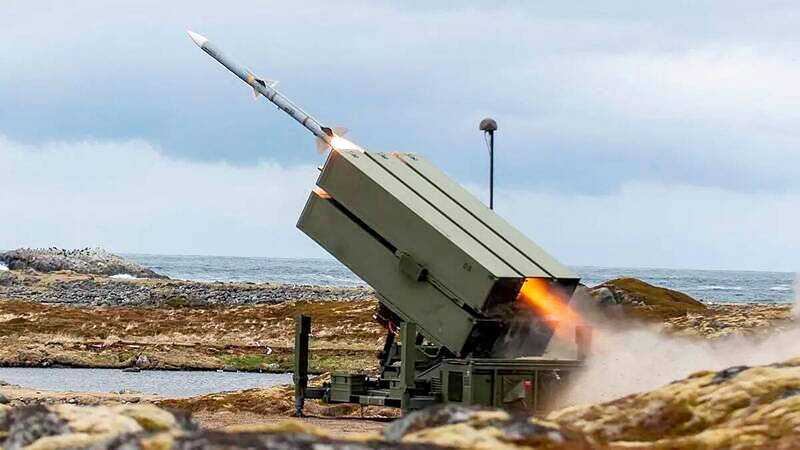
Photo: Screen grab from Kongsberg Defence and Aerospace Web site
Under the Indigenous Defense Submarine and broader shipbuilding programs, five classes of vessels are being constructed. The first consignment of six high-performance vessels and one rescue ship has been delivered and commissioned. A submarine prototype is undergoing sea trials in accordance with testing procedures, while two new-generation frigates and six fast minelaying vessels are progressing in line with planned milestones, it said.
The Indigenous Defense Fighter Trainer program, which began in 2017 and runs through this year, aims to produce 66 advanced jet trainers domestically. As of the end of December last year, 52 aircraft had been delivered, with production continuing on schedule to meet overall targets.
Force-building and combat-readiness efforts focus on bolstering asymmetric capabilities, boosting defense resilience, rebuilding reserve forces and improving responses to “gray zone” threats, the report said.
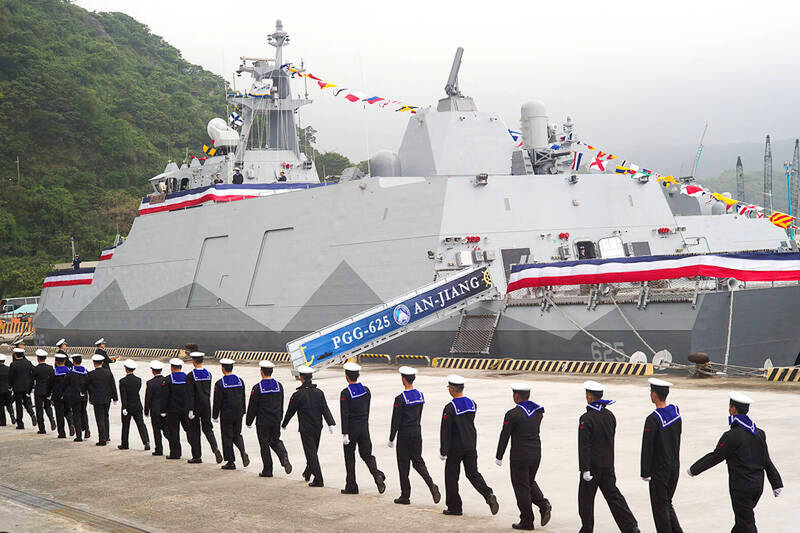
Photo: AFP
Procurement would adjust for evolving regional conditions and technological developments, while domestically produced weapons and equipment remain the priority, it said.
Eight categories of weapons systems, including anti-ship missile systems, are being produced according to schedule, it said.
The military is expanding cooperation with the private sector to integrate emerging and commercially available uncrewed technologies, leveraging civilian innovation and expertise to support operational needs, it added.
To foster industry growth, the Chungshan Institute of Science and Technology (CSIST) is advancing development of an industrial park dedicated to uncrewed systems, it said, adding that the Ministry of Economic Affairs and the Chiayi County Government are coordinating investment strategies to attract companies and form an industrial cluster aimed at building a non-red international supply chain.
Plans are under way to establish the “T-Dome” air-defense network through a dual-track approach combining indigenous development and foreign procurement.
The system is designed to provide layered defenses, enhanced situational awareness and flexible interception options, creating a mobile and resilient asymmetric air-defense capability, the report said.
Counter-drone systems are a priority, with the CSIST developing domestic platforms to complement commercially procured systems for outlying islands and frontline units, strengthening overall protection capabilities, it said.
Separately, the Ministry of National Defense (MND) is planning to buy nine National Advanced Surface-to-Air Missile Systems (NASAMS) from the US for deployment at air bases across Taiwan, a source said on Saturday.
In the previous arms sale package to Taiwan, Washington authorized the sale of three NASAMS, alongside High Mobility Artillery Rocket Systems, M109A7 self-propelled howitzers and anti-tank guided missiles.
Taiwan’s goal is to obtain that number of NASAMS as part of President William Lai’s (賴清德) signature initiative to build the “T-Dome,” a defense official familiar with the matter said on condition of anonymity.
The anticipated US arms package would consist of Integrated Air and Missile Battle Command Systems, Patriot surface-to-air missiles and NASAMS, the official said.
The package would likely include radar systems for detecting stealth aircraft, other supplementary radar systems and 123 AIM-120 air-to-air missiles, they said.
Although Taiwan had hoped for the package to be finalized early this year, US President Donald Trump is not expected to implement the sale until after his planned meeting with Chinese President Xi Jinping (習近平) in April.
The MND believes that at least nine NASAMS are needed to defend key air force installations and the strategically important Penghu archipelago, the official said.
NASAMS provides a capability to intercept medium and low-altitude threats ranging from hostile aircraft, cruise missiles and ballistic missiles, supplementing Taiwanese fighter jets’ air-to-air missiles, they said.
The AIM-120 missiles are launched from aircraft to shoot down enemy jets, helicopters, uncrewed aerial vehicles and cruise missiles at long range, they said.
The quantity of weapons Taiwan purchases ultimately depends on the US, they added.
The government is struggling to obtain legislative approval for a NT$1.25 trillion (US$39.66 billion) special defense budget to build the T-Dome, including authorization for funding the procurement of US weapon systems.
Additional reporting by Lo Tien-pin and Jonathan Chin

A signaling system malfunction disrupted high-speed rail (HSR) services beginning at 8am today, with trains temporarily reduced to three northbound and three southbound trains per hour as authorities conduct inspections. The malfunction occurred on a section of track in Miaoli County during pre-operation checks early this morning, forcing northbound and southbound trains to use a single track, the HSR operator said. The regular schedule has been replaced with three hourly trains offering only nonreserved seating in each direction, stopping at every station, it said, adding that business class cars would still have reserved seating. Departures from terminal stations are scheduled at the top

Taiwan is still in the process of assessing the possibility of recruiting workers from Eswatini, the Ministry of Foreign Affairs said yesterday, adding that its goal is to help Eswatini upgrade its vocational training centers. If there are plans to recruit workers from Eswatini, safeguarding national security, protecting public health and ensuring the employment rights of Taiwanese would be prerequisites, Department of West Asian and African Affairs Director-General Yen Chia-liang (顏嘉良) told a news conference. Key considerations would also include filling labor shortages in specific industries, and fostering bilateral professional and technical exchanges, he said. Yen was asked about the progress of labor

VERBOSE VESSELS: A CGA cutter and a China Coast Guard exchanged verbal barbs for more than a day in Taiwanese-controlled waters before the Chinese vessel left The Taiwanese and Chinese coast guards had a standoff near the strategically located Pratas Islands (Dongsha Islands, 東沙群島) in the north of the South China Sea, the Coast Guard Administration (CGA) said yesterday. The two sides engaged in intense radio exchanges over sovereignty claims during the 33-hour standoff. China Coast Guard vessel 3501 eventually left the restricted waters, 26.6 nautical miles (49.2km) west of the Pratas Islands, at 5pm yesterday, the CGA said. Lying approximately between southern Taiwan and Hong Kong, the Taiwan-controlled Pratas are seen by some security experts as vulnerable to Chinese attack due to their distance — more than

A US uncrewed surface vessel (USV) encountered multiple Chinese warships during an autonomous transit of the Taiwan Strait, US defense company Seasats said in a statement on Wednesday. Seasats announced that a Lightfish USV had completed the first autonomous transit of the Taiwan Strait. Over five days, the USV traversed the entire length of the Strait while constantly monitoring surface vessel traffic, the company said. The Lightfish encountered multiple Chinese warships, one of which was a Chinese People’s Liberation Army Navy (PLAN) Type 056 corvette, it said. The Chinese vessels were operating “well within Taiwan’s exclusive economic zone without transmitting their identity via the


 RSS
RSS