


North Korean leader Kim Jong-un vowed to lift living standards as he opened a landmark congress, state media said yesterday, offering a glimpse of economic strains within the sanctions-hit nation.
Kim took center stage with a speech to start the Workers’ Party congress, a gathering that directs state efforts on everything from house building to war planning.
Held just once every five years, the days-long congress offers a rare glimpse into the workings of a nation where even mundane details are shrouded in secrecy.
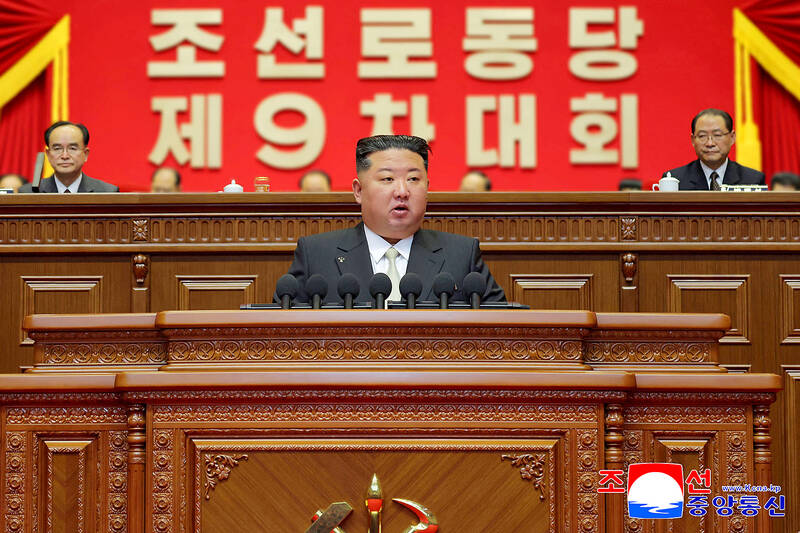
Photo: Korean Central News Agency via Reuters
“Today, our party is faced with heavy and urgent historic tasks of boosting economic construction and the people’s standard of living, and transforming all realms of state and social life as early as possible,” Kim said. “This requires us to wage a more active and persistent struggle without allowing even a moment’s standstill or stagnation.”
For decades, nuclear weapons and military prowess came before everything else in North Korea, even as food stocks dried up and famine took hold. However, since assuming power in 2011, Kim has stressed the need to also fortify the impoverished nation’s economy.
At the last party congress in 2021, Kim made an extremely rare admission that mistakes had been made in “almost all areas” of economic development.
Analysts believed such language is designed to head off public discontent stirred by food shortages, military spending and Pyongyang’s continued support for Russia’s war effort in Ukraine.
North Korea had overcome its “worst difficulties” in the last five years, and was now entering a new stage of “optimism and confidence in the future,” Kim said.
Its economy has for years languished under heavy Western sanctions that aim to choke off funding for its nuclear weapons program, but Pyongyang refuses to surrender its atomic arsenal.
Kim has already declared this year’s congress would unveil the next phase in the nation’s nuclear weapons program.
Thousands of party elites packed the cavernous House of Culture in Pyongyang for the opening day of the congress.
It is just the ninth time the Workers’ Party congress has convened under the Kim family’s decades-long rule.
The ruling parties of China and Russia sent friendly messages to mark the start of the meeting.
“In recent years, under the strategic guidance of the top leaders of the two parties and two countries, China-DPRK relations have entered a new historical period,” a telegram from the Chinese Communist Party said, using the official acronym for North Korea.

‘NO SECURITY RISK’: The Railway Bureau reassured the public that the technicians’ activities were limited to technical guidance and did not involve sensitive systems The Railway Bureau yesterday said it had invited eight Chinese technicians to assist with an airport MRT construction project. The bureau issued the confirmation after an Internet user said Chinese nationals had entered the construction zone of Taiwan Taoyuan International Airport’s Terminal 3 project. They asked why “individuals from an enemy state” were allowed access to such a major national infrastructure project, which raised serious concerns over Taiwan’s industrial safety, sensitive systems and information security. The bureau’s Northern Region Engineering Branch Office said subcontractor Taiwan Handle Industrial Co (台灣手把工業) of the Taoyuan airport MRT’s “Contract No. CU05 Project A14 Station Civil, MEP &

A US uncrewed surface vessel (USV) encountered multiple Chinese warships during an autonomous transit of the Taiwan Strait, US defense company Seasats said in a statement on Wednesday. Seasats announced that a Lightfish USV had completed the first autonomous transit of the Taiwan Strait. Over five days, the USV traversed the entire length of the Strait while constantly monitoring surface vessel traffic, the company said. The Lightfish encountered multiple Chinese warships, one of which was a Chinese People’s Liberation Army Navy (PLAN) Type 056 corvette, it said. The Chinese vessels were operating “well within Taiwan’s exclusive economic zone without transmitting their identity via the
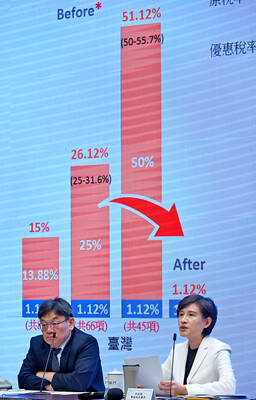
GREATER REACH? Auto parts and wood products would face tariffs of up to 15%, matching those targeting the EU, Japan and South Korea, Vice Premier said The US has announced that preferential tariff treatment for Taiwan’s non-semiconductor Section 232 goods would take effect retroactively from May 1, the Executive Yuan said yesterday. The US government yesterday posted a notice on the Federal Register’s public inspection Web site previewing tariff concessions for Taiwan under a memorandum of understanding (MOU) on Taiwan-US investment after two months of negotiations. The MOU signed on Jan. 15 stipulated three major preferential tariff arrangements: a 15 percent “reciprocal” tariff rate for Taiwan without stacking most-favored nation (MFN) rates; preferential Section 232 treatment for semiconductors and related products; and preferential Section 232 treatment for non-semiconductor
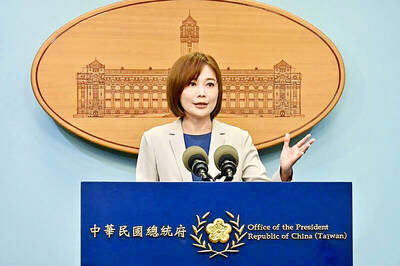
TIT-FOR-TAT: The US allegedly revoked the visa of a Chinese national working at Xinhua News Agency in the US in response to Beijing’s expulsion of Vivian Wang The Presidential Office yesterday condemned China for expelling a New York Times correspondent from Beijing following the newspaper’s interview with President William Lai (賴清德), saying the move highlighted Beijing’s suppression of press freedom and its threat to international news media. Taiwan has noted a series of recent incidents in which Beijing used similar tactics to “threaten and pressure international media outlets and journalists,” Presidential Office spokeswoman Karen Kuo (郭雅慧) said in a statement. “This concerns not only press freedom and freedom of expression, but also the safety of journalists, and Taiwan and relevant partners are paying close attention to the situation,” she


 RSS
RSS