


The Peruvian Congress was yesterday set to elect an interim president to replace Jose Jeri, who was impeached in a graft scandal just four months after taking office.
Jeri, 39, was accused in the irregular hiring of several women in his government, and of suspected graft involving a Chinese businessman.
The new interim president would be Peru’s eighth head of state in 10 years, after the Latin American country burned through a string of leaders who were impeached or investigated for wrongdoing.
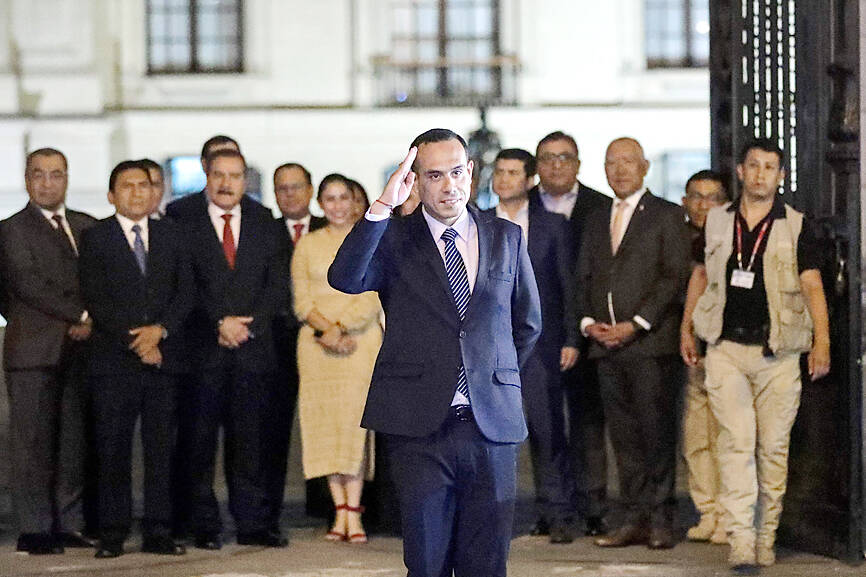
Photo: AFP
Lawmakers were to choose a new parliamentary speaker who would lead the country until July 28, when the next president elected in national polls takes office.
Jeri became president following the impeachment of his predecessor, Dina Boluarte, in October.
The vote, which was scheduled to begin at 6pm, would end a power vacuum of more than 24 hours, unprecedented in the nation’s recent history.
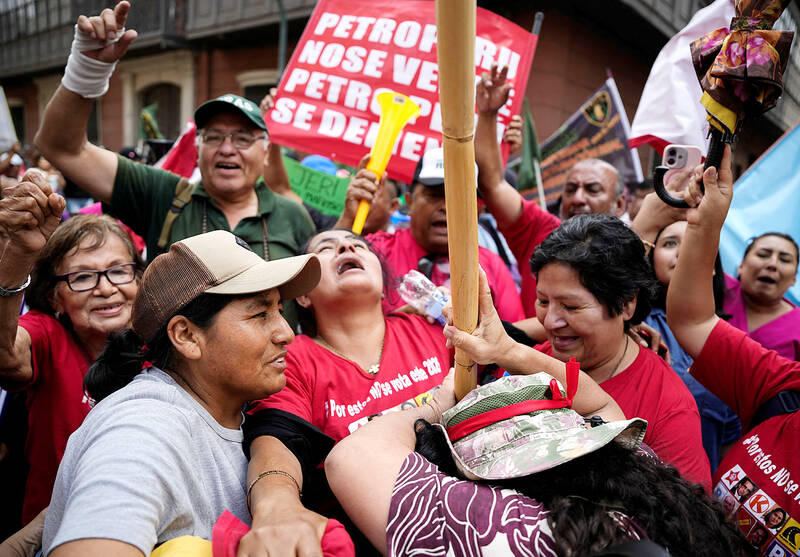
Photo: Reuters
Four members of the Peruvian Congress have thrown their hat in the ring for the top job: former Congress president Maria del Carmen Alva, left-wing congressman Jose Balcazar, veteran socialist Edgar Raymundo, and Hector Acuna, whose party is tainted by corruption scandals.
Alva is one of the favorites to win the vote.
Jeri is constitutionally barred from running.
Peru’s chronic political instability has seen four of its past seven presidents impeached, and two resigning before suffering the same fate. Only one completed his intended term, centrist academic Francisco Sagasti.
Congress on Tuesday voted overwhelmingly to impeach Jeri, who was serving as interim president after massive protests last year ousted Boluarte, Peru’s first female leader who served for only 22 months.
The new interim president is to serve out the remainder of Jeri’s term. A new leader would then take over following elections on April 12.
Peru has been gripped by a wave of extortion that has claimed dozens of lives, high levels of post-COVID-19 pandemic poverty and unemployment, and the domestic rise of gangs such as Venezuela’s Tren de Aragua.
Paula Jimenez, a 22-year-old saleswoman in the Peruvian capital, Lima, said the political crisis was “secondary” compared to the everyday problems of ordinary people.
She accused parliament of focusing on internal squabbles rather than the concerns of Peruvians.
Edgardo Torres, a 29-year-old industrial engineer from Lima, said Peru needed “a true leader” to bring some much-needed political stability.
Prosecutors last week opened an investigation into whether Jeri “exercised undue influence” in government appointments.
Jeri has protested his innocence.
He found himself in the spotlight over claims revealed by investigative TV program Cuarto Poder that five women were improperly given jobs in the president’s office and the environment ministry after meeting with Jeri.
Prosecutors said there were in fact nine women.
Jeri is also under investigation for alleged “illegal sponsorship of interests” following a secret meeting with a Chinese businessman with commercial ties with the government.

SILENCING CRITICS: In addition to blocking Taiwan, China aimed to prevent rights activists from speaking out against authoritarian states, a Cabinet department said The Ministry of Foreign Affairs (MOFA) yesterday condemned transnational repression by Beijing after RightsCon, a major digital human rights conference scheduled to be held in Zambia this week, was abruptly canceled due to Chinese pressure over Taiwanese participation. This year’s RightsCon, the world’s largest conference discussing issues “at the intersection of human rights and technology,” was scheduled to take place from tomorrow to Friday in Lusaka, and expected to draw 2,600 in-person attendees from 150 countries, along with 1,100 online participants. However, organizers were forced to cancel the event due to behind-the-scenes pressure from China, the ministry said, expressing its “strongest condemnation”
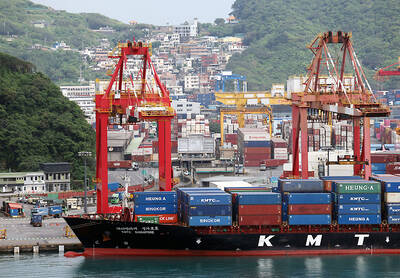
Taiwan’s economy grew far faster than expected in the first quarter, as booming demand for artificial intelligence (AI) applications drove a surge in exports, spilling over into investment and consumption, the Directorate-General of Budget, Accounting and Statistics (DGBAS) said yesterday. GDP growth was 13.69 percent year-on-year during the January-to-March period, beating the DGBAS’ February forecast by 2.23 percentage points and marking the most robust growth in nearly four decades, DGBAS senior official Chiang Hsin-yi (江心怡) told a news conference in Taipei. The result was powered by exports, which remain the backbone of Taiwan’s economy, Chiang said. Outbound shipments jumped 51.12 percent year-on-year to
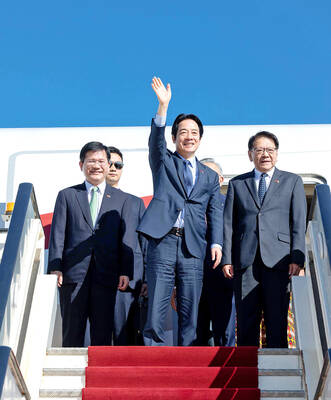
DELAYED BUT DETERMINED: The president’s visit highlights Taiwan’s right to international engagement amid regional pressure from China President Willaim Lai (賴清德) yesterday arrived in Eswatini, more than a week after his planned visit to Taiwan’s sole African ally was suspended because of revoked overflight permits. “The visit, originally scheduled for April 22, was postponed due to unforeseen external factors,” Lai wrote on social media. “After several days of careful arrangements by our diplomatic and national security teams, we successfully arrived today.” Lai said he looked forward to further deepening Taiwan-Eswatini relations through closer cooperation in the economy, agriculture, culture and education, as well as advancing the nation’s international partnerships. The president was initially scheduled to arrive in time to celebrate
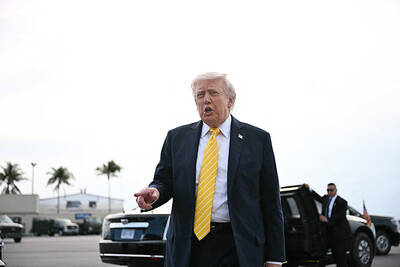
Iran’s Islamic Revolutionary Guard Corp (IRGC) yesterday said the US faced a choice between an “impossible” military operation or a “bad deal” with Tehran, after US President Donald Trump disparaged Iran’s latest peace proposal. Negotiations between the two countries have been deadlocked since a ceasefire came into effect on April 8, with only one round of direct peace talks held so far. Iran’s Tasnim and Fars news agencies reported that Tehran had submitted a 14-point proposal to mediator Pakistan, but Trump was quick to cast doubt on it. “I will soon be reviewing the plan that Iran has just sent to us, but


 RSS
RSS