


The Japanese House of Representatives yesterday formally reappointed Sanae Takaichi as prime minister, 10 days after her historic landslide election victory.
Takaichi, 64, became Japan’s first female prime minister in October and won a two-thirds majority for her party in the snap lower house elections on Feb. 8.
She has pledged to bolster Japan’s defenses to protect its territory and waters, likely further straining relations with Beijing, and to boost the flagging economy.
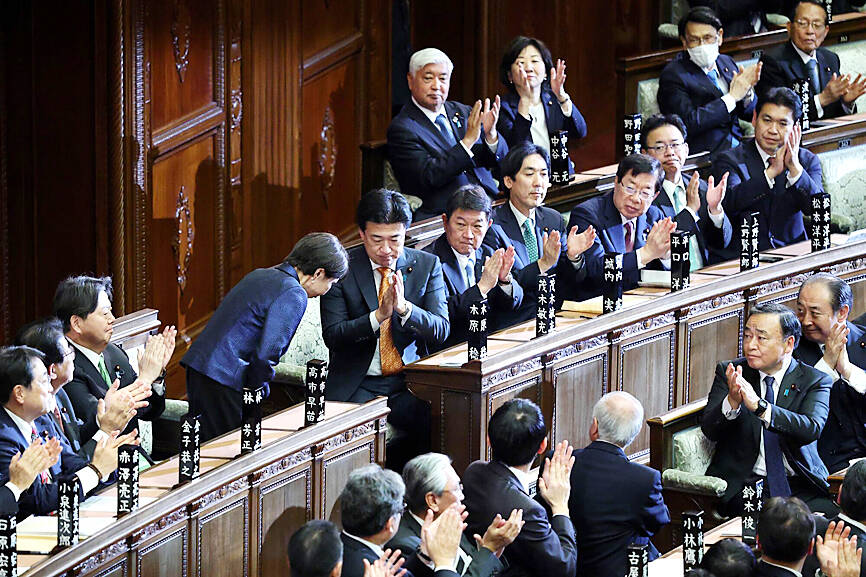
Photo: Bloomberg
Takaichi suggested in November that Japan could take military action if Beijing sought to take Taiwan by force — angering China.
Chinese Minister of Foreign Affairs Wang Yi (王毅) told the Munich Security Conference on Saturday that forces in Japan were seeking to “revive militarism.”
Takaichi is expected to pledge in a policy speech tomorrow to update Japan’s “Free and Open Indo-Pacific” (FOIP) strategic framework, local media reported.
“Compared with when FOIP was first proposed, the international situation and security environment surrounding Japan have become significantly more severe,” Japanese Chief Cabinet Secretary Minoru Kihara said on Monday.
In practice this would likely mean strengthening supply chains and promoting free trade through the Comprehensive and Progressive Agreement for Trans-Pacific Partnership.
Takaichi’s government also plans to pass legislation to establish a National Intelligence Agency and to begin concrete discussions towards an anti-espionage law, the reports said.
Takaichi has also promised to tighten rules surrounding immigration, even though Asia’s No. 1 economy is struggling with labor shortages and a falling population.
She is also expected to reiterate her campaign pledge to suspend consumption tax on food for two years to ease inflationary pressures on households, local media said.
This promise has exacerbated market worries about Japan’s colossal debt, with yields on long-dated government bonds hitting record highs last month.
IMF chief of mission in Japan Rahul Anand yesterday said that Japan’s debt interest payments would double from last year to 2031.
“Removing the consumption tax [on food] would weaken the tax revenue base, since the consumption tax is an important way to raise revenues without creating distortions in the economy,” Anand said.
To ease such concerns, Takaichi would repeat her mantra of having a “responsible, proactive” fiscal policy and set a target on reducing government debt, the reports said.
She would also announce the creation of a cross-party “national council” to discuss taxation and how to fund aging Japan’s ballooning social security bill.
However, Takaichi’s first order of business would be obtaining approval for Japan’s budget for the fiscal year beginning on April 1 after the process was delayed by the election.
The ruling coalition also wants to pass legislation that would outlaw destroying the Japanese flag, the media reports said.
It wants to accelerate debate on changing the constitution and on revising the imperial family’s rules to ease a looming succession crisis.
Takaichi and many within her Liberal Democratic Party (LDP) oppose making it possible for a woman to become emperor, but rules could be changed to “adopt” new male members.
Takaichi was due to give a news conference later yesterday.

A signaling system malfunction disrupted high-speed rail (HSR) services beginning at 8am today, with trains temporarily reduced to three northbound and three southbound trains per hour as authorities conduct inspections. The malfunction occurred on a section of track in Miaoli County during pre-operation checks early this morning, forcing northbound and southbound trains to use a single track, the HSR operator said. The regular schedule has been replaced with three hourly trains offering only nonreserved seating in each direction, stopping at every station, it said, adding that business class cars would still have reserved seating. Departures from terminal stations are scheduled at the top

Taiwan is still in the process of assessing the possibility of recruiting workers from Eswatini, the Ministry of Foreign Affairs said yesterday, adding that its goal is to help Eswatini upgrade its vocational training centers. If there are plans to recruit workers from Eswatini, safeguarding national security, protecting public health and ensuring the employment rights of Taiwanese would be prerequisites, Department of West Asian and African Affairs Director-General Yen Chia-liang (顏嘉良) told a news conference. Key considerations would also include filling labor shortages in specific industries, and fostering bilateral professional and technical exchanges, he said. Yen was asked about the progress of labor

A US uncrewed surface vessel (USV) encountered multiple Chinese warships during an autonomous transit of the Taiwan Strait, US defense company Seasats said in a statement on Wednesday. Seasats announced that a Lightfish USV had completed the first autonomous transit of the Taiwan Strait. Over five days, the USV traversed the entire length of the Strait while constantly monitoring surface vessel traffic, the company said. The Lightfish encountered multiple Chinese warships, one of which was a Chinese People’s Liberation Army Navy (PLAN) Type 056 corvette, it said. The Chinese vessels were operating “well within Taiwan’s exclusive economic zone without transmitting their identity via the

VERBOSE VESSELS: A CGA cutter and a China Coast Guard exchanged verbal barbs for more than a day in Taiwanese-controlled waters before the Chinese vessel left The Taiwanese and Chinese coast guards had a standoff near the strategically located Pratas Islands (Dongsha Islands, 東沙群島) in the north of the South China Sea, the Coast Guard Administration (CGA) said yesterday. The two sides engaged in intense radio exchanges over sovereignty claims during the 33-hour standoff. China Coast Guard vessel 3501 eventually left the restricted waters, 26.6 nautical miles (49.2km) west of the Pratas Islands, at 5pm yesterday, the CGA said. Lying approximately between southern Taiwan and Hong Kong, the Taiwan-controlled Pratas are seen by some security experts as vulnerable to Chinese attack due to their distance — more than


 RSS
RSS