


A bipartisan group of 37 US lawmakers have written to senior Taiwanese politicians expressing concern about the legislature stalling proposed defense spending, saying that the threat posed by China has never been greater.
President William Lai (賴清德) last year proposed US$40 billion in extra defense spending to counter threats from China. However, the opposition Chinese Nationalist Party (KMT) and Taiwan People’s Party (TPP), which together have a majority in the Legislative Yuan, have refused to review the proposal on the grounds that Lai refuses to include the increased military salary in his budget, the bill for which passed a third reading last year.
The US letter, addressed to Legislative Speaker Han Kuo-yu (韓國瑜), the heads of the KMT and the TPP, as well as the Democratic Progressive Party (DPP) caucus whip, stated that the US and Taiwan shared a strong and enduring partnership.
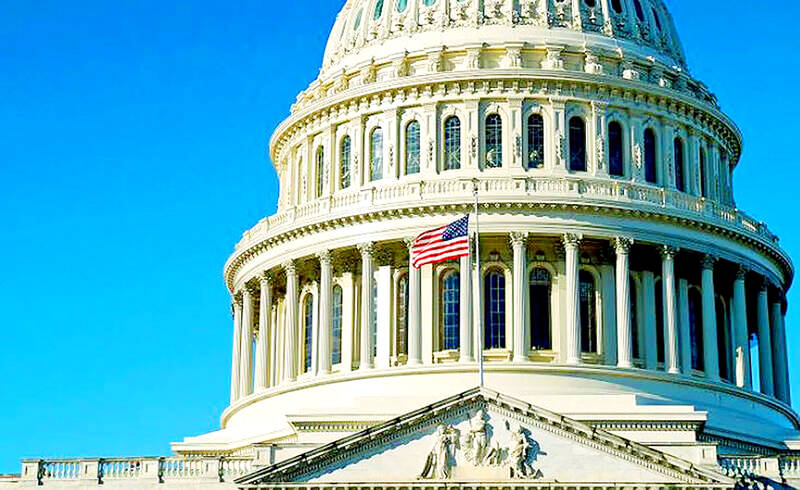
Photo: Reuters
“However, the threat posed by the People’s Republic of China against Taiwan has never been greater. [Chinese President] Xi Jinping (習近平) is focusing every element of the PRC’s [People’s Republic of China] national power to control Taiwan,” the letter said.
The US must address the massive backlog in weapons deliveries to Taiwan, but Taipei needs to step up, too, it added.
“We commend Taiwan for making important progress in strengthening its military readiness, reserve forces, and asymmetric defense capabilities,” it said. “Nevertheless, we fear that without significant increases in Taiwan’s defense spending at levels reflected in President Lai’s proposed special budget, this progress will be insufficient.”
Signatories of the letter included US senators Pete Ricketts and Chris Coons — senior members of the US Senate Committee on Foreign Relations — and US House Committee on Foreign Affairs senior members Young Kim and Ami Bera.
KMT spokesman Niu Hsu-ting (牛煦庭) yesterday said the defense budget “is certainly vital,” and added that “it is just as crucial to ensure that no one uses special defense legislation as a vehicle to smuggle in unrelated measures.”
“We will respond to expectations from the US. At the same time, the KMT caucus will not compromise on its responsibility to strictly oversee and scrutinize the budget throughout the process,” he said, adding that as soon as the new legislative session formally begins after the Lunar New Year holidays, details about the KMT caucus’ version of the special arms procurement bill are expected to be announced.
The TPP said it has always supported a “reasonable and steadily growing” defense budget and understood the US’ concerns, adding that spending requests had to be subject to democratic oversight and fiscal discipline.
Meanwhile, the DPP said it agreed with the letter and hoped the recipients would read it “thoroughly.”
Additional reporting by Liu Wan-lin

A signaling system malfunction disrupted high-speed rail (HSR) services beginning at 8am today, with trains temporarily reduced to three northbound and three southbound trains per hour as authorities conduct inspections. The malfunction occurred on a section of track in Miaoli County during pre-operation checks early this morning, forcing northbound and southbound trains to use a single track, the HSR operator said. The regular schedule has been replaced with three hourly trains offering only nonreserved seating in each direction, stopping at every station, it said, adding that business class cars would still have reserved seating. Departures from terminal stations are scheduled at the top

Taiwan is still in the process of assessing the possibility of recruiting workers from Eswatini, the Ministry of Foreign Affairs said yesterday, adding that its goal is to help Eswatini upgrade its vocational training centers. If there are plans to recruit workers from Eswatini, safeguarding national security, protecting public health and ensuring the employment rights of Taiwanese would be prerequisites, Department of West Asian and African Affairs Director-General Yen Chia-liang (顏嘉良) told a news conference. Key considerations would also include filling labor shortages in specific industries, and fostering bilateral professional and technical exchanges, he said. Yen was asked about the progress of labor

VERBOSE VESSELS: A CGA cutter and a China Coast Guard exchanged verbal barbs for more than a day in Taiwanese-controlled waters before the Chinese vessel left The Taiwanese and Chinese coast guards had a standoff near the strategically located Pratas Islands (Dongsha Islands, 東沙群島) in the north of the South China Sea, the Coast Guard Administration (CGA) said yesterday. The two sides engaged in intense radio exchanges over sovereignty claims during the 33-hour standoff. China Coast Guard vessel 3501 eventually left the restricted waters, 26.6 nautical miles (49.2km) west of the Pratas Islands, at 5pm yesterday, the CGA said. Lying approximately between southern Taiwan and Hong Kong, the Taiwan-controlled Pratas are seen by some security experts as vulnerable to Chinese attack due to their distance — more than

A US uncrewed surface vessel (USV) encountered multiple Chinese warships during an autonomous transit of the Taiwan Strait, US defense company Seasats said in a statement on Wednesday. Seasats announced that a Lightfish USV had completed the first autonomous transit of the Taiwan Strait. Over five days, the USV traversed the entire length of the Strait while constantly monitoring surface vessel traffic, the company said. The Lightfish encountered multiple Chinese warships, one of which was a Chinese People’s Liberation Army Navy (PLAN) Type 056 corvette, it said. The Chinese vessels were operating “well within Taiwan’s exclusive economic zone without transmitting their identity via the


 RSS
RSS