


The US on Tuesday barred Palauan Senate President Hokkons Baules and his family from entering the US, accusing him of corruption linked to China, as Washington pushes back on Beijing’s effort to boost its influence in the Pacific.
“Baules abused his public position by accepting bribes in exchange for providing advocacy and support for government, business, and criminal interests from China,” US Department of State spokesman Tommy Pigott said in a statement.
“His actions constituted significant corruption and adversely affected US interests in Palau,” Pigott said.
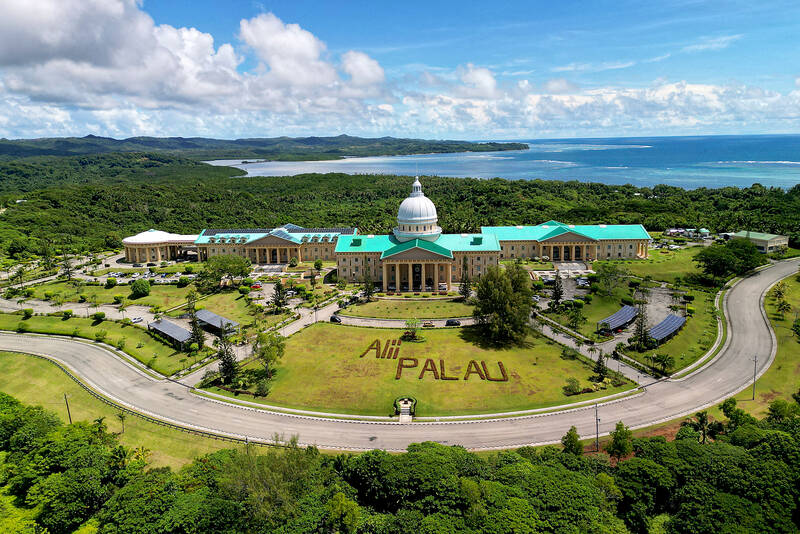
Photo: Reuters
The department also designated Anderson Jibas, a former mayor from the Marshall Islands, who it said had been involved in “theft, misuse and abuse of funds,” from the US-provided Bikini Resettlement Trust intended to address the legacy of US nuclear bomb testing in the 1940s and 1950s.
The designations would bar the two men and their immediate family members from entering the US.
The embassies of Palau and the Marshall Islands in Washington did not respond immediately to requests for comment, and Baules and Jibas could not be reached for comment.
Palau and the Marshall Islands, two strategically positioned US-allied Pacific island nations that have official diplomatic ties with Taiwan, have in the past few years become a focus in an intensifying geopolitical contest between Washington and Beijing.
Both countries receive economic support from the US through their Compacts of Free Association (COFA) and in return Washington is responsible for their defense, while gaining exclusive military access to strategic swathes of the Pacific.
China, keen to make inroads in the region, has been wooing the financially strapped Pacific economies with development and economic opportunities.
Baules, who pleaded guilty to heroin trafficking in 1989, has been one of the island’s most vociferous advocates for China.
Under his leadership, the senate has passed resolutions criticizing US military activity in Palau, while he has personally advocated for expanded ties with China.
Corporate records show that his family operates a local business called Fuji Restaurant, which Palauan authorities have linked to Chinese criminal activity.
“Corruption is an open door to advance its [China’s] agenda, especially in countries that recognize Taiwan and have critical US military bases,” said Cleo Paskal, an expert on the COFA states with the Foundation for Defense of Democracies think tank.
In the past few years, Palau officials have sought increased US patrols of its waters after incursions by Chinese vessels into its exclusive economic zone. Palau also hosts US-controlled airstrips and the US military is building advanced radar stations there.
Kwajalein Atoll in the Marshall Islands is home to a critical testing base for US missile defenses.

A signaling system malfunction disrupted high-speed rail (HSR) services beginning at 8am today, with trains temporarily reduced to three northbound and three southbound trains per hour as authorities conduct inspections. The malfunction occurred on a section of track in Miaoli County during pre-operation checks early this morning, forcing northbound and southbound trains to use a single track, the HSR operator said. The regular schedule has been replaced with three hourly trains offering only nonreserved seating in each direction, stopping at every station, it said, adding that business class cars would still have reserved seating. Departures from terminal stations are scheduled at the top
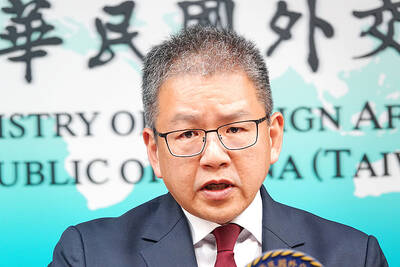
Taiwan is still in the process of assessing the possibility of recruiting workers from Eswatini, the Ministry of Foreign Affairs said yesterday, adding that its goal is to help Eswatini upgrade its vocational training centers. If there are plans to recruit workers from Eswatini, safeguarding national security, protecting public health and ensuring the employment rights of Taiwanese would be prerequisites, Department of West Asian and African Affairs Director-General Yen Chia-liang (顏嘉良) told a news conference. Key considerations would also include filling labor shortages in specific industries, and fostering bilateral professional and technical exchanges, he said. Yen was asked about the progress of labor

A US uncrewed surface vessel (USV) encountered multiple Chinese warships during an autonomous transit of the Taiwan Strait, US defense company Seasats said in a statement on Wednesday. Seasats announced that a Lightfish USV had completed the first autonomous transit of the Taiwan Strait. Over five days, the USV traversed the entire length of the Strait while constantly monitoring surface vessel traffic, the company said. The Lightfish encountered multiple Chinese warships, one of which was a Chinese People’s Liberation Army Navy (PLAN) Type 056 corvette, it said. The Chinese vessels were operating “well within Taiwan’s exclusive economic zone without transmitting their identity via the
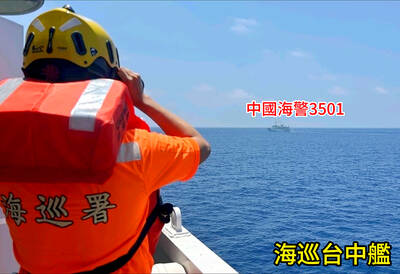
VERBOSE VESSELS: A CGA cutter and a China Coast Guard exchanged verbal barbs for more than a day in Taiwanese-controlled waters before the Chinese vessel left The Taiwanese and Chinese coast guards had a standoff near the strategically located Pratas Islands (Dongsha Islands, 東沙群島) in the north of the South China Sea, the Coast Guard Administration (CGA) said yesterday. The two sides engaged in intense radio exchanges over sovereignty claims during the 33-hour standoff. China Coast Guard vessel 3501 eventually left the restricted waters, 26.6 nautical miles (49.2km) west of the Pratas Islands, at 5pm yesterday, the CGA said. Lying approximately between southern Taiwan and Hong Kong, the Taiwan-controlled Pratas are seen by some security experts as vulnerable to Chinese attack due to their distance — more than


 RSS
RSS