


President William Lai (賴清德) this morning told the nation that “defense cannot wait,” as he urged the legislature to pass the government’s proposed NT$1.25 trillion (US$39.74 billion) special defense budget.
The Executive Yuan on Nov. 27 approved the budget to strengthen Taiwan’s defense and asymmetric warfare capabilities, with funds to be allocated over eight years.
However, opposition lawmakers have refused to schedule a review of the proposal 10 times, instead submitting an alternative budget that only includes certain items to be reviewed on an annual basis.
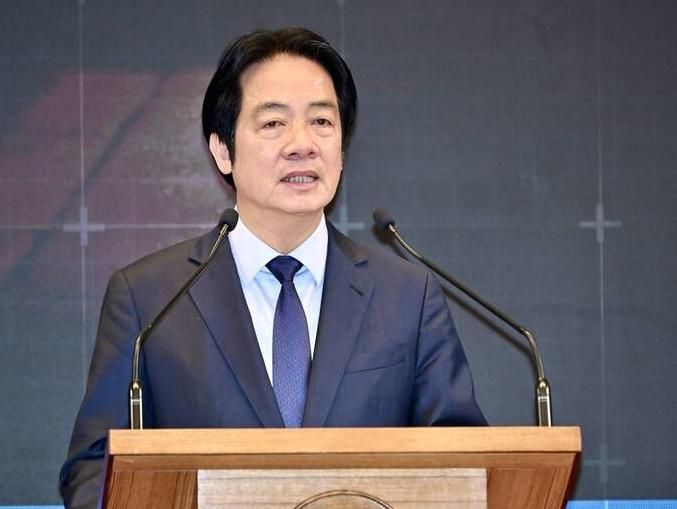
Photo: George Tsorng, Taipei Times
The main opposition Chinese Nationalist Party (KMT) has said it would not “sign blank checks” and has a right to scrutinize the bill.
As the Lunar New Year approaches, Lai said he hopes the legislature can “turn over a new leaf” and pass the defense budget as quickly as possible once the new session begins.
“National defense cannot wait. Our safety cannot wait. Support for our troops cannot wait,” he said.
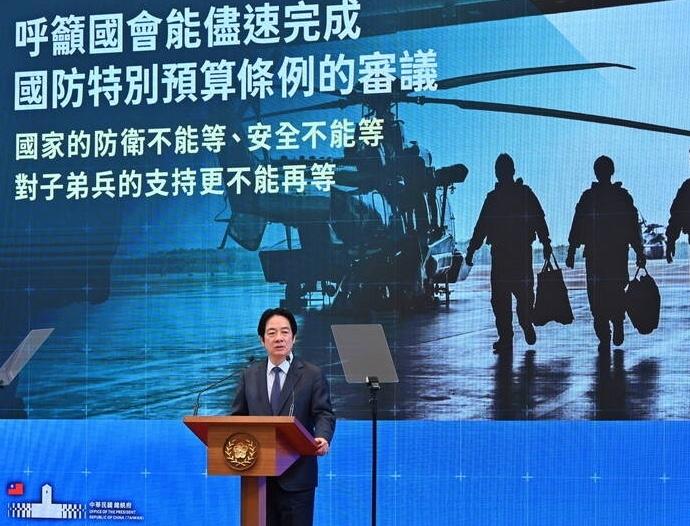
Photo: George Tsorng, Taipei Times
It is an international consensus that Taiwan’s peace and stability is essential to global security and prosperity, he said.
Taiwan’s Indo-Pacific neighbors have also increased defense spending in reaction to China’s mounting military aggression, he said.
Japan’s military budget has reached NT$1.8 trillion, South Korea’s stands at NT$1.4 trillion and the Philippines has also raised its spending, he said, adding that Taiwan cannot fall behind.
Lai thanked the US administration for its support, adding that the defense budget has received support from the White House and bipartisan members of Congress.
However, with the bill blocked, Taiwan may fall off the priority list, delivery may be delayed for critical weapons systems and the international community may begin to doubt Taiwan’s commitment to its own defense, he said.
“We have a responsibility to the international community. Increasing our defense spending is not a provocation, but proof of our commitment to self-defense and ensuring global security,” Lai said.
Amid increasingly complex regional dynamics, providing the troops with the most advanced and precise weaponry is essential to protecting Taiwanese lives and livelihoods, he said.
Lai recalled that when he was a legislator 21 years ago, the Executive Yuan approved a special defense bill allowing a major arms procurement from the US that was to include eight submarines.
However, the legislature’s Procedure Committee blocked the budget 69 times and the procurement failed, he said.
Had the bill been passed and those eight submarines joined Taiwan’s fleet, the nation could have contributed far more to regional peace and security, he said.
“We cannot make the same mistake again,” Lai added.
Opposition parties have criticized the government’s budget for failing to include a uniform salary increase for all volunteer soldiers from NT$15,000 to NT$30,000, which was approved by the legislature in June last year.
The Executive Yuan in December filed for a constitutional interpretation and a temporary injunction of the opposition-backed bill.
Addressing the opposition’s accusation that the government does not support the armed services, Lai said those beliefs are “completely unfounded.”
The Cabinet is seeking a constitutional interpretation, as a uniform raise lacks professional consideration, he said.
The armed forces are a large organization with various regions, units and missions entitled to different allowances by design, he said.
If the proposal is deemed constitutional, the funding would be replenished via a supplementary budget, he added.
Moreover, Lai said that his Democratic Progressive Party (DPP) cares for the armed services more than the KMT.
In the past decade, the DPP has raised military salaries four times — a 14 percent cumulative increase — while also upgrading weapons, renovating military housing and increasing 23 different allowances, he said.
Last year alone, five allowances were raised, increasing annual spending by NT$13.8 billion, he added.
Also addressing the news conference, Minister of National Defense Wellington Koo (顧立雄) said that the delay in passing the budget risks a "rupture" in the joint line of defense against China.
The government had had intensive talks with the US on what weapons Taiwan needed, Koo said.
"In the Indo-Pacific region, especially among the countries along the first island chain, Taiwan plays a uniquely critical, almost fated, role," Koo said. "We do not want Taiwan to become the rupture in the Indo-Pacific collective deterrence posture."
Additional reporting by Reuters
SECURITY: Taipei presses the US for arms supplies, saying the arms sales are not only a reflection of the US security commitment to Taiwan but also serve as a mutual deterrent against regional threats Taiwan is committed to preserving the cross-strait “status quo” and contributing to regional peace and stability, the Presidential Office said yesterday. “It is an undeniable fact that the Republic of China is a sovereign and independent democratic nation,” Presidential Office spokeswoman Karen Kuo (郭雅慧) reiterated, adding that Beijing has no right to claim sovereignty over Taiwan. The statements came after US President Donald Trump warned against Taiwanese independence. Trump wrapped up a state visit to Beijing on Friday, during which Chinese President Xi Jinping (習近平) had pressed him not to support Taiwan. Taiwan depends heavily on US security backing to deter China from carrying
The subsidiary of Taiwan Semiconductor Manufacturing Co (TSMC, 台積電) in Kumamoto, Japan, turned a profit in the first quarter of this year, marking the first time the first fab of the unit has become profitable since mass production started at the end of 2024. According to the contract chipmaker’s financial statement released on Friday, Japan Advanced Semiconductor Manufacturing Inc (JASM), a joint venture running the fab in Kumamoto, posted NT$951 million (US$30.19 million) in profit in the January-to-March period, compared with a loss of NT$1.39 billion in the previous quarter, and a loss of NT$3.25 billion in the first quarter of
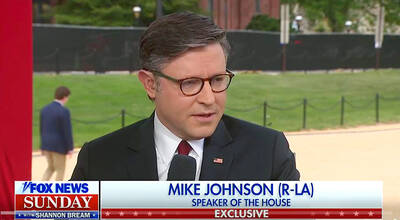
RESOLUTE BACKING: Two Republican senators are planning to introduce legislation that would impose immediate sanctions on China if it attempts to invade Taiwan US House of Representatives Speaker Mike Johnson on Sunday reaffirmed US congressional support for Taiwan, saying the US and “all freedom-loving people” have a stake in preventing China from seizing Taiwan by force. Johnson made the remarks in an interview with Fox News Sunday on US President Donald Trump’s summit with Chinese President Xi Jinping (習近平) last week. In an interview that aired on Friday on Fox News, just as Trump wrapped up a high-stakes visit to China, he said he has yet to green-light a new US$14 billion arms package to Taiwan and that it “depends on China.” “It’s a very good
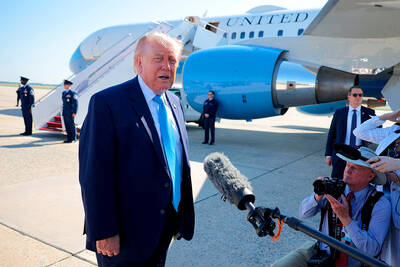
US President Donald Trump yesterday said he would speak to President William Lai (賴清德) as his administration considers whether to move ahead with a US$14 billion weapons sale to Taiwan — a potential arms deal that has drawn criticism from China. “Well, I’ll speak to him. I speak to everybody,” Trump told reporters yesterday when asked if he had any plans to call his counterpart, although he did not offer a time frame for when such a conversation could take place. Trump previously said he would speak to the person “that’s running Taiwan,” without specifying who he meant. “We have that situation very


 RSS
RSS