


Independent Legislator May Chin (高金素梅) and 17 others were brought in for questioning yesterday after prosecutors searched her office over alleged corruption involving national security concerns tied to campaign finances and assistant expenses.
The Ministry of Justice Investigation Bureau’s national security unit searched Chin’s residence at 6am, seizing her computer hard drive, personal mobile phone and other devices, Chinese-language media reported.
Investigators searched Chin’s office at the Legislative Yuan at 9:30am, reports said.
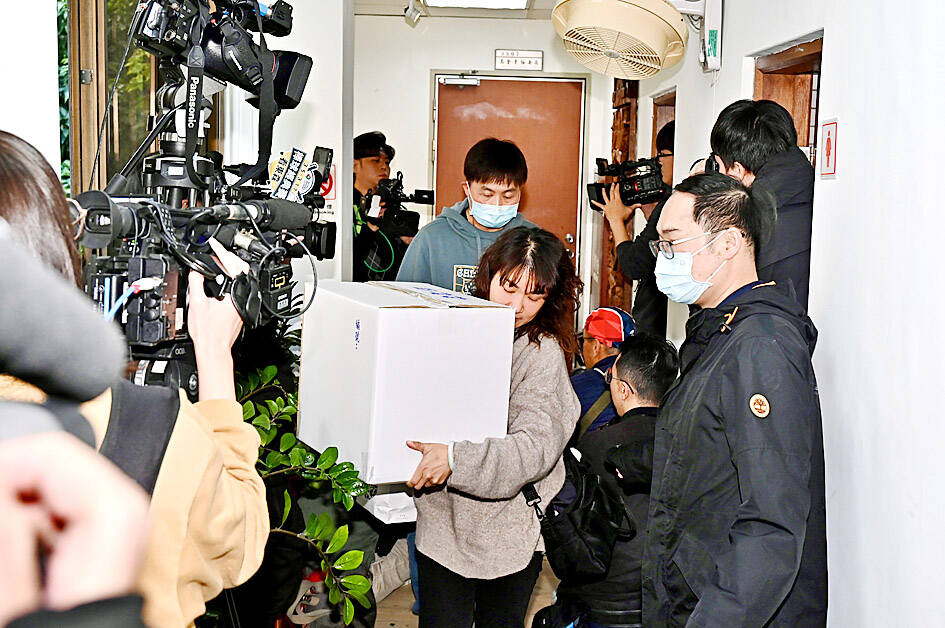
Photo: Tu Chien-jung, Taipei Times
The search was carried out in accordance with the law, the Legislative Yuan said, adding that it was not aware of the details of the case as they were not disclosed because the investigation was ongoing .
Prosecutors are reportedly investigating Chin on suspicion of claiming assistant fees for staff who did not work for her, in contravention of the Anti-Corruption Act (貪污治罪條例), sources said.
Sources also alleged that Chin’s legislative campaign was backed by Chinese funding in a breach of the Anti-Infiltration Act (反滲透法).
Chin and her assistant, surnamed Chang (張), among others, are suspected of embezzling assistant fees, contravening the Medical Devices Act (醫療器材管理法) and fraudulently obtaining subsidies, the Taipei District Prosecutors’ Office said.
Investigators searched 30 locations, including Chin’s office and residence, as well as the residences of other suspected parties, and summoned 18 people for questioning, the office said.
The others include independent Taitung County Councilor Chen Cheng-tsung (陳政宗), independent Hualien County Councilor Chien Chih-lung (簡智隆) and independent Pingtung City Councilor Aljui Piyuvel, sources said.
As of press time last night, none had responded to requests for comment.
Prosecutors are investigating Piyuvel, a former member of Chin’s campaign team, for allegedly bribing voters during the 2022 local elections with COVID-19 rapid test kits that were made in China, sources said.
Piyuvel was acquitted in a first trial, but investigators confirmed that Chin had collected and provided the test kits.
Authorities are now investigating whether importing the test kits complied with regulations and whether China was involved.
Chin has served as a legislator representing the highland indigenous constituency for more than 20 years, since first taking office in 2002. Her political alignment has shifted from being an independent to being part of the Non-Partisan Solidarity Union or the People First Party caucus.
After the union disbanded, Chin returned to being an independent legislator, but acts as part of the Chinese Nationalist Party’s (KMT) pan-blue coalition and participates in its negotiations.
Chin has long courted controversy over her close interactions with China, including meetings with senior Chinese leaders, attending a 2015 military parade in China and portraying herself as representative of Taiwan’s ethnic minorities while promoting pro-Beijing narratives.
She has also faced criticism at home for her performance as a legislator, with watchdog groups citing her low attendance and limited participation in legislating bills.
Additional reporting by Wang Ting-chuan, Liu Wan-lin and Lee Wen-hsin

A signaling system malfunction disrupted high-speed rail (HSR) services beginning at 8am today, with trains temporarily reduced to three northbound and three southbound trains per hour as authorities conduct inspections. The malfunction occurred on a section of track in Miaoli County during pre-operation checks early this morning, forcing northbound and southbound trains to use a single track, the HSR operator said. The regular schedule has been replaced with three hourly trains offering only nonreserved seating in each direction, stopping at every station, it said, adding that business class cars would still have reserved seating. Departures from terminal stations are scheduled at the top

Taiwan is still in the process of assessing the possibility of recruiting workers from Eswatini, the Ministry of Foreign Affairs said yesterday, adding that its goal is to help Eswatini upgrade its vocational training centers. If there are plans to recruit workers from Eswatini, safeguarding national security, protecting public health and ensuring the employment rights of Taiwanese would be prerequisites, Department of West Asian and African Affairs Director-General Yen Chia-liang (顏嘉良) told a news conference. Key considerations would also include filling labor shortages in specific industries, and fostering bilateral professional and technical exchanges, he said. Yen was asked about the progress of labor

VERBOSE VESSELS: A CGA cutter and a China Coast Guard exchanged verbal barbs for more than a day in Taiwanese-controlled waters before the Chinese vessel left The Taiwanese and Chinese coast guards had a standoff near the strategically located Pratas Islands (Dongsha Islands, 東沙群島) in the north of the South China Sea, the Coast Guard Administration (CGA) said yesterday. The two sides engaged in intense radio exchanges over sovereignty claims during the 33-hour standoff. China Coast Guard vessel 3501 eventually left the restricted waters, 26.6 nautical miles (49.2km) west of the Pratas Islands, at 5pm yesterday, the CGA said. Lying approximately between southern Taiwan and Hong Kong, the Taiwan-controlled Pratas are seen by some security experts as vulnerable to Chinese attack due to their distance — more than

A US uncrewed surface vessel (USV) encountered multiple Chinese warships during an autonomous transit of the Taiwan Strait, US defense company Seasats said in a statement on Wednesday. Seasats announced that a Lightfish USV had completed the first autonomous transit of the Taiwan Strait. Over five days, the USV traversed the entire length of the Strait while constantly monitoring surface vessel traffic, the company said. The Lightfish encountered multiple Chinese warships, one of which was a Chinese People’s Liberation Army Navy (PLAN) Type 056 corvette, it said. The Chinese vessels were operating “well within Taiwan’s exclusive economic zone without transmitting their identity via the


 RSS
RSS