


The Mainland Affairs Council yesterday dismissed Beijing’s call for “reunification,” describing it as a rehash of its longstanding stance with the ultimate goal of Taiwan’s annihilation.
Addressing the meeting of Beijing’s annual “Taiwan Work Conference” yesterday, Chinese People’s Political Consultative Conference Chairman Wang Huning (王滬寧), the Chinese Communist Party’s (CCP) fourth-ranked leader, said officials must advance the “great cause of national reunification,” Xinhua news agency reported.
China will offer firm support for “patriotic pro-reunification forces” in Taiwan and strike hard against “separatists,” Wang said.
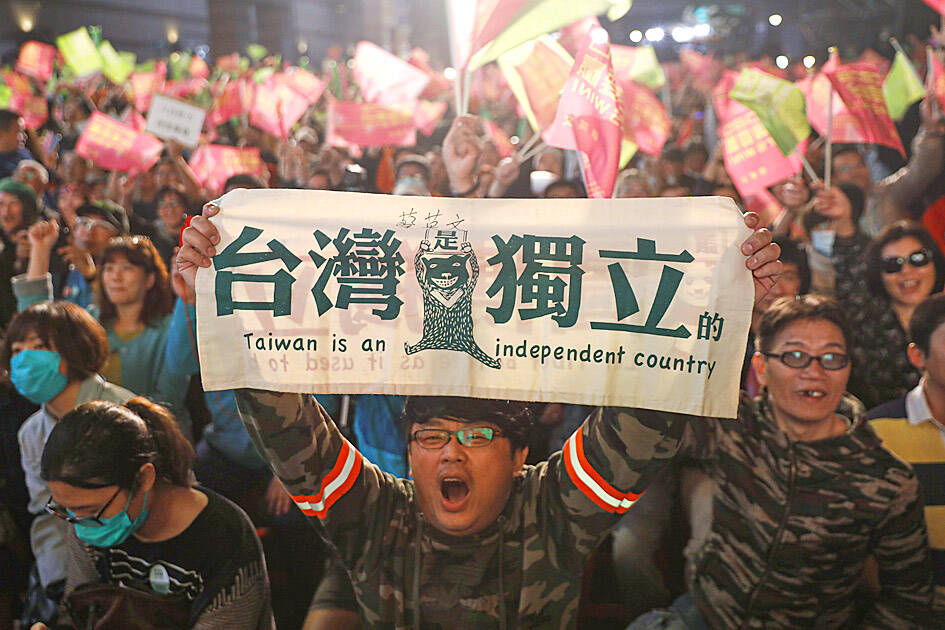
Photo: How Hwee Young, EPA-EFE
He also stressed the need to uphold Beijing’s “one China” principle and the so-called “1992 consensus” to firmly combat “Taiwan independence separatist forces and oppose interference by external forces,” Xinhua said.
The “1992 consensus,” a term former MAC chairman Su Chi (蘇起) in 2006 admitted making up in 2000, refers to a tacit understanding between the Chinese Nationalist Party (KMT) and the CCP that both sides of the Taiwan Strait acknowledge there is “one China,” with each side having its own interpretation of what “China” means.
Wang also called for facilitating people-to-people and primary-level exchanges, and supporting Taiwanese compatriots, especially young people, seeking to study, work and live in China, Xinhua said.
Wang underlined the importance of supporting the development of Taiwanese businesspeople and enterprises in China, so that people on both sides of the Strait could share the opportunities and achievements of Chinese modernization, it said.
The MAC said that the CCP’s endorsement of “pro-unification forces” and establishing “patriots” to rule Taiwan is an acknowledgement that China meant to sow division.
While Beijing stressed the need to uphold the so-called “one China” principle and “1992 consensus,” the logical end is Taiwan’s annihilation, it said.
Taiwan continues to monitor China’s actions and respond to them pragmatically to protect the nation’s sovereignty and security, the council added.
Meanwhile, sources in Beijing said that the CCP has formulated four key objectives for intervening in Taiwan’s elections through local election task forces, “united front” work and cognitive warfare aimed at influencing public opinion online.
Beijing’s creation of task forces at the conference was “a form of aggression against Taiwan,” Taiwan Economic Democracy Union convener Lai Chung-chiang (賴中強) said.
He urged people to recognize which candidates are supported by the CCP and be aware of China’s election interference tactics.
The CCP is planning to use economic coercion and incentives, in addition to political maneuvering to intervene in Taiwan’s local elections this year, he said.
One tactic would be to impose sweeping bans on imports of certain agricultural or food products, then selectively reopen imports for regions or companies connected to political figures it supports, he said.
He referenced previous import bans on Taiwanese pineapple, custard apples, grouper, kaoliang liquor and tea, which were selectively lifted to support specific candidates.
The public should be aware of these tactics and condemn China’s use of economic coercion to influence democratic elections, he said.
Taiwan has made progress in diversifying exports for agricultural products and reducing reliance on the Chinese market, which should help counter the effects, he said.
Moreover, the CCP regularly sponsors trips to China for village chiefs, community organization leaders and residents, which would likely continue on a large scale in the lead-up to the elections, he said.
Online cognitive warfare tactics would continue and expand this year, with new tactics expected to emerge, he said.

A signaling system malfunction disrupted high-speed rail (HSR) services beginning at 8am today, with trains temporarily reduced to three northbound and three southbound trains per hour as authorities conduct inspections. The malfunction occurred on a section of track in Miaoli County during pre-operation checks early this morning, forcing northbound and southbound trains to use a single track, the HSR operator said. The regular schedule has been replaced with three hourly trains offering only nonreserved seating in each direction, stopping at every station, it said, adding that business class cars would still have reserved seating. Departures from terminal stations are scheduled at the top

Taiwan is still in the process of assessing the possibility of recruiting workers from Eswatini, the Ministry of Foreign Affairs said yesterday, adding that its goal is to help Eswatini upgrade its vocational training centers. If there are plans to recruit workers from Eswatini, safeguarding national security, protecting public health and ensuring the employment rights of Taiwanese would be prerequisites, Department of West Asian and African Affairs Director-General Yen Chia-liang (顏嘉良) told a news conference. Key considerations would also include filling labor shortages in specific industries, and fostering bilateral professional and technical exchanges, he said. Yen was asked about the progress of labor

VERBOSE VESSELS: A CGA cutter and a China Coast Guard exchanged verbal barbs for more than a day in Taiwanese-controlled waters before the Chinese vessel left The Taiwanese and Chinese coast guards had a standoff near the strategically located Pratas Islands (Dongsha Islands, 東沙群島) in the north of the South China Sea, the Coast Guard Administration (CGA) said yesterday. The two sides engaged in intense radio exchanges over sovereignty claims during the 33-hour standoff. China Coast Guard vessel 3501 eventually left the restricted waters, 26.6 nautical miles (49.2km) west of the Pratas Islands, at 5pm yesterday, the CGA said. Lying approximately between southern Taiwan and Hong Kong, the Taiwan-controlled Pratas are seen by some security experts as vulnerable to Chinese attack due to their distance — more than

A US uncrewed surface vessel (USV) encountered multiple Chinese warships during an autonomous transit of the Taiwan Strait, US defense company Seasats said in a statement on Wednesday. Seasats announced that a Lightfish USV had completed the first autonomous transit of the Taiwan Strait. Over five days, the USV traversed the entire length of the Strait while constantly monitoring surface vessel traffic, the company said. The Lightfish encountered multiple Chinese warships, one of which was a Chinese People’s Liberation Army Navy (PLAN) Type 056 corvette, it said. The Chinese vessels were operating “well within Taiwan’s exclusive economic zone without transmitting their identity via the


 RSS
RSS