


Bipartisan US lawmakers have once again criticized and expressed disappointment that Taiwan’s efforts to enhance its self-defense capabilities are being hindered.
US senators Jim Risch and Jeanne Shaheen, chairman and ranking member of the US Senate Committee on Foreign Relations respectively, released a joint statement yesterday saying they were “deeply disappointed” that the NT$1.25 trillion (US$39.46 billion) special defense budget for this year to 2033 proposed by President William Lai (賴清德) remains stalled in the legislature.
“We urge Taiwan’s political parties to work in good faith across party lines to fully fund Taiwan’s self-defense,” the senators said.
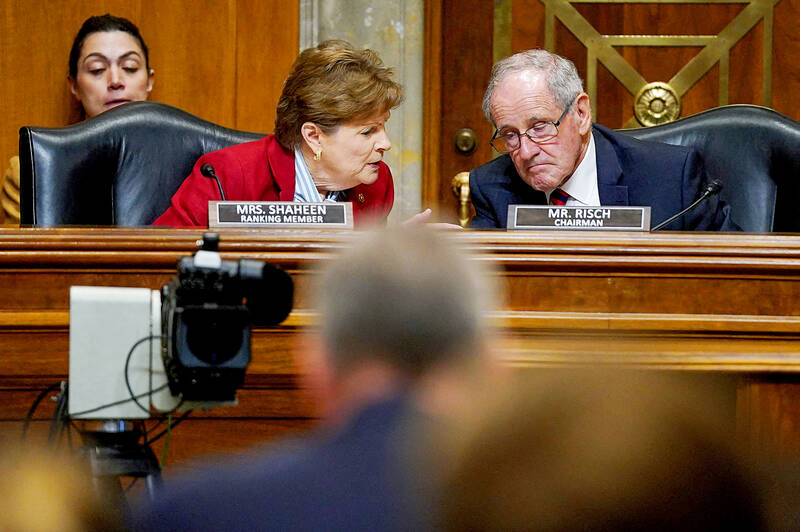
Photo: Reuters
They called on Taiwan’s parties to put aside their differences and work together, and urged political leaders to focus on securing vital military reforms, rather than seeking photo opportunities with the Chinese Communist Party.
Citing China’s brazen military exercises simulating a blockade of Taiwan in December last year, the senators said the drills serve as a reminder of Beijing’s intentions toward Taiwan, and its threats to a free and open Indo-Pacific region.
The special defense funding is critical for military reforms and improvements to whole-of-society resilience, for Taiwan’s security, and its partnership with the US, they added.
The Legislative Yuan has repeatedly blocked a review of the Cabinet’s special defense budget since Lai announced it in November last year, with the opposition — the Chinese Nationalist Party (KMT) and the Taiwan People’s Party (TPP) — demanding that Lai first brief lawmakers and take questions on the proposal — a request the president has rejected.
Backed by the KMT, the TPP proposed its own version of a national defense special act on Friday last week, which caps arms spending at NT$400 billion through to 2033, and requires that funding be allotted on a yearly basis.
Responding to the US senators’ statement, the KMT yesterday said it supports a reasonable defense budget and called on the American Institute in Taiwan to accurately convey its position to the US Congress, which it alleged was being misled by the ruling Democratic Progressive Party (DPP) government.
Taiwan’s budget system differs from that of the US, the KMT said, adding that the legislature last year approved more than NT$600 billion in defense spending, and that this year’s budget would remain at the same level, unaffected by the passage of this year’s general budget.
Opposition parties are withholding the review of the total budget for this fiscal year, because the DPP refuses to allocate NT$30 billion to raise the salaries of soldiers, the bill for which has already passed a third reading in the Legislative Yuan, it said.
When the DPP government includes the increased military salary in its budget, the opposition would immediately review and approve the defense budget, the KMT said, adding that the “treatment of soldiers should also be an important part of the defense budget.”

A signaling system malfunction disrupted high-speed rail (HSR) services beginning at 8am today, with trains temporarily reduced to three northbound and three southbound trains per hour as authorities conduct inspections. The malfunction occurred on a section of track in Miaoli County during pre-operation checks early this morning, forcing northbound and southbound trains to use a single track, the HSR operator said. The regular schedule has been replaced with three hourly trains offering only nonreserved seating in each direction, stopping at every station, it said, adding that business class cars would still have reserved seating. Departures from terminal stations are scheduled at the top

Taiwan is still in the process of assessing the possibility of recruiting workers from Eswatini, the Ministry of Foreign Affairs said yesterday, adding that its goal is to help Eswatini upgrade its vocational training centers. If there are plans to recruit workers from Eswatini, safeguarding national security, protecting public health and ensuring the employment rights of Taiwanese would be prerequisites, Department of West Asian and African Affairs Director-General Yen Chia-liang (顏嘉良) told a news conference. Key considerations would also include filling labor shortages in specific industries, and fostering bilateral professional and technical exchanges, he said. Yen was asked about the progress of labor

A US uncrewed surface vessel (USV) encountered multiple Chinese warships during an autonomous transit of the Taiwan Strait, US defense company Seasats said in a statement on Wednesday. Seasats announced that a Lightfish USV had completed the first autonomous transit of the Taiwan Strait. Over five days, the USV traversed the entire length of the Strait while constantly monitoring surface vessel traffic, the company said. The Lightfish encountered multiple Chinese warships, one of which was a Chinese People’s Liberation Army Navy (PLAN) Type 056 corvette, it said. The Chinese vessels were operating “well within Taiwan’s exclusive economic zone without transmitting their identity via the

VERBOSE VESSELS: A CGA cutter and a China Coast Guard exchanged verbal barbs for more than a day in Taiwanese-controlled waters before the Chinese vessel left The Taiwanese and Chinese coast guards had a standoff near the strategically located Pratas Islands (Dongsha Islands, 東沙群島) in the north of the South China Sea, the Coast Guard Administration (CGA) said yesterday. The two sides engaged in intense radio exchanges over sovereignty claims during the 33-hour standoff. China Coast Guard vessel 3501 eventually left the restricted waters, 26.6 nautical miles (49.2km) west of the Pratas Islands, at 5pm yesterday, the CGA said. Lying approximately between southern Taiwan and Hong Kong, the Taiwan-controlled Pratas are seen by some security experts as vulnerable to Chinese attack due to their distance — more than


 RSS
RSS