


US President Donald Trump has signed an executive order for the customer list of US weapons that would prioritize countries with higher defense spending and strategic importance, the White House said on Friday.
The order establishing the “America First Arms Transfer Strategy” marks a significant shift in US arms sales policy. It directs federal agencies to prioritize foreign military sales to partners that have invested substantially in their own defense capabilities and occupy critical roles or geographies.
The move aims to accelerate delivery of US-manufactured weapons to allies deemed essential for regional security, while leveraging foreign purchases to expand domestic production capacity.

Photo: CNP / Bloomberg
No specific countries were mentioned in the executive order.
“Future arms sales will prioritize American interests by using foreign purchases and capital to build American production and capacity,” the White House said.
Under the new strategy, the US secretaries of defense, state and commerce are tasked with developing a sales catalogue of prioritized platforms and systems, and identifying opportunities for sales that align with the strategy’s objectives.
For decades, the sales were delivered on a first come, first served basis.
The executive order also calls for streamlining bureaucratic processes, including enhanced end-use monitoring and third-party transfer procedures, to reduce delays and improve transparency.
The previous “partner-first” approach led to production backlogs and delivery delays, as orders were mismatched with US manufacturing capabilities, the White House said.
By prioritizing countries with higher defense spending and strategic importance, the administration seeks to ensure that US defense exports support national security and domestic industrial revitalization, it added.
Taiwan Youth Generation Exchange Association chairman Chen Li-fu (陳俐甫) yesterday said the US has long treated arms sales as a commercial transaction on a “first come, first served” basis.
Under the new policy, arms sales would depend on loyalty and shared interests, he said.
“This means the US will dynamically adjust the order of arms deliveries based on ‘political loyalty’ and ‘cooperation efficiency,’” Chen said.
“Countries willing to allocate their own budgets and align with US strategy will become ‘VIPs,’ enjoying priority access,” he said. “Conversely, if a country’s domestic politics turn anti-US or pro-China, or if it refuses to allocate funds, the US reserves the right to jump the queue, delay, or even cancel deliveries.”
Trump’s stance is clear, so if Taiwan is unwilling to allocate a budget for defense, it risks “self-destruction,” as Washington would never prioritize a country that refuses to help itself, he said.
He cited Indonesia’s F-15 purchases and South Korea’s parliament delaying approval of the Investing in America Act as examples of warnings.
“If Taiwan continues to stall its defense budget, under Trump’s ‘America First’ approach, the US may judge that Taiwan lacks commitment to self-defense and redirect arms sales to other, more proactive allies — leaving Taiwan unable to purchase them even if it later wants to,” he said.

CREDIT-GRABBER: China said its coast guard rescued the crew of a fishing vessel that caught fire, who were actually rescued by a nearby Taiwanese boat and the CGA Maritime search and rescue operations do not have borders, and China should not use a shipwreck to infringe upon Taiwanese sovereignty, the Coast Guard Administration (CGA) said yesterday. The coast guard made the statement in response to the China Coast Guard (CCG) saying it saved a Taiwanese fishing boat. The Chuan Yu No. 6 (全漁6號), a fishing vessel registered in Keelung, on Thursday caught fire and sank in waters northeast of Diaoyutai Islands (釣魚台). The vessel left Keelung’s Badouzih Fishing Harbor (八斗子漁港) at 3:35pm on Sunday last week, with seven people on board — a 62-year-old Taiwanese captain surnamed Chang (張) and six

LEVERAGE: China did not ‘need to fire a shot’ to deny Taiwan airspace over Africa when it owns ‘half the continent’s debt,’ a US official said, calling it economic warfare The EU has raised concerns about overflight rights following the delay of President William Lai’s (賴清德) planned state visit to the Kingdom of Eswatini after three African nations denied overflight clearance for his charter at the last minute. Taiwanese allies Paraguay and Saint Kitts and Nevis, as well as several US lawmakers and the Inter-Parliamentary Alliance on China (IPAC) condemned China for allegedly pressuring the countries. Lai was scheduled to fly directly to Taiwan’s only African ally from yesterday to Sunday to celebrate the 40th anniversary of King Mswati III’s accession and his 58th birthday, but Seychelles, Mauritius and Madagascar suddenly revoked

RISKY BUSINESS: The ‘incentives’ include initiatives that get suspended for no reason, creating uncertainty and resulting in considerable losses for Taiwanese, the MAC said China’s “incentives” failed to sway sentiment in Taiwan, as willingness to work in China hit a record low of 1.6 percent, a Ministry of Labor survey showed. The Directorate-General of Budget, Accounting and Statistics (DGBAS) also reported that the number of Taiwanese workers in China has nearly halved from a peak of 430,000 in 2012 to an estimated 231,000 in 2024. That marked a new low in the proportion of Taiwanese going abroad to work. The ministry’s annual survey on “Labor Life and Employment Status” includes questions respondents’ willingness to seek employment overseas. Willingness to work in China has steadily declined from
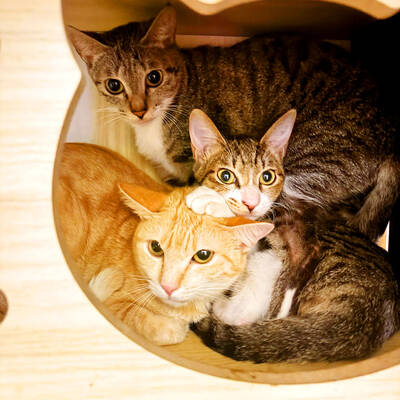
The number of pet cats in Taiwan surpassed that of pet dogs for the first time last year, reaching 1,742,033, a 32.8 percent increase from 2023, the Ministry of Agriculture said yesterday, citing a survey. By contrast, the number of pet dogs declined slightly by 1.2 percent over the same period to 1,462,528, the ministry said. Despite the shift, households with dogs still slightly outnumber those with cats by 1.2 percent. However, while the number of households with multiple dogs has remained relatively stable, households keeping more than two cats have increased, contributing to the overall rise in the feline population. The trend


 RSS
RSS