


The Legislative Yuan should be able to approve the Taiwan-US tariff agreement this month, providing certainty for businesses, Deputy Legislative Speaker Johnny Chiang (江啟臣) said yesterday.
While touring a production line at Victor Taichung Machinery Works yesterday with American Institute in Taiwan (AIT) Director Raymond Greene, Chiang said he had confirmed with Greene that the agreement should be finalized by the middle of this month.
The US has agreed to lower tariffs on Taiwanese goods from 20 percent to 15 percent, without stacking them on the most-favored nation rates.
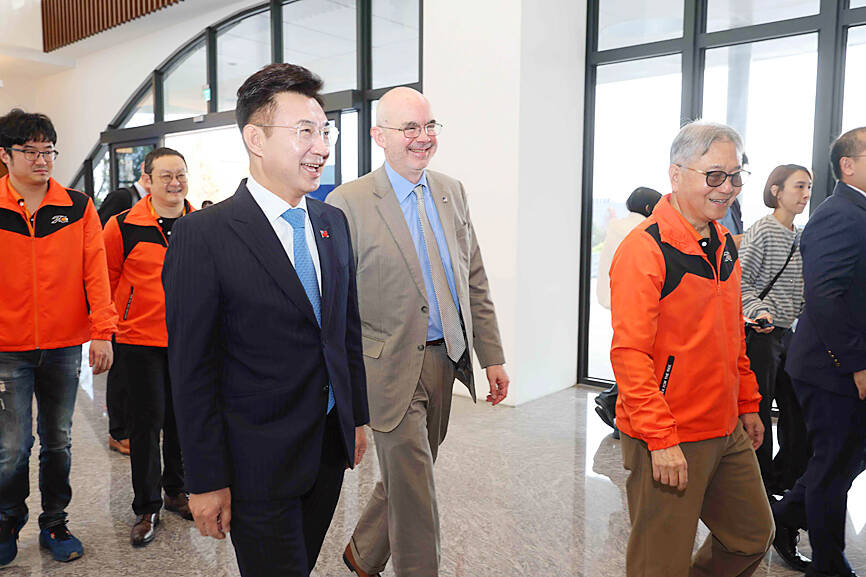
Photo: Tsai Shu-yuan, Taipei Times
The agreement grants semiconductors and related products most-favored-nation treatment under Section 232 of the US Trade Expansion Act.
As part of the agreement, Taiwanese semiconductor, electronics manufacturing service, artificial intelligence (AI) and energy companies would invest US$250 billion in the US based on their own plans.
The government also agreed to provide up to US$250 billion in credit guarantees for financial institutions to support investments in the US market by the semiconductor, and information and communications technology sectors.
The Taiwan-US Reciprocal Trade Agreement awaits signing.
Physical AI is a niche market for next-generation manufacturing in Taichung that would greatly complement the US’ focus on AI software, Chiang said.
Legislator Ho Hsin-chun (何欣純), the Democratic Progressive Party’s Taichung mayoral candidate, said Greene’s visit is a good sign for Taichung’s international ambitions.
Meanwhile, Greene said Taiwan is a dependable partner and plays a critical role in global supply chains.
US companies are changing their views, prioritizing security over costs, he said.
Taiwan-US relations have entered a “golden era,” Greene added, referring to Taiwan’s status as the US’ fourth-largest trade partner and how the US is the largest source of foreign investment in Taiwan.
While collaborations are primarily clustered in the semiconductor and AI industries, there would be opportunities for Taiwan and the US to build mutually beneficial deals in other economic sectors, such as the mechanical industry, he said.
Physical AI requires high-end robotics and mechanical functions, areas where Taiwan has a wealth of experience, Greene said, adding that such collaborations would help realize US President Donald Trump’s goal of reindustrializing the US.

A signaling system malfunction disrupted high-speed rail (HSR) services beginning at 8am today, with trains temporarily reduced to three northbound and three southbound trains per hour as authorities conduct inspections. The malfunction occurred on a section of track in Miaoli County during pre-operation checks early this morning, forcing northbound and southbound trains to use a single track, the HSR operator said. The regular schedule has been replaced with three hourly trains offering only nonreserved seating in each direction, stopping at every station, it said, adding that business class cars would still have reserved seating. Departures from terminal stations are scheduled at the top
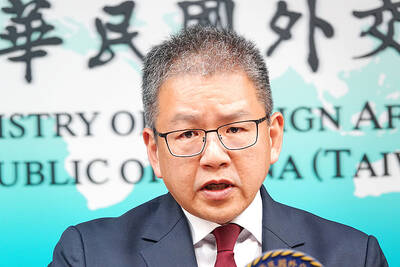
Taiwan is still in the process of assessing the possibility of recruiting workers from Eswatini, the Ministry of Foreign Affairs said yesterday, adding that its goal is to help Eswatini upgrade its vocational training centers. If there are plans to recruit workers from Eswatini, safeguarding national security, protecting public health and ensuring the employment rights of Taiwanese would be prerequisites, Department of West Asian and African Affairs Director-General Yen Chia-liang (顏嘉良) told a news conference. Key considerations would also include filling labor shortages in specific industries, and fostering bilateral professional and technical exchanges, he said. Yen was asked about the progress of labor

VERBOSE VESSELS: A CGA cutter and a China Coast Guard exchanged verbal barbs for more than a day in Taiwanese-controlled waters before the Chinese vessel left The Taiwanese and Chinese coast guards had a standoff near the strategically located Pratas Islands (Dongsha Islands, 東沙群島) in the north of the South China Sea, the Coast Guard Administration (CGA) said yesterday. The two sides engaged in intense radio exchanges over sovereignty claims during the 33-hour standoff. China Coast Guard vessel 3501 eventually left the restricted waters, 26.6 nautical miles (49.2km) west of the Pratas Islands, at 5pm yesterday, the CGA said. Lying approximately between southern Taiwan and Hong Kong, the Taiwan-controlled Pratas are seen by some security experts as vulnerable to Chinese attack due to their distance — more than

A US uncrewed surface vessel (USV) encountered multiple Chinese warships during an autonomous transit of the Taiwan Strait, US defense company Seasats said in a statement on Wednesday. Seasats announced that a Lightfish USV had completed the first autonomous transit of the Taiwan Strait. Over five days, the USV traversed the entire length of the Strait while constantly monitoring surface vessel traffic, the company said. The Lightfish encountered multiple Chinese warships, one of which was a Chinese People’s Liberation Army Navy (PLAN) Type 056 corvette, it said. The Chinese vessels were operating “well within Taiwan’s exclusive economic zone without transmitting their identity via the


 RSS
RSS