


Chinese President Xi Jinping (習近平) held back-to-back calls with Russian President Vladimir Putin and US President Donald Trump this week, which analysts said was rare and significant as Beijing positions itself as a stable global power.
Xi’s video call with Putin on Wednesday afternoon was followed just hours later by a phone call with Trump.
Xi and Putin spoke for 1.5 hours, the Kremlin’s foreign policy aide said, while Trump said they had a “long and thorough” conversation.
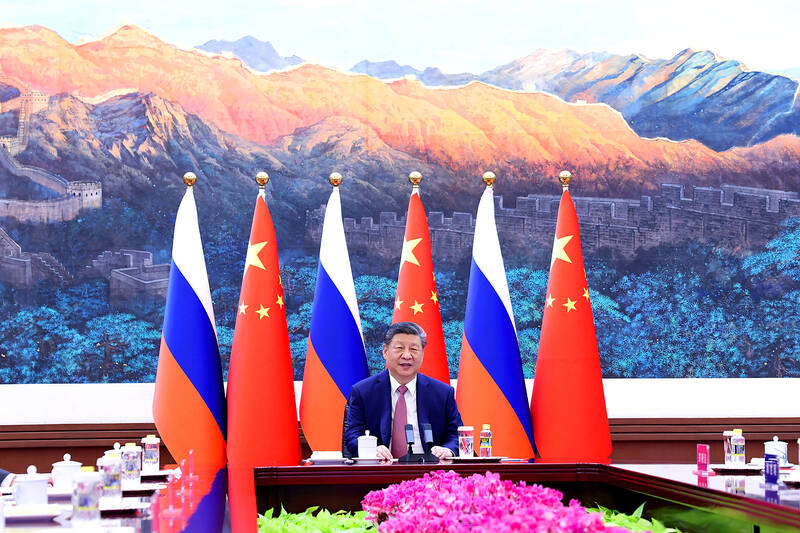
Photo: Xinhua News Agency via AP
“It does demonstrate that Xi can hold court and easily pick up the phone to speak with the two ‘strong’ leaders of the world,” Nanyang Technological University associate professor Dylan Loh (駱明輝) said.
Russia and the US are two of the “most consequential” countries to China, Loh said, adding that the timing could have been “a simple scheduling issue.”
Trump said he and Xi discussed trade, Russia’s war in Ukraine, and Iran.
China had committed to increasing soybean purchases from the US to 20 million tonnes in the current season, he added.
Loh said that the call confirmed that “in spite of what’s happened around the world, there is going to be a short-term tactical stabilization of US-China relations.”
However, Xi warned Washington to exercise caution in arms sales to Taiwan.
Deputy Minister of Foreign Affairs Chen Ming-chi (陳明祺) said, “we don’t worry too much about this whole telephone communication.”
“In fact, we believe that it will contribute to stabilize the situation,” he said.
Meanwhile, Xi and Putin hailed the deepening of Chinese-Russian ties as they try to present a united front against the West.
The two discussed their “opinions” on the US, and “special attention was given to the tense situation in Iran,” the Kremlin said.
Xi is seeking to position himself as equidistant from Putin and Trump, S. Rajaratnam School of International Studies assistant professor Benjamin Ho (何子恩) said.
“China is trying to seek international maneuver space to ensure that whatever happens globally, it does not get fenced into a corner,” he said.
Domestically, China is reeling from a corruption probe into Zhang Youxia (張又俠), a top military general in the Chinese People’s Liberation Army, which sent shockwaves through defense observers.
Analysts said that while Zhang’s investigation would likely not have been discussed with Putin and Trump, the timing of the calls could be a way for Xi to project confidence domestically.
Faced with uncertain and fragile domestic conditions, the “two-timing” calls were “probably for domestic posturing to demonstrate Xi’s political standing in the global theater,” Ho said.

A signaling system malfunction disrupted high-speed rail (HSR) services beginning at 8am today, with trains temporarily reduced to three northbound and three southbound trains per hour as authorities conduct inspections. The malfunction occurred on a section of track in Miaoli County during pre-operation checks early this morning, forcing northbound and southbound trains to use a single track, the HSR operator said. The regular schedule has been replaced with three hourly trains offering only nonreserved seating in each direction, stopping at every station, it said, adding that business class cars would still have reserved seating. Departures from terminal stations are scheduled at the top

Taiwan is still in the process of assessing the possibility of recruiting workers from Eswatini, the Ministry of Foreign Affairs said yesterday, adding that its goal is to help Eswatini upgrade its vocational training centers. If there are plans to recruit workers from Eswatini, safeguarding national security, protecting public health and ensuring the employment rights of Taiwanese would be prerequisites, Department of West Asian and African Affairs Director-General Yen Chia-liang (顏嘉良) told a news conference. Key considerations would also include filling labor shortages in specific industries, and fostering bilateral professional and technical exchanges, he said. Yen was asked about the progress of labor

VERBOSE VESSELS: A CGA cutter and a China Coast Guard exchanged verbal barbs for more than a day in Taiwanese-controlled waters before the Chinese vessel left The Taiwanese and Chinese coast guards had a standoff near the strategically located Pratas Islands (Dongsha Islands, 東沙群島) in the north of the South China Sea, the Coast Guard Administration (CGA) said yesterday. The two sides engaged in intense radio exchanges over sovereignty claims during the 33-hour standoff. China Coast Guard vessel 3501 eventually left the restricted waters, 26.6 nautical miles (49.2km) west of the Pratas Islands, at 5pm yesterday, the CGA said. Lying approximately between southern Taiwan and Hong Kong, the Taiwan-controlled Pratas are seen by some security experts as vulnerable to Chinese attack due to their distance — more than

A US uncrewed surface vessel (USV) encountered multiple Chinese warships during an autonomous transit of the Taiwan Strait, US defense company Seasats said in a statement on Wednesday. Seasats announced that a Lightfish USV had completed the first autonomous transit of the Taiwan Strait. Over five days, the USV traversed the entire length of the Strait while constantly monitoring surface vessel traffic, the company said. The Lightfish encountered multiple Chinese warships, one of which was a Chinese People’s Liberation Army Navy (PLAN) Type 056 corvette, it said. The Chinese vessels were operating “well within Taiwan’s exclusive economic zone without transmitting their identity via the


 RSS
RSS